Leigh Livne


How can values create value? On this podcast, Michael Eisenberg talks with business leaders and venture capitalists to explore the values and purpose behind their businesses, the impact technology can have on humanity, and the humanity behind digitization.




Leigh Livne
Leigh Livne
Leigh Livne
.jpg)
Leigh Livne
Leigh Livne
Why do sharks gather off Israel's Mediterranean coast? Shark scientist Dr. Leigh Livne studies them at Hadera, and her research on pregnant sharks made it into Sir David Attenborough's BBC series Asia. She also converted to Judaism, made aliyah, and runs Belle Aviv, Tel Aviv's nearly 35,000-member community for women.
On this episode of Yalla, Let's Go!, Erica Marom and Abbey Onn talk with Leigh about sharks in Israel, converting to Judaism, building a community, and building a life here.
Leigh grew up in an American military family, left the U.S. at 17 for a decade of study in England, and moved to Israel in 2014 for a PhD in marine science after an Israeli postdoc (and his cooking) convinced her to come. She explains what's really happening at the Hadera power and desalination site, how she and her research partner, Aviad, catch, rope, and sample adult dusky and sandbar sharks alongside the boat, and how she got a black eye at 39 weeks pregnant. She also opens up about her two-year Orthodox conversion with Rabbi Ariel Konstantyn at the Tel Aviv International Synagogue, making aliyah in 2020, and turning Belle Aviv from a Facebook group into a company.
Plus: whether sharks actually want to eat you. (They don't.)
Subscribe for more conversations with people who live, work, build, and stay in Israel.
0:00 - Intro
1:28 - Welcome & Pulse Check: Abbey's Hadera Shark Swim and the Fishing Hook
3:40 - Meet Dr. Leigh Livne: Shark Scientist and Belle Aviv Admin
4:15 - Life Story in a Minute: Military Family, 10 Years in England, PhD in Israel
5:05 - Why Israel? An Israeli Postdoc and the Food
6:34 - Sharks in Israel: The Hadera Power Plant, Desalination, and Warm Water
7:31 - Tagging Dusky and Sandbar Sharks — and the One Male Who Keeps Coming Back
8:03 - Sir David Attenborough, BBC's Asia, and "All the Sharks Are Pregnant"
8:37 - How Shark Researchers Catch, Rope, and Sample Sharks
9:43 - Shark Research Injuries: A Severed Tendon and a Black Eye at 39 Weeks Pregnant
9:57 - Doing a PhD in Israel as an Immigrant: Funding and Mentors Dan Tchernov and Shai Einbinder
11:16 - Why She Chose to Convert to Judaism
13:07 - Orthodox Conversion at Tel Aviv International Synagogue and Making Aliyah in 2020
13:58 - Belle Aviv: How Tel Aviv's Women-Only Facebook Group Began
15:41 - "Military Operation": Cleaning Up Belle Aviv With 24 Moderators
16:23 - From Facebook Group to Company: Monetizing Belle Aviv
17:42 - Belle Aviv's First In-Person Signature Event
18:51 - Has She Ever Considered Leaving Israel? Europe, Asia, and Staying Put
20:14 - What She Loves Most About Israel: The Food
20:39 - Aliyah Advice: Calm Down and Believe in Yourself
22:24 - Finding Home: Too Much for England, a Puppy in Israel
22:53 - At 80, Looking Back: A Shark Career That Only Happened in Israel
23:40 - Shark Myth Busted: Do Sharks Want to Eat You? + Rapid Fire
[Leigh Livne — 0:00]
I'm the one bringing in the shark. I'm putting the ropes on the shark.
[Erica Marom — 0:03]
But what does that mean?
[Leigh Livne — 0:04]
It means, like, CrossFit. Like, I'm fighting the shark.
[Abbey Onn — 0:08]
That's a lot of heavy lifting.
[Leigh Livne — 0:09]
I got a black eye when I was 39 weeks pregnant with the last kid. The best part, I think, of my research so far is that Sir David Attenborough and the BBC were interested, and they did BBC Asia.
[Erica Marom — 0:21]
Wow.
[Leigh Livne — 0:22]
Yeah. So hearing David Attenborough go, like, "All the sharks…"
[Erica Marom — 0:28]
So you're the admin of Belle Aviv, this amazing community for women who made aliyah [immigration to Israel] and live in Tel Aviv or the Tel Aviv area. So tell us a little bit about it. What do you love most about living here?
[Leigh Livne — 0:40]
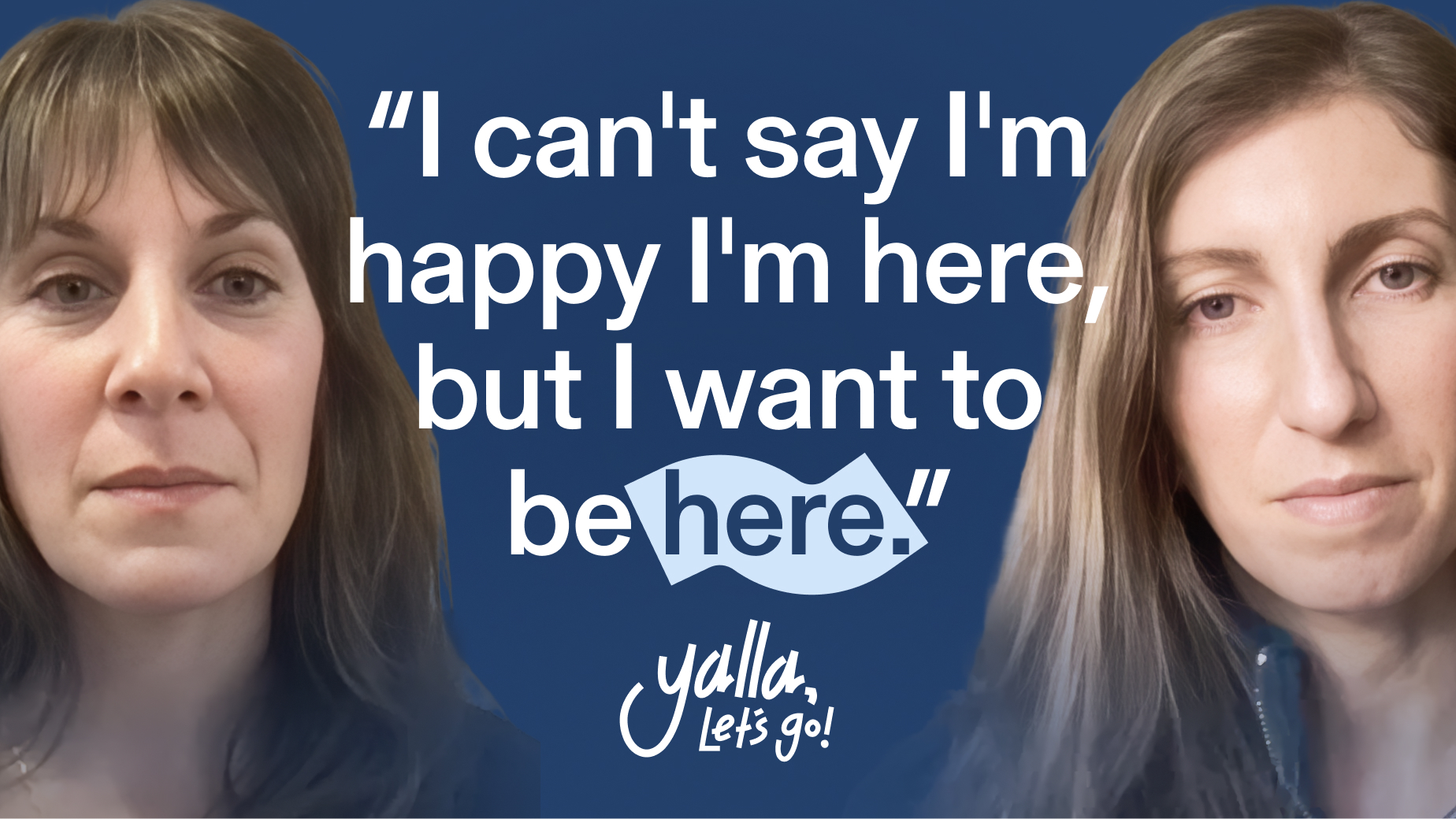
I guess the food. Seriously, much like a shark, I go for my hunting grounds. I wanted to go all the way. I wanted to make sure that if I did this really hard thing, that it couldn't be taken away from me. But I was not Jewish, so I converted and I made aliyah in 2020.
[Erica Marom — 0:57]
Wow. Welcome to the tribe.
[Leigh Livne — 0:59]
Thank you.
[Erica Marom — 1:01]
So when you're looking back on your life, when you're 80-something years old and you've lived in all these different places around the world, what's one thing that you think will have been true?
[Leigh Livne — 1:11]
I guess my whole career. Oh, yeah. I'm married. I have kids.
[Erica Marom — 1:28]
Welcome back to another episode of Yalla, Let's Go!, the podcast Abbey and I started to remind ourselves why we made aliyah and chose to live in Israel. We talk to people from all walks of life, athletes and chefs, people who work in high tech and VC, politicians and influencers, and ask them the questions that you really want to know about what it means to build a life in Israel. We have a really exciting guest with us today, but before we get into it, Abbey, pulse check. How are you feeling about living in Israel now?
[Abbey Onn — 1:55]
So my pulse check isn't really about this moment. It's really related to our guest today. A couple of years ago, I'm going to make this so short. A couple of years ago, Oded and I, my husband and I, took our three children to Hadera, where there are these electric stations that make the water warm, and in the winter it brings sharks. So we thought it'd be cool to take our kids swimming with sharks, because that's really normal. They were all very small, and slowly we went in one by one, and we went in, my husband and I, and we were holding our daughter's hand, and I was wearing, like, a big plastic face mask. And for a minute and a half, there's, like, sharks underneath us. It's amazing. And it was like, "Wow, this is the best decision of our life." And after a minute and a half, I was like, "I am in significant pain. And I don't know why. I don't think I've been bitten by a shark. Like, something is not okay." And I'm trying to communicate this to Oded, and he was being so gallant. We love him. He picks me up and, like, pulls me closer to him, and I'm like, "Oh no, more pain. Stop, stop, stop, stop, stop."
[Abbey Onn — 2:52]
And I cannot figure out what's happening. And I finally take my mask off and I look down. I have been wrapped in fishing wire, and I have the hook of the fisherman in the fat of my thigh. And so every time Oded pulls me, he is pulling the wire tighter on my body.
[Erica Marom — 3:10]
Oh my God.
[Abbey Onn — 3:11]
And so I was like, "Okay, cool, not a shark." And I, like, unroll myself, and then I pull the hook out of my thigh.
[Erica Marom — 3:18]
Oh my God.
[Abbey Onn — 3:19]
And my daughter, who, I don't know, she must have been six or seven at the time, looks, as I'm bleeding into the water above the sharks, goes, "I think we get out now."
[Erica Marom — 3:27]
Oh my God.
[Abbey Onn — 3:28]
And I was like, "I think we get out now." And the only positive thing of this story, other than it being a good story, is I could tell Oded afterwards that I'm still a catch.
[Erica Marom — 3:37]
Yeah, I love that.
[Erica Marom — 3:39]
Okay, now it's time.
[Erica Marom — 3:40]
Okay, okay. So we have an amazing guest with us today, Dr. Leigh Livne, who is a shark scientist who made aliyah from the U.S., and she's also the founder of Belle Aviv, an online community for women in Tel Aviv. We are so excited to talk to you today. I am obsessed with sharks in an abnormal way. My dream is to go diving with great white sharks when I turn 50. So we have so many things we want to ask you today and get into with you. But first, as always, we're going to ask you to tell us your life story in under a minute.
[Leigh Livne — 4:15]
I am American. I spent— I'm from a military family, so we moved around a lot around America. And I left, actually, when I was 17. I wanted to travel, but I didn't want to do it on a very— at a very tight budget. So I decided to just study abroad, and that led to 10 years living in England. So I haven't really been back to the U.S. since I was 17. During the second degree, I met an Israeli postdoc, and he recommended that I move here to do a PhD. So I moved here, and I have now been here, I think, for 12 years. Married, Jewish, almost three kids. And yeah, shark research has been the last few years of my life, and Belle Aviv has also been around, I think, seven to eight years.
[Erica Marom — 5:05]
So you have studied on different continents. You've had all the coasts in the world to choose from to continue your shark research. Why Israel?
[Leigh Livne — 5:14]
So I met this Israeli postdoc, and he was a crazy dancer and made incredible food. He was just a very weird guy, in a weird and a really wonderful way. And I was like, "Where are you from?" He was like, "Israel." And I was like, "Well, if you—" I went to his house. Like, he invited all of us to eat, and I ate, probably, now I understand, I ate like an Israeli does. And I was just, "Where was this food?" Like, in between mouthfuls, I was just like, "Where did this food come from?" And he was like, "Israel." And I was like, "Cool, that's my next destination." Because I'm very food-driven, much like a shark. Like, I go for my hunting grounds.
[Leigh Livne — 5:50]
And so he put me in touch, you know, like, everyone knows everyone in Israel, so he put me in touch with everyone here. And I just flew here. I didn't even come to Israel first. I just went to Manchester, met a professor there that was doing artificial reefs and fish community assemblages, and I said, "Sure, I'll come." And he was like, "You're insane." He's like, "Are you Jewish? Do you even know, you know, what Judaism is? It's very hot." And I was just like, "I don't care." And I was, like, thinking of this food in my mind.
[Erica Marom — 6:24]
Wow.
[Leigh Livne — 6:25]
I was like, "I just have to go there." And so I landed here, only knew him, and that was in 2014 that I— yeah.
[Erica Marom — 6:34]
So I don't know if everybody knows this, but there is, as Abbey said in her pulse check, this, like, shark gathering hangout place near the power plants in Hadera.
[Abbey Onn — 6:43]
Power plants.
[Abbey Onn — 6:43]
That's it.
[Erica Marom — 6:43]
Yeah, yeah. Because of the warm water. Can you tell us a little bit about, like, what's going on there, and a little bit about the work that you've done on the pregnant sharks?
[Leigh Livne — 6:52]
So Hadera is the site of— it's a combined power and desalination. So you have salty water and hot water that are kind of meeting in this tiny, tiny space, and you have a really high conflict of interest from humans, from industry. You have Nahal Alexander there, that is the stream that's coming in. So it's like every summer you have fish die-offs. You have a lot of people on the beach, people that want to watch the sharks, and it's very hard to manage in such shallow water all of these things. And there are adult sharks there. There's adult female, mainly dusky sharks, and adult sandbar sharks, mainly males. So they're sex segregated, but they're also species segregated.
[Leigh Livne — 7:31]
Funnily enough, there's one male dusky. We fit them with acoustic transmitters, and so we can see if they come back year on year. He's the only dusky that comes back to this site, like a creep. Every year. We have one male and, like, 79 females that we've tagged. We estimate that the aggregation is around 80 to 100 individuals.
[Erica Marom — 7:53]
Is he the one impregnating all of them?
[Leigh Livne — 7:55]
No, no, he's just super creepy. Like, it's not mating season.
[Erica Marom — 7:58]
Wow.
[Leigh Livne — 7:58]
He just comes back and is like, "Hey."
[Abbey Onn — 7:58]
I'm just here for the drinks.
[Erica Marom — 8:02]
Yeah.
[Leigh Livne — 8:03]
The best part, I think, of my research so far is that Sir David Attenborough and the BBC were interested, and they did BBC Asia, episode one. There's a clip for two, three minutes about Hadera and the reproduction.
[Erica Marom — 8:15]
Wow.
[Leigh Livne — 8:15]
Yeah. So hearing David Attenborough go, like, "All the sharks are pregnant." And I was like.
[Erica Marom — 8:15]
Wow.
[Leigh Livne — 8:15]
I didn't say that, but very cool to hear. I did not say that in the interview. I said all the sharks that I've scanned have been pregnant, but I don't care. That's the best story. I was just like, "Okay, career done." Like, yes. I was like.
[Abbey Onn — 8:15]
That's the Oscar.
[Erica Marom — 8:35]
Exactly. How can you beat that?
[Leigh Livne — 8:37]
And it was just, like, also, inside I was just like, "Yeah, nobody's interested in reproduction. Cool." So I arrange crew, equipment. I'm saying, what you're doing on the boat, I'm the one bringing in the shark. I'm putting the ropes on the shark. I'm like, me and Aviad, the two of us, we are the ones that handle the shark in terms of catch and then sampling.
[Erica Marom — 8:55]
But what does that mean?
[Leigh Livne — 8:56]
It means, like, CrossFit. Like, I'm fighting the shark.
[Abbey Onn — 9:00]
That's a lot of heavy lifting.
[Leigh Livne — 9:01]
Yes, that's that.
[Leigh Livne — 9:02]
Yeah, yeah.
[Leigh Livne — 9:03]
So I am bringing in the shark and then, you know, tiring out the shark on the line. Once we catch, we bring it alongside the boat to keep it in natural environment. A lot of research institutes will bring the shark on board, and we just don't have a big enough boat for that, so keep them in the water. And so I'm putting the ropes on the pectoral fin and the caudal fin, and then we're doing all the sampling. So me and Aviad do the sampling, and then we release. And our most trusted volunteers, if they've been with us a long enough time, we'll try to train them to do this, but this is really dangerous stuff. Aviad, you know, severed his tendon and was out for, like, a year. He had to—
[Erica Marom — 9:43]
Because he was bitten by a shark?
[Leigh Livne — 9:44]
No, no, no. Actually, the pectoral fin punctured the tendon.
[Erica Marom — 9:47]
Really?
[Leigh Livne — 9:47]
Yeah, yeah.
[Erica Marom — 9:48]
It's sharp?
[Leigh Livne — 9:49]
Yes. Like, well, yeah, it's sharp, and it's very rigid. I got a black eye when I was 39 weeks pregnant with the last kid.
[Abbey Onn — 9:57]
I feel like most Israelis, like most people that grew up here, leave Israel for academia to go do either their second or third degree or their postdoc, and you came and did yours here.
[Leigh Livne — 10:06]
Yeah, but I was not Jewish, so it was like, for me also, like, yeah, no.
[Erica Marom — 10:06]
So even harder.
[Abbey Onn — 10:11]
Yeah, so even, even harder in some ways. But can you talk through kind of being in academia, doing it, like, the culture's in Hebrew, the culture is different, how are you accessing funding? Like, things that are challenging generally.
[Leigh Livne — 10:24]
So for my PhD, I was very lucky to be funded. It's a very well-known organization. They fund PhDs every year, but they would like to remain always anonymous. So they funded me. I guess now I realize they fund one or two a year, so it's very lucky. I also have to say that most of my— I attribute, or I'm most grateful to my bosses, both Dan Tchernov and Shai Einbinder. They basically always make sure that if it's, like, a PhD student, they always make sure they have a part-time supplementary job to keep them afloat, without you even having to ask. They just find ways. Like, they find your niche of what you're really good at, and then they find a way that that helps them, and then you are less stressed during your PhD. And without Dan, Danny, taking me on, and, like, their belief in me, I don't think I would be doing so well.
[Abbey Onn — 11:16]
Okay, I want to dig into a different piece, because when you introduced yourself, you said you're from the United States and then you moved here, and part of what you said is that you're Jewish, but that you're not originally Jewish.
[Leigh Livne — 11:26]
No.
[Abbey Onn — 11:26]
Can you— do you mind talking us through that?
[Leigh Livne — 11:28]
Yeah. I met my partner. Like, I had lived here already for six years on a student visa, and I had decided basically within two, three years, like, there's a lot of men, like many fish in the sea, and I have a feeling that I'm probably going to marry one of them, because they just kind of latch on to you. I don't know why. They probably think it's a green card thing. But I have to say, the men here really like to marry, and they were like, "Do you want to move in? Do you want to go to Shabbat dinner?" Like, within a week. And I'm like, "Wow." And I was like, "No to you." But, like, the cloud is telling me that this is a dating area, and you're in your early 30s, you're probably going to meet someone. If you live here for years, you're going to meet someone. So I was starting to think, like, what would it mean to live here?
[Leigh Livne — 12:21]
And I also was in this weird niche of academia that I wasn't really learning Hebrew, because I had planned to move to Asia, so I wasn't taking it seriously. And I was in Tel Aviv, so it's very easy not to take it seriously. And my job is science, so it's all in English. So I was like, "Okay, I need to make some decisions here." And I had basically already been going towards, "I would like to be Jewish if I were to stay here." Not so much for myself. Later, now, it is for myself, but at the time, I was like, I think it's very, like, not odd, but you don't want your kid to be standing, sticking out. And I was definitely, in my childhood, super bullied. And that's just being, you know, a human. So to be here and to have a reason, you know, kids are mean, you know. So I was just like, "Well, you know, anything that comes out of me should just be Jewish."
[Leigh Livne — 13:07]
And so then I met my partner, and I asked him, like, very early on. I was like, "If this is going to be a thing, I would be interested in doing conversion." And he was completely into it. But I only wanted to do, like, Orthodox, proper— like, not proper, people will be angry about hearing that. But, like, I wanted to go all the way. I wanted to make sure that if I did this really hard thing, that it couldn't be taken away from me. So I did two years with the incredible Rabbi Ariel Konstantyn at Tel Aviv International Synagogue. Two years with my husband, lots of hours, and really loved it. I met almost all of my friends through that as well, my long-term friends. So I converted and I made aliyah in 2020.
[Erica Marom — 13:53]
Wow.
[Abbey Onn — 13:54]
Amazing. Wow.
[Erica Marom — 13:55]
Welcome to the tribe.
[Leigh Livne — 13:56]
Thank you.
[Erica Marom — 13:58]
Let's talk about your other exciting venture in your life, Belle Aviv.
[Leigh Livne — 14:01]
Yes.
[Erica Marom — 14:02]
So you're the admin of Belle Aviv, this amazing community for women who made aliyah and live in Tel Aviv or the Tel Aviv area. Tell us what this community is and what it does, and also, you're turning it into a company now. So tell us a little bit about it.
[Leigh Livne — 14:18]
Okay. So Belle Aviv, insane name, born of the creativity of Gal Perelman. She just was, like, looking at Secret Tel Aviv, and she was like, "What about if it were just for women?" And her brain just, like, lit up in Belle Aviv, and so she created this group. But she's obviously a very creative mind. I think she was working in marketing. I haven't spoken to her. She's not on Facebook, ironically, so I haven't spoken to her for many years, but I did speak to her the year that it started.
[Leigh Livne — 14:51]
And I remember I had just moved here to Ramat Gan, and I was like, "No friends here." And I think I had found Belle Aviv. It was, I think, 600 members, maybe, at that point. It was really, like, new. And then a couple years later, there were a lot of men in the group, and it was getting to, I think, around 6,000 members, and it was already, like, a big thing. Like, people really loved the group, and a lot of women were in the group being like, "I know there's, like, a lot of men in here, so I'm starting to not trust the group." And so I wrote to Gal and I said, like, "Make me admin. I'll clean it up and I'll make it, like, you know." And she was like, "Oh, thank God, thank God." She's like, "My job is just too intense. Like, I just can't do this." She's been just, like, letting people in. She can't handle the amount of member requests.
[Leigh Livne — 15:41]
So I joined. Like, military operation. Thank you, my mom and dad are both military. So very much was like, I hired 24 women for the day, made them moderators, one for— well, for me, the alphabet. I don't even know in the alphabet how many numbers. Sorry, it's embarrassing. And I was like, "You take A, B, C." And I gave each woman a letter, and I said, "Just type in A, find every person, delete all the men." I created some very basic boundaries and About Us. I just, like, played with it a bit, and I made it very, like, "Here's a few boundaries and rules to make the group grow." And now it's 35,000, almost.
[Leigh Livne — 16:23]
And yeah, I think at around 15 was the first time that I thought about maybe moving into, like, a company direction. Or, like, I mean, I'm a scientist, so I heard the word "monetizing," and I was like, "No," because I have no idea what that means. You know, like, that just means adverts or something, like Google and spam and stuff. So I was just like, "No." And so I talked with the two moderators that I kept on, both incredible women, and we all agreed that we're just too busy in life. So for basically, like, three, four years, five years, we've had the discussion a couple of times. And then in this summer, this past year, it was just too big, and I was getting invited, and some consulting firms were saying, like, "This is just— what are you doing? You really need to do something with this group."
[Leigh Livne — 17:01]
So I kind of made the plunge, in my early morning hours and my late evening hours and weekends, to really take it off the ground. And so we are moving more into, like, signature events, retreats. So I have several different, like, avenues that I would like to introduce based on what Belle Aviv is for, which is basically, it's the place for a woman to ask anything in Belle Aviv. A review, recommendation. It's— I don't know. All I hear all the time is, "I don't know, ask in Belle Aviv." "Why don't you ask Belle Aviv?"
[Erica Marom — 17:39]
That's true. Good tagline.
[Leigh Livne — 17:41]
Yeah.
[Abbey Onn — 17:42]
And I see all my friends are asking and responding, and I think it's such a beautiful, helpful community. You are having your first in-person event on October 14th. Can you tell us about what that's going to be?
[Leigh Livne — 17:51]
Yes. We're hopefully to have, like, signature events many times a year, at least six times a year, and this will be the first launch event. Like, basically taking Belle Aviv, but in real life. Meet all the favorite people that you've, you know, followed or seen all their posts. There's really active people, you can meet them live. But also, instead of the more traditional event of women's community, buy some stuff, do some shopping, mingling, that kind of thing, we're going to just basically take Belle Aviv, what it is in Facebook, and then have, like, service providers, basically. So therapists, coaches, you can have consultations with them if you buy a ticket, and we're going to have, like, different areas and booths. There was somebody messaging me about yoga. So.
[Erica Marom — 17:51]
Cool.
[Leigh Livne — 17:51]
Yoga. I was also hoping to have, like, more, maybe an entrepreneurs' circle. So it's going to be definitely a little different in style. So we're calling them event providers versus vendors. From six to midnight.
[Erica Marom — 18:50]
Wow.
[Leigh Livne — 18:50]
Yeah.
[Erica Marom — 18:51]
So you came here for the sea. You stayed for a lot more than just sharks. You're married, you have a whole life here. Have you ever considered going somewhere else?
[Leigh Livne — 19:03]
Yes.
[Erica Marom — 19:04]
Say more.
[Leigh Livne — 19:05]
Every day. No, I really— I've gone back and forth. Now I definitely know that I could never live in England again full time. But I'm also— I don't think I'll stay here forever. This is my fifth country, and I don't want it to be forever. Even though I find myself, like, this is the most life I've ever had in terms of friends and family and things like that. So I've always been very transient. Everywhere else I went, I could always see myself staying, but I always knew I was going to go. And for the first time, I'm thinking, "I don't think I'm going to go." And I'm like, "That's not okay."
[Leigh Livne — 19:39]
Well, I have kids here, but I do want them to have a different experience. My husband's very into Europe. He is the opposite. Like, he lived in his parents' house, you know, the standard Israeli, living with the parents till you're, like, 30 kind of thing. So we couldn't be more different. So for him it's all very exciting and adventure, and I'm like, "Well, I did England, Europe for 10 years, and it would be going back to something very familiar," I think. So I don't want to move back, and I actually believe I'd rather move to Asia or something.
[Erica Marom — 20:14]
So what do you love most about living here?
[Leigh Livne — 20:18]
I guess the food. Just, seriously, that is pretty much it. I'm really here for the food. I actually really like—
[Erica Marom — 20:27]
Well, you came for the food and you got what you wanted.
[Leigh Livne — 20:29]
Yeah. Every day, three times a day.
[Abbey Onn — 20:31]
It's the cottage cheese that's keeping you here.
[Leigh Livne — 20:33]
Exactly. It actually tastes really shit in other countries. It's very good here.
[Abbey Onn — 20:39]
Okay. You've had a really different path, I think, than a lot of people we've spoken to on the podcast. So what's one piece of advice you would give to people that either just arrived or are considering moving here?
[Leigh Livne — 20:48]
Just calm down. Like, you just— I mean, it's really— I mean, I see people that really stress out about every choice they make in life. And as somebody who is literally— I just stumble in. Like, there's a concept in physics of, like, stability, where you have the ball and it's rolling, and then it's like, "Ah, chaos," and then it, like, finds its way again. So that's kind of, like, literally my life. It's just like, "Now I'll do this, now I'll do this." Like, my whole reason for moving to England was, "Well, college in the U.S. is expensive, and I want to go do this thing that England does better than the U.S., which is archaeology or Egyptology." So I was like, "Why don't I combine?" Like, I'm always looking for, like, a unique way to do something, and just don't—
[Leigh Livne — 21:35]
I see a lot of people overthinking every decision that they make, and I wish, like— and I tell them, you know, half a year is nothing in your life. You won't even remember this half a year of stress that you're going through. So I guess it's just, you should really, really, like, believe in yourself. And if you don't believe in yourself, you should definitely work on that, because life could be a lot easier. And kind of believe that— I'm kind of on the fence about, like, believe that things will work out. No, you make daily choices, micro choices, that lead to different things. So knowing when to say yes and knowing when to say no, but also understanding that shit just happens, which is just life, is just so important to living here.
[Abbey Onn — 22:24]
I feel like you're more Israeli than— you were, like, meant to be here. Yihye beseder [because it'll be fine].
[Leigh Livne — 22:28]
I was way too much for people in England. They were like, "You are just, like, really confident." And I was like, "Isn't that a good thing?" And then I came here, and they were just like, "Oh, you're a puppy." And I was like, wait, I'm never enough? Or I'm just not, like, in any place. So I really feel like, definitely, my personality is more suited to being here.
[Erica Marom — 22:47]
For sure. Yeah.
[Abbey Onn — 22:49]
I can't wait to speak to you after Asia.
[Erica Marom — 22:51]
Yeah.
[Leigh Livne — 22:51]
Yeah, I would love that.
[Erica Marom — 22:53]
So when you're looking back on your life, when you're 80-something years old and you've lived in all these different places around the world, what's one thing that you think will have been true because you came to Israel and made aliyah, that wouldn't have been true otherwise?
[Leigh Livne — 23:07]
I guess my whole career wouldn't have happened if I didn't come here, because I really did try for, like, a decade to be doing something with sharks beyond volunteering, and it was not working out, to the point where I was like, "Okay, just putting that on a shelf." Oh, yeah. I'm married. I have kids. I guess I should make it about that. Like, I really guess I should make it about that. But I have to say, like, I'm definitely not the default parent. So, like, it's always, like, my family— Yeah, no, that is not me.
[Abbey Onn — 23:40]
All right, we want to do a rapid fire with you. We're going to ask you a couple of questions, and we want you to give us the first word that comes to your mind. And I feel like the first question is perfect for you.
[Leigh Livne — 23:47]
Okay.
[Erica Marom — 23:47]
Yeah.
[Abbey Onn — 23:48]
Favorite Israeli food or snack?
[Leigh Livne — 23:50]
Challah.
[Abbey Onn — 23:52]
I'm your girl.
[Leigh Livne — 23:53]
Yes.
[Erica Marom — 23:53]
What's your favorite place in Israel?
[Leigh Livne — 23:56]
I like my home. I think, my sanctuary.
[Abbey Onn — 23:59]
Hebrew phrase or slang that you love?
[Leigh Livne — 24:01]
Ooh, sababa [cool] ganoush [eggplant dip]. But I think I made that up.
[Erica Marom — 24:05]
What? I never heard that before.
[Abbey Onn — 24:06]
I think you did make that up.
[Leigh Livne — 24:07]
I made that up, yeah.
[Erica Marom — 24:07]
Amazing.
[Leigh Livne — 24:08]
I love making up Hebrew words. Sababa.
[Erica Marom — 24:11]
What is the thing you miss most from back home?
[Leigh Livne — 24:14]
Someone always making me a cup of tea without me asking. But home being England. Like, yeah, I really miss that.
[Abbey Onn — 24:23]
What does Shabbat or Saturday look like for you?
[Leigh Livne — 24:27]
Phones are off. Actually, my phone is off pretty much. There's no smartphone, I'm going to dumbphone. So phones are off for sure, even the dumbphone. Building. And I do a lot of building, a lot of crafting, and working out. Love weightlifting.
[Erica Marom — 24:44]
Give us one shark myth, or myth— but what's— what do you say?
[Erica Marom — 24:49]
Myth busting?
[Erica Marom — 24:49]
Yeah. What do you say?
[Leigh Livne — 24:50]
Myth busted.
[Erica Marom — 24:51]
Yes. One shark myth busted.
[Leigh Livne — 24:54]
That they like the taste of humans, or that they want to eat humans, or that they're interested in us in general.
[Erica Marom — 25:01]
So they don't like the taste of us?
[Leigh Livne — 25:02]
I mean, they've been around longer than, I think, trees, and we are just so boring to them. Like, very boring. They're like, "You pathetic, puny puppies."
[Abbey Onn — 25:11]
Puppies. Okay.
[Leigh Livne — 25:12]
They're just like, "What are you doing here in my space?" It's just not a thing.
[Erica Marom — 25:17]
Thank you so much for joining us. We have loved talking to you, and let us know when we can come. You know, there's, like, Take Your Daughter to Work Day. We want, like, take your— we want to go to work. Yeah. Take your podcast hosts to work with you.

Follow Leigh on LinkedIn
Subscribe to Yalla, Let’s Go
Learn more about Aleph
Sign up for Aleph’s monthly email newsletter
Subscribe to our YouTube channel
Follow us on Instagram
Follow us on TikTok
Follow Aleph on Twitter
Follow Aleph on LinkedIn
Follow Aleph on Instagram
Hosts: Erica Marom, Abbey Onn
Executive Producer: Sarah Bard
Producer: Sofi Levak, Dalit Merenfeld
Video and Editing: Nadav Elovic
Music and Creative Direction: Uri Ar
Content and Editorial: Jackie Goldberg
Design: Nimrod Sapir
Follow Leigh on LinkedIn
Subscribe to Yalla, Let’s Go
Learn more about Aleph
Sign up for Aleph’s monthly email newsletter
Subscribe to our YouTube channel
Follow us on Instagram
Follow us on TikTok
Follow Aleph on Twitter
Follow Aleph on LinkedIn
Follow Aleph on Instagram
Hosts: Erica Marom, Abbey Onn
Executive Producer: Sarah Bard
Producer: Sofi Levak, Dalit Merenfeld
Video and Editing: Nadav Elovic
Music and Creative Direction: Uri Ar
Content and Editorial: Jackie Goldberg
Design: Nimrod Sapir
Follow Leigh on LinkedIn
Subscribe to Yalla, Let’s Go
Learn more about Aleph
Sign up for Aleph’s monthly email newsletter
Subscribe to our YouTube channel
Follow us on Instagram
Follow us on TikTok
Follow Aleph on Twitter
Follow Aleph on LinkedIn
Follow Aleph on Instagram
Hosts: Erica Marom, Abbey Onn
Executive Producer: Sarah Bard
Producer: Sofi Levak, Dalit Merenfeld
Video and Editing: Nadav Elovic
Music and Creative Direction: Uri Ar
Content and Editorial: Jackie Goldberg
Design: Nimrod Sapir
.jpg)
.jpg)
.jpg)
.jpg)
.jpg)
.jpg)
.jpg)

.jpg)




























.jpg)


.jpg)
.jpg)
.jpg)
.jpg)

.jpg)
.jpg)
.jpg)
.jpg)

.jpg)