Jacques Benkoski


How can values create value? On this podcast, Michael Eisenberg talks with business leaders and venture capitalists to explore the values and purpose behind their businesses, the impact technology can have on humanity, and the humanity behind digitization.




Jacques Benkoski
Jacques Benkoski
Jacques Benkoski
Jacques Benkoski
Jacques Benkoski
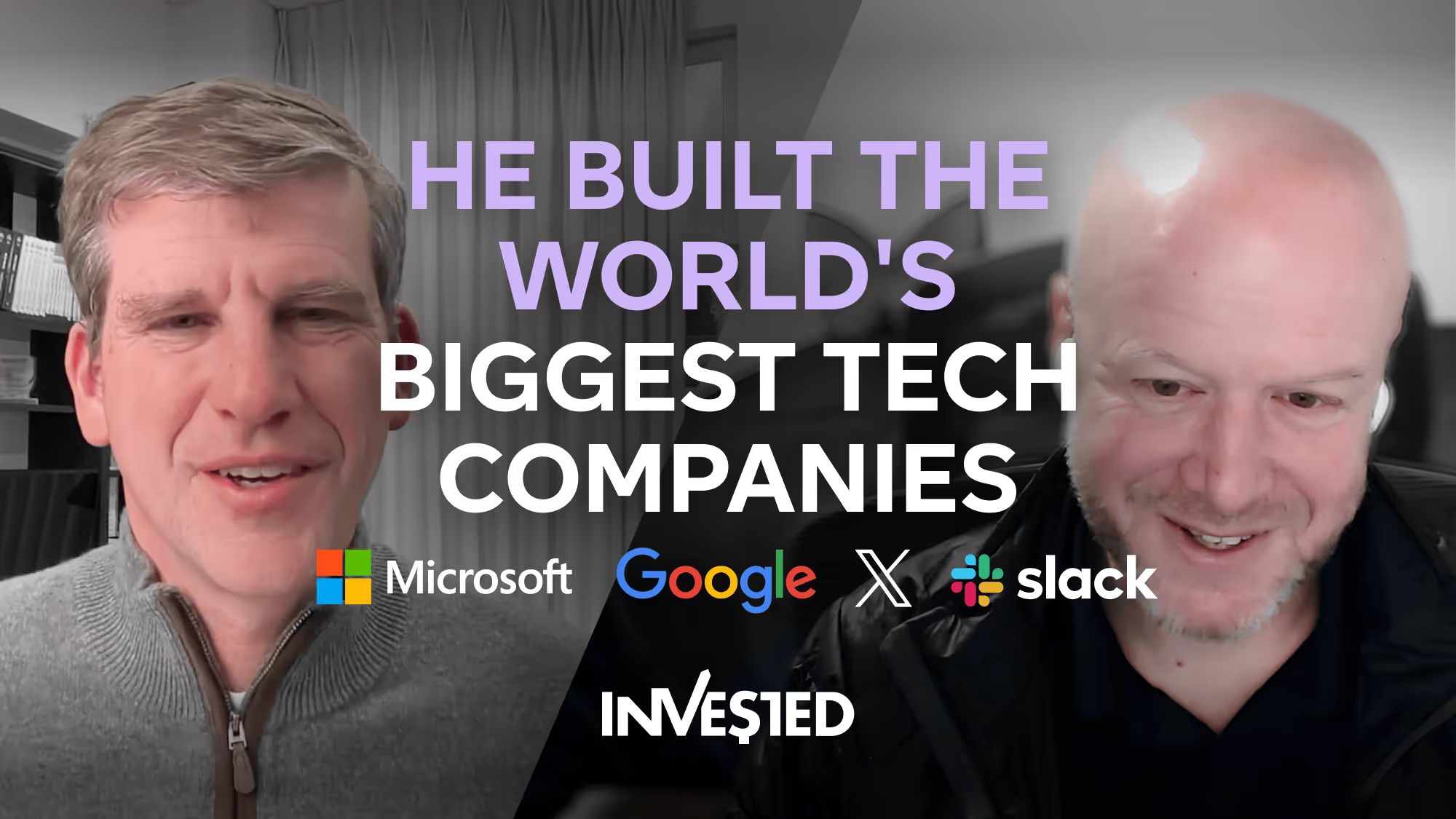
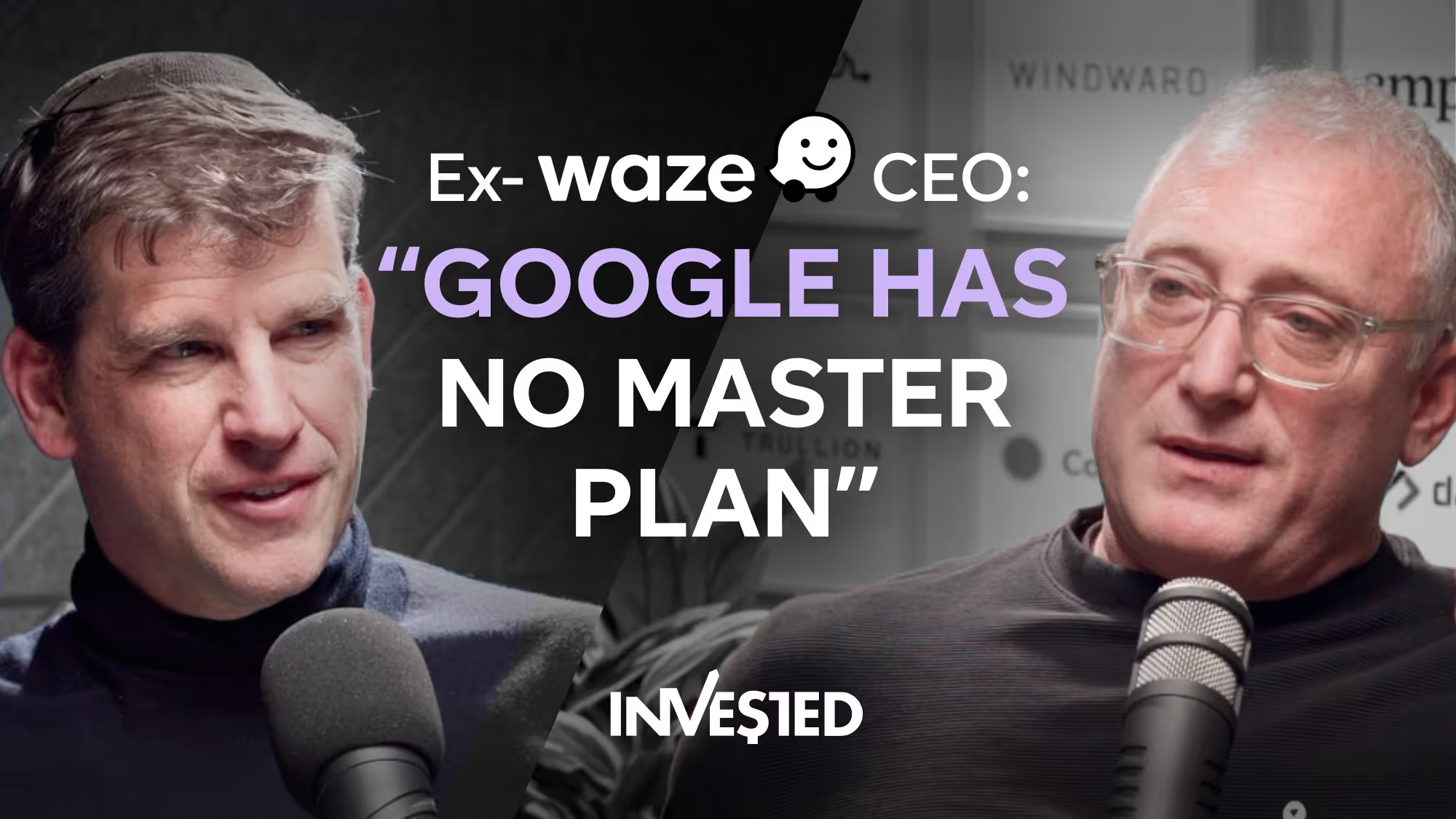
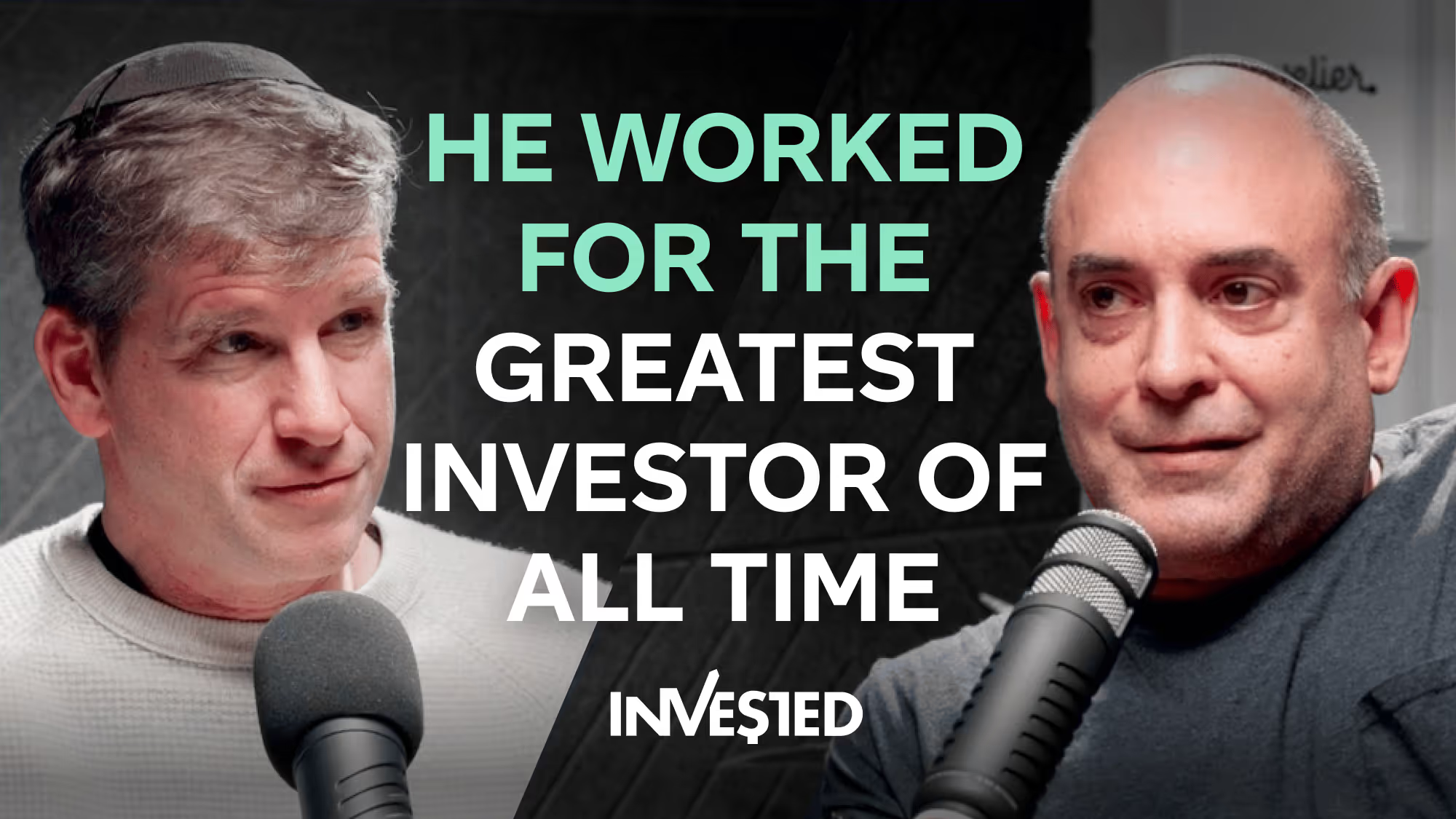
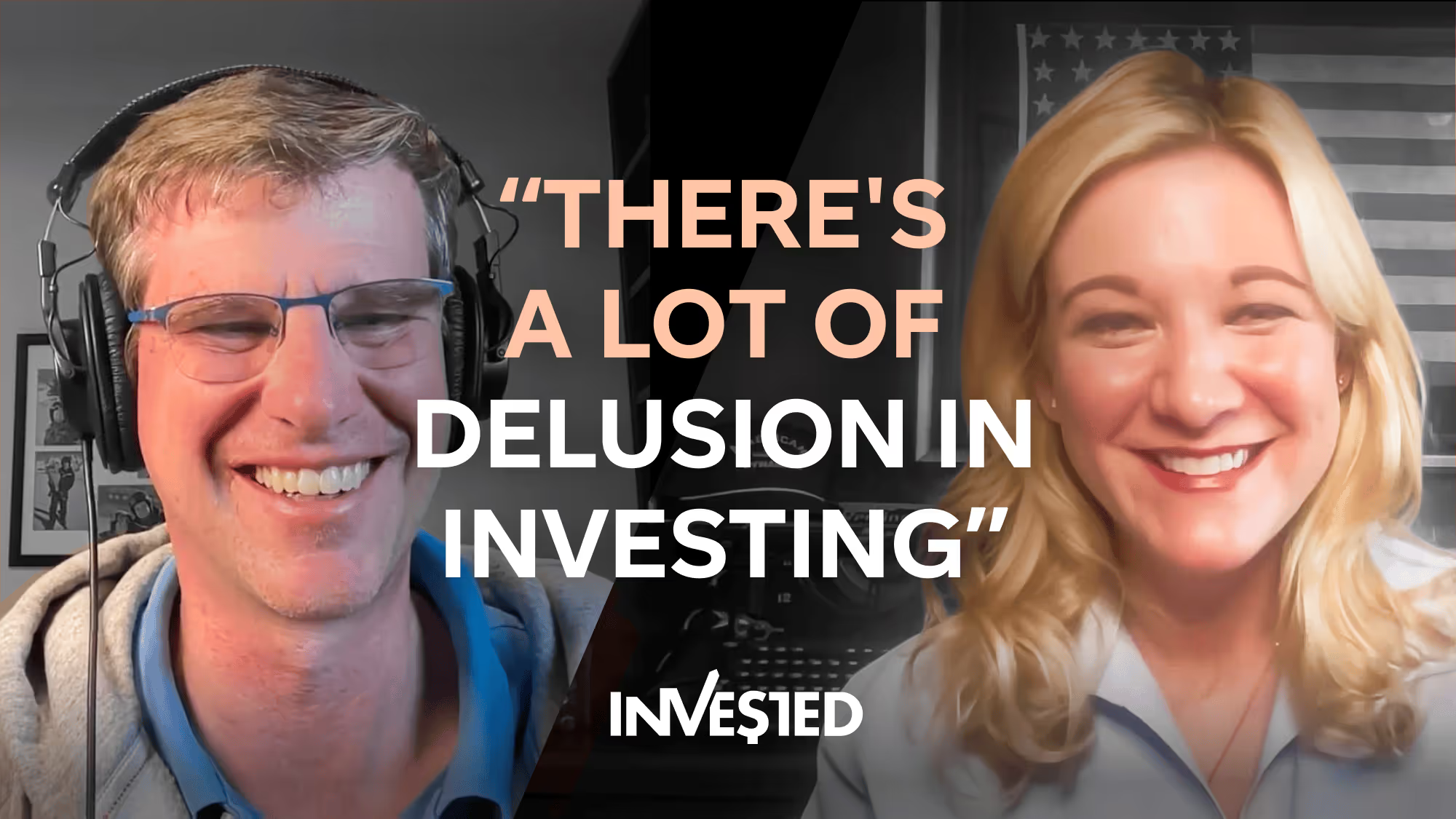
On this episode of Invested, Michael sits down with Dr. Jacques Benkoski, a seasoned technologist, operator, and venture capitalist with a career spanning research, corporate, startups, and international investing. As a partner at U.S. Venture Partners (USVP), Jacques brings decades of experience investing in the U.S. and Israel across cloud infrastructure, enterprise software, and cybersecurity. A speaker and mentor, he has taught his Market Entry Strategy seminar to over 5,000 entrepreneurs and released an expanded version of these materials in the eponymous book to help entrepreneurs turn vision into execution, and scale with purpose.
Please rate this episode 5 stars wherever you stream your podcasts!
00:00 - Intro
03:59 - Riding the Dot-Com Wave
08:09 - Joining USVP & the Israel Strategy
12:06 - Bubbles Are Good
14:50 - AI Adoption Will Follow Workflows, Not Replace Them
17:44 - 95% of AI Projects Fail - and That’s Normal
19:21 - Israel’s Biggest Founder Weakness
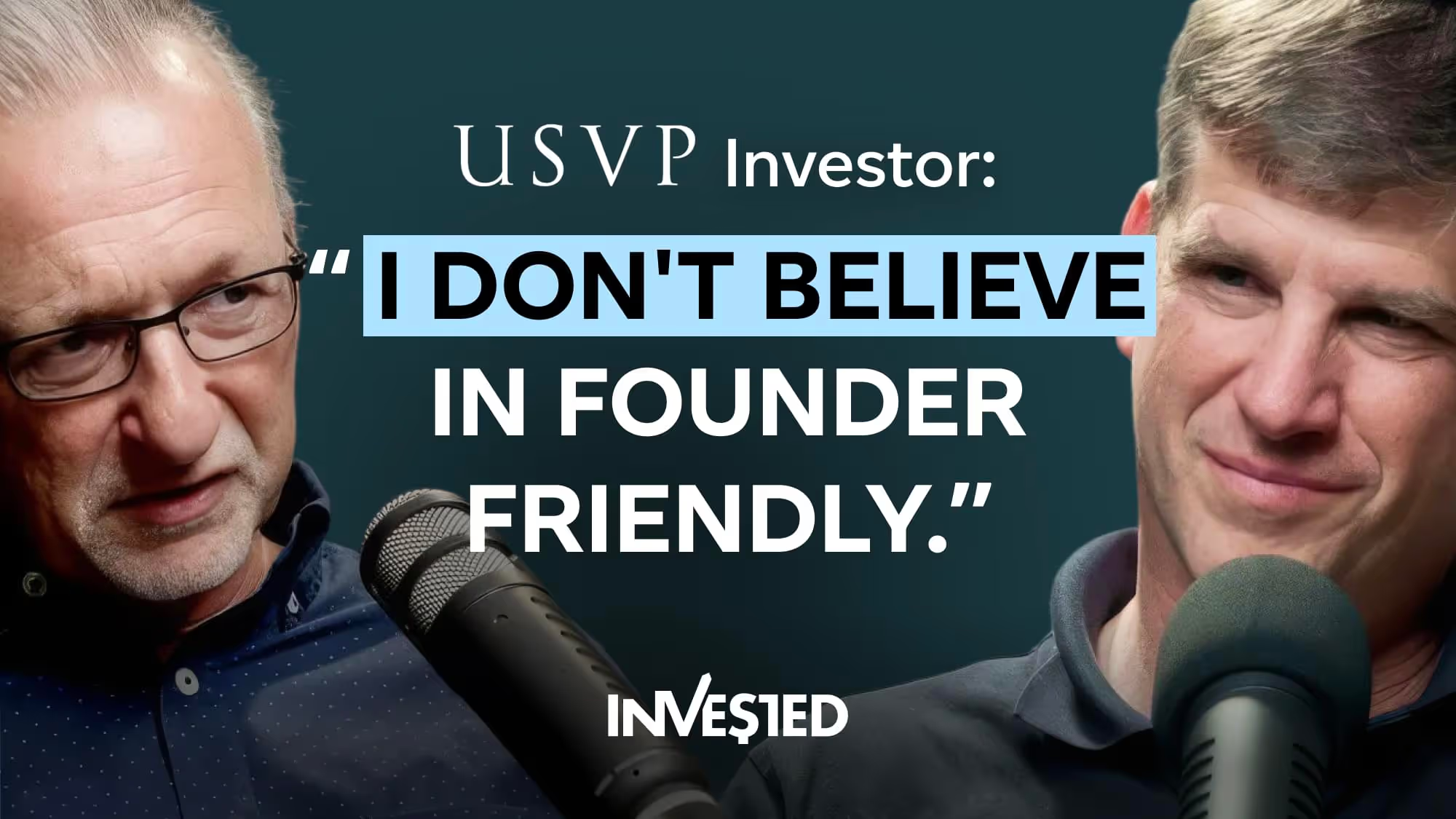
20:45 - Why Being Founder-Friendly isn’t Helpful
24:16 - The Wiz Effect
31:20 - Jacques’s Market Entry Strategy
38:49 - Why ‘Crossing the Chasm’ Is Obsolete
47:19 - War Doesn’t Affect Investment in Israel
52:00 - Israeli Trait That Hurts Sales
56:16 - The Galapagos Syndrome
Jacques Benkoski (00:00.064)
Everybody is expecting that AI adoption will be limited by its ability to be integrated into customer workflows. They say, no, that's wrong. Customer workflows will evolve to take advantage of AI.
Michael Eisenberg:
Founder friendly, is that a good thing or is it overrated?
Jacques Benkoski:
I don't believe in being founder friendly.
Wiz broke that triangle. It was able to sell, at a high price, a product that's really easy, with pretty dumb salespeople.
Michael Eisenberg:
Oh come on, you've never been on a board where there's been a board member who was prescriptive and–?
Jacques Benkoski:
I have, and I'm usually the one that stands up and has them to shut up.
Michael Eisenberg (00:30.894)
Okay, so you see there is tension on the board!
Jacques Benkoski:
No, no.
I beg people that during the first phase of validation, you cannot be selling. You are in listening mode. And that's hard on Israelis.
Michael Eisenberg (00:45.72)
Welcome back to another episode of Invested. I'm here with an old friend, Jacques Benkoski. Welcome.
Jacques Benkoski:
Thank you for having me.
Michael Eisenberg:
Jacques is a veteran investor at USVP. USVP is a storied firm. I hope we're going to get into that a bit. I met Jacques through his partner, Steve Krauss, also a longtime friend and a mutual friend. Jacques, welcome to Invested.
Jacques Benkoski:
Thank you, it's a pleasure to be here.
Michael Eisenberg:
Why don't you give everyone your background? For those who didn't hear the accent, it's French.
Jacques Benkoski (01:18.606)
It's not, it’s actually Belgian.
Michael Eisenberg:
It’s Belgian!
Jacques Benkoski:
It's French speaking Belgian, but it's a slightly different accent. And so I was born in Belgium. I grew up there until I was 18. At age 18, I came to Technion in some crazy idea. And I learned Hebrew in passing. They wanted me to do a year of Mechina. But since I was accepted to start school, I said, “Well, I'll start. Worst case, I'll fail. But let me start and see if I can make it. And I learned Hebrew in passing.” I still speak, as you know, very well.
Michael Eisenberg: (01:48.384)
Technion, for those who don't know is like the Israeli MIT, and Mechina is like a prep program you do for a year before they actually let you into university.
Jacques Benkoski:
Correct. So I managed to bypass that and succeed nonetheless. And to the surprise of a lot of people, I actually find that Hebrew is a particularly easy language to learn. People have this notion that it is really hard, but once you get past the alphabet, which is 26 signs, you know, you can learn in a few weeks. The language itself is very easy, very structured. And Israelis are particularly flexible. If you don't speak well, they understand you anyway. And so you can get fluent to a level that people understand you very quickly.
Michael Eisenberg:
And then after the Technion?
Jacques Benkoski (02:32.75)
And after Technion, I went to get a Master's and a PhD in the United States, at Carnegie Mellon. At that time, I was more of a researcher type guy. I did a lot of academic research, wrote 30 technical papers. And then after that, I went into industry, worked in a very large company in the semiconductor space.
Michael Eisenberg:
Which one?
Jacques Benkoski (03:00.83)
It's called STMicroelectronics. Not many people know it. It's the fifth largest semiconductor company in the world. We were based in France, so that the kids could learn some French as well. And then, as the story goes, and many people, a friend of mine did a startup, except at that time, nobody knew what a startup was. It was a small company that was losing money. And so, but I had the chance to test his product in my company. And I was so impressed that I decided to join the startup.
I was among the few 10th of the earliest employees. The company was a huge success. We ended up going public in 1994.
Michael Eisenberg:
The company's name was?
Jacques Benkoski:
Epic design technology. Won't speak to anybody, I think, in the audience.
Michael Eisenberg:
Not anymore.
Jacques Benkoski:
Not anymore, exactly. And so the company was public for three years, which was a very important experience, to go through the going public and how you behave as a public company, and how different that is from being a private company. And after three years, we got acquired.
Michael Eisenberg:
By?
Jacques Benkoski (03:59.214)
By Synopsis. Thank you. And then, as the story goes, another friend called me up and he said, “I just started a company, but I'm a technical founder. And by now you're a business guy. And would you like to be my CEO?” It sounded like a great idea. We’re talking late ‘97, early ‘98. And so we wrote the.com, which is eerily similar to the current situation that we see today with AI.
Michael Eisenberg:
We’re gonna use the fact that two of us are old guys to talk about that in a second.
Jacques Benkoski:
We can do that for sure. And so, just for reference, I raised a hundred million dollars during those years. And a hundred million dollars of those years is like many hundreds of millions of dollars of today.
Michael Eisenberg:
What was the company's name?
Jacques Benkoski:
The company was called Monterey Design Systems. But the reason we were able to raise so much money, even though we were doing something very boring–technical software, high performance type stuff–is, HP at that time suddenly had a vision that they wanted to build data centers.
Data centers didn't exist. Everybody had computers on premise. So HP came to us and said, “Could we work together? The software will run in our data center, and you'll have just the front end with the customer.” Today you call that SaaS. Back in those days, we called that ASP, application service provider. And since it was this brand new internet delivered software, we raised money like crazy. Fast forward to 2001, the world comes apart in ways that people that haven't been around at the time can't really understand. People go like, “Oh, the crisis of 2008, nothing to do with the 2001.” It was way deeper, way more killing everything in tech. 2008 was mostly a financial crisis, but not so much a tech crisis. And so more than a third of my customers went bankrupt. We're not talking churn here. We're talking gone.
Michael Eisenberg:
I'll just open up the conversation because I think this is an important point. There was a ton of companies whose customers were financed by venture capital at the time. And ASPs was this whole class of companies. You had a pile of them in different layers of the stack. This was an ASP. Then there was Exodus, which was like a hosting facility, and on and on. I forget the name of the big one in Atlanta right now.
But their customers, a large percentage of their customers were backed by venture capital. Venture capital dried up when what Barron's famously called ‘dot bomb’ about Amazon happened. And then, you know, a third of your customers just went bankrupt in four minutes. Go ahead.
Jacques Benkoski (06:42.574)
And so at that time, in 2001, of course, no capital available. And my customers were going away, and suddenly nobody was in the mood of using software that would run on very large supercomputers. And so the saving grace was buying another small company named Aristo. If we’re naming everyone, which was run by a delightful gentleman called Simon Bloch. If you know him. Nice Jewish guy in Silicon Valley.
And they had a product that ran on a PC. And so we morphed ourselves into that company, and shelved our existing product cause nobody wanted it anymore, and became them. And with that, we were able to turn the corner, and that company was acquired by Synopsys again in 2004. USVP was an investor in Epic Design Technology. Met Steve for the first time when he was a board member at Epic.
Again, we're talking 1993, ‘94. And then the second company, the one that we acquired, was backed by USVP. And so I had incredible luck of having Erwin Federman become my board member, effectively my mentor.
Michael Eisenberg:
The legend.
Jacques Benkoski (08:09.134)
The legend, absolutely. And so after I sold that company, USVP was like, “Well, what are you going to do now?” It was sort of a very classical story. And I said, “Well, I don't know, but I'm not going to do another startup right now.” And so they said, “Well, why don't you come and hang out with us?”
So I hung out for a number of years. I did a job of being executive chairman of companies, which I tremendously enjoyed, and gave me more experience in helping coach entrepreneurs without actually running the company. And then eventually USVP was like, “Well, what is it going to be? Are you going to stay, or you're not going to stay?”
Around that time, we’re talking 2008, 2009, everybody discovers Israel. Everybody opens an office in Israel,and USVP, who had been investing in Israel very early with companies like Compugen, and Mellanox, and Checkpoint, was miffed. Like, wait a minute, what is going on here? We were doing Israel. And so we had a lot of soul searching, and me knowing Israel very well, I was asked to figure out what we were going to do. And so we came up with this strategy, which doesn't have a good name. It's called, ‘let's not open an office in Israel.’
Michael Eisenberg:
Yeah. I actually call it the frequent flier strategy.
Jacques Benkoski:
Okay. Fair enough. Fair enough. Under the notion that we were doing series A's and series B, we weren't going to do seed in Israel. And so it was much better for us to position as a U.S. venture capitalist that understands Israeli companies, that brings the U.S. expertise to those companies, and be friendly with all the seed funds in Israel, Aleph included. And this strategy has worked extremely well, as you may know. And we've been very successful in deploying it, and we think it has a lot of legs to continue to do so.
Michael Eisenberg:
Okay, I wanna unpack a couple of things somewhat quickly. First of all, for just a historical record, Jacques mentioned that USVP backed Compugen, where the firm I was previously associated with was an investor. They were the first institutional money into Check Point, a small place called BRM had the original money, few hundreds of thousand dollars into Check Point, and then in the first half of the 90s, USVP and Venrock each put, I think it was $10 million each into Checkpoint in the early days, till it became worth a lot of money. And I believe Erwin Federman led that as well, and was on the board for a very long time, if my memory serves me correctly.
Jacques Benkoski:
Erwin was chairman of the board until he turned 85. And then he went to Gill and he said, “I don't think it's proper to have a board member of 85.” And that was the end of that.
Michael Eisenberg:
He's just a remarkable person. Also, USVP, it should be said, and this talks to your background, did a lot of work in semiconductors, and semiconductor equipment technologies over time. Erwin obviously was the leader of that. And then I think you've been also famously invested here because of Check Point, but not only, in many cyber companies that have done well in Israel, and you yourself then. So what is some of the portfolio you've developed in Israel?
Jacques Benkoski (11:14.222)
So the current flagship company is Cato Networks, which is run by Shlomo Kramer.
Michael Eisenberg:
Yeah, CATO, C-A-T-O.
Jacques Benkoski:
CATO, which is, if you have seen the recent press releases, not giving you any non-confidential information, but just raised money at $0.5 billion.
Michael Eisenberg:
And Shlomo was one of the founders of Check Point.
Jacques Benkoski:
Correct. And we've had the pleasure of investing in his other companies. We invested in Imperva, which is a company he ran after a checkpoint.
Michael Eisenberg:
Just traded hands again in PE right now also.
Jacques Benkoski:
Exactly. And we were the first investor in Trastea, where Shlomo was the seed and founding investor. And so those are all Shlomo related, very significant success. And we recognize his leadership and his skill, and it's a pleasure to have our name somewhat associated with his.
Michael Eisenberg (12:06.414)
So you mentioned earlier that you think what's going on in AI is highly reminiscent of what those of us with some gray hair remember from ‘97, eight, nine, 2000, 2001 and 2002. Unpack that for me.
Jacques Benkoski:
Look, if you look at what happened in those years, people got the notion that the web was going to happen, and the web was going to enable a whole bunch of new industries and new services and all that, and started investing and building up the infrastructure to do so. Data centers, networking equipment, and so on. And what happened is not that it didn't happen. It just happened later and slower than expected.
You know, if you look at Webvan as an example, which was the laughing stock of those years, where I see for those who don't know, Webvan was delivering your groceries at home. I think it's now called Instacart. But at that time it was sort of a joke, like, oh my God, what are people thinking? You know, you're going to order on the web and you'll be delivered at home. Pet.com and all of those were just fun. Like, that's never going to happen. And then it eventually did happen. It just happened in 2003, 2004 and so on. And so the real issue was that the buildup was way ahead of the adoption, and the buildup was sunk money, if you want, because it wasn't being used. What we're seeing right now with AI is reminiscent, in that people are talking about building nuclear reactors next to data centers. We all know it takes a decade at a minimum to build and put in service such a system if you ever could. And so that frenzy, that buildup is currently well ahead of demand.
Michael Eisenberg (13:52.11)
Almost nobody alive anymore remembers what it's like to build a nuclear reactor in the United States. There's not a lot of learned experience.
Jacques Benkoski:
Exactly that. Exactly that, too. But it's just, the pace of the buildup compared to the pace of adoption creates this gap. And one of the frightening similarities in what you were saying earlier is the amount of AI buildup where you can trace the source of the money to venture capital, as opposed to revenue is at 60 plus percent. And so, if the demand is going to catch up quickly, such that all that capacity will be used will be good. But chances are that technology always takes a little longer than we think, and it will perhaps lead to the end of what after all seems to be a bubble. I can't guarantee it, and maybe it won't happen, but it's very similar.
Michael Eisenberg:
But you think this time is not different.
Jacques Benkoski:
You know, every time somebody says this time it's different is when you know that you should be careful.
Michael Eisenberg (14:50.882)
I was sitting with a young man I have a lot of respect for named Mackey Craven. He used to be at OpenView, now he's opening his own firm on Monday in New York. That's, I guess, two days ago now. And I told him that early in my career I experienced the bubble in the dot com crash, and it was so much pain, so much bleeding, so many scars. It's probably taken me 15 to 20 years to recover from the lessons of that, number one. And some of the lessons are super valuable, obviously. And at the same time, I've come to view bubbles as a positive and not a negative. Because a lot of what you said is true, which is, we are still today benefiting from the fiber optics laid by the bubble. No one remembers Global Crossing anymore, but we're all benefiting from Global Crossing. You can look it up on Wikipedia, if you're listening to this. Nobody remembers Exodus or all the other ASPs or hosting companies.
They were the foundations for our modern hosting architecture in many ways, and even the notions of cloud computing. What do you think are going to be the artifacts that we'll use in a decade from now of the current, what you think is a bubble in AI?
Jacques Benkoski (16:04.43)
That's a good question. I think certainly the infrastructure that is built in terms of how you build applications and how you deliver applications. Aaron Levie, the CEO of Box, which is a company very close to our heart, too, just tweeted yesterday that everybody is expecting that AI adoption will be limited by its ability to be integrated into customer workflows. And he says, no, that's wrong. Customer workflows will evolve to take advantage of AI. And we are all examples of that. We Google, which is a learned behavior. We know how to Google, right? We've learned how you enter a query in Google so that you get the right answer. You don't Google the way you talk. You Google the way you Google. And so his argument is absolutely cogent to me, that we will change the way we work to use that AI. And that, I think, is certainly gonna create a new way of thinking, a new way of working. And those will stay with us.
Michael Eisenberg:
That's almost a human perspective, but what's the physical infrastructure that you think gets laid now that is–or is there not? Because you sound like you're pretty skeptical of the data center build out.
Jacques Benkoski:
I'm not skeptical of it. I'm wondering whether the speed at which we’re investing and building those things will be justified by a commensurate use. And somebody posted, I think a few days ago, that 95% of AI projects currently fail. It's probably the right number.
Michael Eisenberg (17:44.63)
You know, 90% of venture investments fail too, right? You and I are still sitting here.
Jacques Benkoski:
I'm not saying that those data centers will not be used. I just worry that the speed of and the depth of the investment that is being done may just be ahead of its time. Not to say that any of those data centers won't be used eventually.
Michael Eisenberg (18:07.086)
When you've been wrong as an investor, have you been too early or too late?
Jacques Benkoski:
I've been too early, too late. I think I've been both, mostly too early, but not too late. And you know, when you're early in the market, it's very painful, because it doesn't matter that you started early. Whoever started at the time that the market picked up is at the starting line to get there with you. And so I've watched companies that sort of waited for the market for two and three years, only to have a new entrance in the third year come up and take the cheese.
Michael Eisenberg:
You've been doing these Israeli investments for almost 20 years now, on behalf of USVP. One of the things you said was that your goal was to make USVP the friendliest American fund for Israeli entrepreneurs. Did you pull that off?
Jacques Benkoski:
I think the word friendliest, I don't know if I used then, but maybe you Googled it and you found it.
Michael Eisenberg (19:03.276)
You know, it's like you said. We learned how to Google.
Jacques Benkoski:
Yes, exactly. I don't know that we are the friendliest. I think we are, I hope we are viewed as one of those that has the biggest value add in the particular context of Israeli companies that have this unique culture and have to enter the market.
Michael Eisenberg (19:21.762)
What does a value add mean?
Jacques Benkoski:
Enabling them to understand the growth challenges in a way that we speak a language that they understand, which a lot of firms that are not so used to investing in Israel don't.
Michael Eisenberg:
Is it cultural affinity?
Jacques Benkoski:
It's cultural affinity, and especially helping them with their idiosyncratic weaknesses.
Michael Eisenberg:
What are those?
Jacques Benkoski:
What are those? Of course we all know them. It's the product. The product is amazing. You know, why do we need anything else? And so, really understanding market entry, the whole notion of deciding on what your ICP needs to be as opposed to just throwing the product out there and somehow they will buy. And what has been interesting is, investing in Israel for 20 years, it is a behavior that was prevalent back then. It's surprisingly not evolving. Like every generation of Israeli entrepreneurs seems to go through the same.
Michael Eisenberg:
It’s not getting better at all?
Jacques Benkoski:
It's getting a little bit better. I think especially the supporting infrastructure is getting better. But the notion, which I think comes from the way they learn tech, right, where there is no customer, the customer is the army– is, let's make the best product possible and that will be good.
Michael Eisenberg (20:45.208)
So going back to friendliest, because I guess at some point you thought that was–is friendliness, like founder friendly, is that a good thing, or is it a...?
Jacques Benkoski:
I don't believe in being founder friendly. Actually, I'm not particularly founder friendly. I think, just like any parent, right? If you're too permissive, you're not helping. And so I think it's all about being the best you can be for your entrepreneurs. And that doesn't necessarily mean be friendly to them.
Michael Eisenberg:
Including firing them?
Jacques Benkoski (21:23.448)
Not necessarily firing them. I always find that if you fire an entrepreneur, like for myself, I consider that a failure. I'm not saying I won't do it. But I failed if that's what the outcome is. We can expand on that. But it's about, look, this is not going to cut it. But this behavior will not allow you to scale. The way you behave will not satisfy a next round U.S. investor and the likes. So, sort of showing, holding a mirror, that's something I learned very much from Erwin, right? You're never prescriptive. You never tell entrepreneurs what to do.
I think it's a very important scale. You just show them by comparisons and by holding a mirror to them, what the decisions they're making or the behavior they're exhibiting will result into. So, and hopefully they get to the right conclusions by themselves. When they don't, I think you have to, you know, just escalate and say, “This is what's going to happen if you don't do X, Y, Z.” And then yes, you're right. In the extreme case, it may be just be, you'll never learn. And so you fire them.
Michael Eisenberg:
And when they don't?
Jacques Benkoski (22:22.848)
Sometimes you say, as a result of that, this company will never be able to scale beyond where it's at, and let's hire a banker and see what we can get for it. And sometimes you go, no, there's more to it. It's just, this particular situation is a bottleneck that we can overcome.
Michael Eisenberg:
You said if you fire a founder, it's a failure, but sometimes you need another CEO there. You just do. I mean, that was common in the business when you and I were growing up in it.
Jacques Benkoski:
Right. The reason I say it's a failure, I mean that on myself, like it's my failure. Because typically we're trying to invest in CEOs that we think will scale. Like if we know from the get-go that they won't scale, it's usually not a good idea for us to proceed.
Michael Eisenberg:
Sure. It’s a failure of early judgment.
Jacques Benkoski (23:18.838)
And so if we thought they would scale and they didn't, either we were wrong, like you said, failure of early judgment. Or we didn't do our job, which is more the case of helping that CEO grow. The job of the CEO changes completely every 18 months. And so it's our job to hold their hands as they go through that personal growth. And, you know, as a parent, if your kid didn't grow, it's kind of on you that you didn't help them grow.
Michael Eisenberg:
Is it your sense, by the way, that things are speeding up now? You know, we talked about the money comparisons. In ‘99, it felt like the clock speed was fast. By the way, in the first half of 2021, I didn't think I could compete anymore, because you had all these guys doing Zoom term sheets in 24 hours. And I thought I was like an old geezer unable to compete. It feels like it's back again.
Jacques Benkoski:
And good thing that you didn't try to compete, because all those term sheets ended up in pretty negative situations.
Michael Eisenberg:
But now it feels like we're back to that again.
Jacques Benkoski:
I think we are. I think we are very much so here, by the way. This is again a very Israel-centric bubble.
Michael Eisenberg (24:16.904)
Silicon Valley also, think, no?
Jacques Benkoski:
Within a very, very narrow part of the market. It's as a proportion of the market, right? It's more in cybersecurity than not, but cybersecurity being such a large part of what's going on here as a percentage of the market that exhibits that. It's very widely that kind of behavior. In the U.S. it's really the eye of the storm of the AI stuff. You know, people getting hired for tens of millions of dollars and all that. It's a market in which we don't play.
But other than that, it is more here, and I think it is creating another generation of overfunded companies that will have to either grow into their valuation as we say, or they will have some trouble.
Michael Eisenberg:
I think Wiz has lit up people's imagination here.
Jacques Benkoski:
It does, it does. And it's unfortunate, because I spent a lot of time analyzing go to market and so on. And to me, Wiz was a mystery. Like it broke every rule that I have for myself. And in trying to understand intellectually where, what do I not understand that allowed Wiz to break all the rules? It sort of forced me to, at least for my own use, to come up with what are the characteristics that Wiz had that allowed it to do that, and then map other companies and explain to them whether they have a chance to be Wiz or they just try to attach themselves to the name, but they don't have those characteristics.
Michael Eisenberg:
Okay, once again, tell me what rules of yours do you think Wiz broke?
Jacques Benkoski:
So, one of the rules that I have is that you cannot grow a Salesforce past a certain speed. If you're growing faster than that, what will typically happen is the Salesforce will be extremely unproductive, will be very inefficient, will not have a chance to learn the product, will not have the chance to learn the methodology. And you end up with money on fire, but not creating the kind of traction you should.
And so we just grew faster than any company I know, uh, that any company we know, um, despite having two higher salespeople to sell. And so how did they get that kind of growth rate? All those salespeople put them to work, and create the kind of growth that they had was a big question for me. And I think if you look at some of the concepts that I work on, creating a relationship between the friction of the product, the price at which you need to sell it at, and the type of salespeople that you have, broke that triangle. It was able to sell at a high price, a product that's really easy, with pretty dumb salespeople. And that is a unique situation. And whenever I look at another company and say, well, we're going to grow like Wiz, I literally ask them, “Do you have that characteristic?”
Michael Eisenberg (27:23.33)
And was just an easy to deploy product is your point, an easy to understand product, an easy–
Jacques Benkoski:
Easy to deploy, yet still able to command multi-hundred-thousand dollar POs.
Michael Eisenberg:
Because the value is so deep, or because Assaf's brand was so good, or because…?
Jacques Benkoski:
I don't think the vast majority of customers even know who Assaf is.
Michael Eisenberg:
And they bought it because they just needed it?
Jacques Benkoski (27:45.88)
They needed it, it was super easy to use, and they created an ability to prove that value very quickly, in a matter of a couple of weeks, three weeks. Typically, to get a multi-hundred-thousand dollars or sometimes millions of dollars PO, it takes months. And yet Wiz was able to do that in weeks and with people that were not particularly skilled. And so that's, if somebody says I'm the next Wiz–
Michael Eisenberg:
Have you seen any other companies that fit those criteria that break your rules?
Jacques Benkoski:
Not really, not yet, no.
Michael Eisenberg:
What's the normal pace that I can grow my Salesforce?
Jacques Benkoski:
You know, you have to look at the speed of your time to fully enabled. And if you can teach you people how to sell in three months, then you can grow probably three X year over year. If you need six or nine months, then you kind of top out at two X. And the reason is simple. If you double your sales every year and the money that you spend on your Salesforce to create that is wasted half of the year in teaching people how to sell, your burn rate is astronomical, if you try to grow any faster than 2X.
Michael Eisenberg:
So I have here your book called The Market Entry Strategy, Charting Your Course to Early Stage Venture Success. This is the outgrowth of seminars that you gave. How many people took those seminars?
Jacques Benkoski (29:09.048)
Correct. Right now, of the people whose email address I have is over 5,000.
Michael Eisenberg:
Over 5,000. Are they all founders or are they…?
Jacques Benkoski:
Mostly founders, sometimes some people bring the entire team. A lot of VCs come too. So yes, but they're founding teams, let's put it this way. It's only live, right? You cannot YouTube it or anything.
Michael Eisenberg (29:28.35)
You can't YouTube it. You have to come to Jacques live. Why?
Jacques Benkoski:
Because the amount of material that is delivered in the seminar is so intense that unless you pay fully attention for the whole two hours, you're gonna miss 90% of it. And when people watch YouTube, they're always doing something else at the same time.
Michael Eisenberg:
Is it free or paid?
Jacques Benkoski:
It's free.
Michael Eisenberg:
You want to make sure people are paying attention.
Jacques Benkoski:
I want to make sure people are paying attention.
Michael Eisenberg:
Nobody's slacking off in class. Do people turn their cameras off in the seminar?
Jacques Benkoski:
So except during COVID, it's not on Zoom, you know, it's live. It's typically cohorts of a hundred, 150 people. I do it in Tel Aviv almost every quarter, and that room fills up within hours of the registration being open. And the feedback that I get is people love it. And to the point we were just talking about, the biggest criticism they have is like, it's too much. It's too much material in two hours. And so the funny thing that has happened, very surprising at the beginning, is people come more than once. I see the same faces.
I have one guy that came four times already. And when I asked why, they say, “Well, as the company evolves, I pay attention more to certain segments of what you teach.” And so it's, as people say it's humbling, but it's not humbling. It's a real pleasure to, uh, to really see people recognize the value. And I'm only doing it for that. I mean, there's obviously no money in that endeavor, as you can imagine.
Michael Eisenberg:
Is there deal flow?
Jacques Benkoski (31:20.142)
Not really. No, there isn't really deal flow. USVP is not seeking deal flow. We get most of our deal flow inbound. What it does do is when I meet an entrepreneur that has been to the class, the quality of that first meeting is an order of magnitude better, because they have a frame of reference that is the one that matters to me. Very often they've adapted their business plan to match what I teach. And so the mind belt happens very fast, and it happens actually, I would say, know, 20, 25% of my first meetings that our entrepreneurs that have been to.
Michael Eisenberg (31:46.114)
Interesting. Pitch the book in 60 seconds.
Jacques Benkoski:
So the book is based on the notion that in a world that is awash with venture capital, your problem is not to find a customer that wants to work with a startup, but to find a customer that wants to work with you and only with you. A customer for whom you are unique, specifically able to deliver something that only you can do for that specific set of customers. And so you flip the script on trying to talk to anybody and see who wants to talk to you, deciding who you want to go talk to. And you pick them on the basis of them being those for whom you can do something unique.
Michael Eisenberg (32:30.964)
Give me an example of that.
Jacques Benkoski:
I think your t-shirt says be different is better than be better, or something like that. That is exactly what it is.
Michael Eisenberg:
Give me an example.
Jacques Benkoski:
One of the classic examples was Medigate, which, if you look at the technology, was very similar to Armis and the other, you know, network sniffing products, but Medigate by decision said, “We're going to go after the medical vertical.” And in doing so, create a product that pretty quickly evolved to be unique, or uniquely suited for the medical vertical in such a way that within months from starting their go to market, nobody could come back in a meeting with a healthcare provider and even speak the lingo and understand their need the way Medigate did. And so even though it wasn't necessarily a product differentiation, it was a market entry differentiation. They were different because they chose to be different.
Michael Eisenberg:
Who was the first customer?
Jacques Benkoski:
The first customer was a large hospital network in the U.S.
Michael Eisenberg (33:27.704)
So the market itself created the product, basically, differentiation. That's a technology differentiation, we call it the productization differentiation?
Jacques Benkoski:
Right. And the depth of knowledge of the unique needs of that market that the company quickly acquired. I was once in a meeting, they invited me to join a meeting with the CISO of a large hospital. And I sat in the meeting and you know, I'm pretty technical. I had no idea what they were talking about. Not because I don't understand networking, but because they were using a jargon that was specific to hospitals and that nobody else could understand. And so I was
told myself after that meeting, nobody can catch up to this company, because they will not master the language like we do.
Michael Eisenberg:
It's almost like product marketing.
Jacques Benkoski:
It is product marketing. is the notion that you must choose your customer and then relentlessly hone to only that set of customers, such that, for that set of customer, only you can do what you can do.
Michael Eisenberg (34:26.2)
So there's something in the book that, other than one little piece, I thought maybe you were talking about me. It says, you warn, and this is the piece that's not about me, that certain big name investors, that's not me, I'm not a big name, just an investor, without the right expertise can be a red flag. What does that mean?
Jacques Benkoski:
I'm not sure which part of it is it. There's one part in the book where I say, “Be careful to come up with brand name angels. People that are very famous, but actually know nothing about this market, who you met and they thought you were wonderful and gave you some play money. And don't think that that's an endorsement, right? That's not a validation. And if you come to me telling me about all those great angels and you try to impress me that those people invested in you, you actually sending the wrong signal. Because if you think this is what matters, you off.”
Michael Eisenberg:
But think about a guy like me, like a generalist like me with no market expertise and certainly no technical expertise. You're very technological and obviously you've done a ton in cyber and a bunch of other places. But I'm like all over the map. I don't really know anything about the things I'm investing in. Like is that a warning? Big red flag, don't go to Michael, he doesn’t know anything.
Jacques Benkoski (35:44.11)
No, and I'm going to give you compliments here. I think Aleph is unique. I think Aleph is one of the very true risk takers in the business. I think a lot of people are not taking enough risk, and you guys embark on stuff that–and I've looked at some of your companies like, what were they thinking–and yet, if it worked, and sometimes it does, then it's an amazing outcome. And so that's the quality that you bring, sort of the willingness to embrace innovation beyond the frontier. And that's a different skill.
Michael Eisenberg:
What I want to challenge for a second, because I think this is an important topic in venture capital, which is this notion of expertise. Gili Raanan, who's an example at CyberStarts, who's been an incredible investor and is an incredible mensch, really focused on this cyber area, cyber for enterprises in particular, and he aced it, and there's a level of expertise there.
You know, we've had many cases in the past, I don't know if I need to tell you this, of what I would call focused funds that have real expertise, but they have kind of gone sideways and missed entire waves of innovation because of that. Where do you think this notion of kind of expertise versus like a fresh mind? Where does your rubber hit the road on that? Or experts versus generalists?
Jacques Benkoski:
You know, there's always the notion that, or when you know nothing about a certain topic, you're more likely to innovate than somebody that knows it fully and will be bound by what they know about the market. I think everybody has their specialty. I think when you invest at the stage where we invest, which is Series A, you do have an initial market adoption signal, more so than you do at the seed, but you still have to have a vision of what is the market transformation that enabled these companies to succeed at this time. And that requires a certain level of knowledge, if not of the specifics of that company, at least of the fractures that are happening in the environment that enabled them to succeed.
Michael Eisenberg:
Do you find there's board tension between people who actually know the market and those like me that are just guessing?
Jacques Benkoski:
I don't think there should ever be board tension, in general. I think people should bring their different ideas and, you know, we are all there to give ideas to the CEO, and the CEO then decides what they want to do. Anybody that's more prescriptive than that is getting out of the role of a board member.
Michael Eisenberg:
Oh come on, you've never been on a board where there's been a board member who was more prescriptive than that?
Jacques Benkoski:
I have, and I'm usually the one that stands up and has them to shut up.
Michael Eisenberg (38:36.3)
You see, there is tension on the board!
Jacques Benkoski:
I know, but seriously, I think when people really understand the role of board members and people get better and better, then you shouldn't have that.
Michael Eisenberg (38:49.134)
You also wrote in the book, and I have to say it was like a dagger in my heart, that certain books like Crossing the Chasm are outdated. The reason it was a dagger is, I remember when that book came out, and I think I remember seeing Jeffrey Moore–who was spelled M-O-O-R-E and Moore Davidow at the time which was a venture fund that's no longer around, spelled M-O-H-R.
Jacques Benkoski:
Right. MDV.
Michael Eisenberg:
Yeah, MDV, great people used to be there. Nancy Schoendorf and John Fiber, great people. Bill Davidow. And I remember meeting Geoffrey Moore there, and it was like, for me that was, wow, this guy wrote the Bible for our business, Crossing the Chasm. This was the Bible, the most published book of all time, but this Bible you're saying is totally outdated. So why is Crossing the Chasm outdated?
Jacques Benkoski:
Crossing the Chasm was written at a time when the total amount of venture capital per year was 1.5 billion. As you know, we are exceeding 600 billion. So there's like many orders of magnitude. It was written at a time where….
Michael Eisenberg:
That enables you to have more AI companies that have venture-capital-backed companies as their….
Jacques Benkoski:
There you go. But it was right at a time that if you were a senior executive in a large company, the notion of working with a startup was very dangerous. And so you had to find, per Geoffrey Moore, you had to find those early adopters that were willing to take the risk to work with a startup and would help you to cross the chasm to a wider adoption by having the initial one. So, pass over today, you have $600 billion a year going. For everything that you do, there's multiple startups, and the large companies have understood painfully that unless they work with startups, then sooner or later, I'm going to be left behind. And so they all have ways to want to embrace startups. So the notion of the entrepreneur trying to find somebody that would talk to them is just obsolete. There's people wanting to talk to entrepreneurs everywhere all the time.
The question now becomes, given that everybody wants to talk to you, even that you have so many competitors, how do you decide how you go to market? And Crossing the Chasm is not relevant.
Michael Eisenberg:
So you’re saying the whole notion of early adopters is not a relevant notion anymore.
Jacques Benkoski:
I don't think it is. You always have somebody that moves a bit faster than others, but you will not have the problem that you can't find somebody that will.
Michael Eisenberg:
That's what I was going to ask. Is it just that the time schedules have compressed, or has the foundational definition changed? Because there's not an endless number of companies that will take early bets on early stage companies. In fact, today came out a column that we run, I think it's every couple of weeks, called Unpopular Opinion, where the CTO of one of our companies’, Hud, name is May Walter, said that one should not sell their products early to startups, it should go to enterprises, which is a little bit of like this early adopter thing. Find an early adopter in the enterprise. They're selling stuff that kind of closes the loop for AI, AI models and AI coding in particular, to kind of test your code in the runtime. So it feels like just the time schedules have collapsed, but this notion of early adopters is still super relevant, at least in enterprise-ish land.
Jacques Benkoski (42:19.724)
I think you're correct, but I think for me, the early adopter is somebody who has a problem that you can solve. And if you can find the people who have a problem that you can solve, they will be your early adopter. You can't do a wide marketing and hope that everybody's going to fall off the tree and be ready to embrace you. The super precision decision of deciding, of figuring out who your customers should be, and that is your decision to make, should yield plenty of early adopters per that definition because you are solving the problem they had.
Michael Eisenberg:
Is it just that the early adopter public is larger maybe?
Jacques Benkoski:
I think you have early adopters everywhere, and that's different than it used to be. When you and I started, if you had three or four Fortune 500, you were like, oh my God, right?
Michael Eisenberg:
Unbelievable.
Jacques Benkoski:
And now every deck of a Series A startup has a few Fortune 500 in it, at least in their pipeline, right? They're not having a problem finding somebody that wants to talk to them. The problem that they're facing is unless they focus, they're going to end up with a bunch of customers that want different things from them. And eventually given the level of competition, they're going to not make it.
Michael Eisenberg (43:35.48)
So, and your framework, just to state it, is, there's a large number of customers there. You can have too many customers, and therefore you need it focused on a certain type of customer, either a vertical or people with the same requirements, et cetera, just to make sure you don't get pulled in 100 directions.
Jacques Benkoski:
You need to find the customers for whom you can not only solve a problem, but only you can solve a problem. You want to create that differentiation and you want to hyper differentiate in the early days such that that market entry, that first few set of customers is easier and also devoid of competition. If you keep it too wide, then you'll be going to be in a bake off against four other startups.
Michael Eisenberg:
Stay out of the red ocean, stay in the blue pond.
Jacques Benkoski:
Well, find a tiny blue pond if you need to, but make it blue. Yeah.
Michael Eisenberg:
That's a little bit like Peter Thiel's thesis around, stay away from competition, do things with no competition. So one of the other interesting things was you seem to write that, if you kind of do this, then you can get early acquisition offers. Is that a good thing?
Jacques Benkoski (44:36.536)
Not necessarily, but every company that has been successful had acquisition offers before, right? Like nobody got to a billion-dollar outcome without having multiple offers along the way.
Michael Eisenberg:
I gotta think about that. I'm not sure that's true.
Jacques Benkoski:
It's only been true in my career.
Michael Eisenberg:
I do less enterprise than you do.
Jacques Benkoski:
Yeah. Nobody knows about it. Nobody knows about you. And then suddenly, people know about you, and yeah.
Michael Eisenberg (45:02.284)
I think that's true. I always say one of the reasons I go to investment banks is that the promiscuity helps that people know about you.
Jacques Benkoski:
Sure. So is it a good thing? It's not a good thing. It is what it is. And, for some situations, it is the right thing to do. For others, it's not, but whether it's a dose acquisition offer or an easier path to getting the next round of funding. The one thing I really care about as a board member, as an investor, is lowering your cost of sales. And if you are penetrating a market in which you are the leader in that tiny blue pond, your cost of sales collapses. People call you. You don't have to chase every–
Michael Eisenberg:
Resonate in an echo chamber where people talk to each other.
Jacques Benkoski:
Correct. People wouldn't think of doing an RFP in the space where you're relevant without you. And so instead of spending all this money trying to do marketing and chasing, where perhaps somebody is looking for something, people start coming to you in that micro segment.
Michael Eisenberg (46:00.782)
How do you think about, it's the wrong word, but how do you think about PR? PR is the wrong word today, but it's kind of getting brand recognition in this, what you call micro segment or blue pond today?
Jacques Benkoski:
I think in that respect, it's the same as before. The focus is the difference, right? If you think that, for example, conversation I have with my entrepreneurs, they have a funding announcement and you know, they want to get in TechCrunch and Calcalist and all that. And I'm like, “Let's step back here for a second. Why do we do a press release? What is the number one reason? We want to get new leads. We want to get customers to know that we exist. So the only framework in which we care to create a wave is in the specific industry that we target. So let's try to get an exclusive with Crazy Industry Magazine, and get an article there about an announcement.” The TechCrunch, it's good to tell your cousins and your parents and all that, that you got funding. The customers don't care.
Michael Eisenberg:
By the way, one of the things I discovered in my career is actually how important that is to so many people to tell their parents and cousins that, “Hey, Mom, I was in the newspaper.”
Jacques Benkoski:
It's particularly bad in Israel, I have to tell you that.
Michael Eisenberg (47:19.15)
That's a good segue, by the way. So you've been coming here as an investor for about 20 years. And you come here often as an investor. You've been here during the middle of this war that we're in now, and I'm sure in other things. What keeps bringing you back other than your Hebrew?
Jacques Benkoski:
It's great technology, great people, great opportunities, you know, and more people recognize it, which makes it more competitive.
Michael Eisenberg:
Isn't it pretty stunning just how many people have turned up since this war started? Like the markets become super saturated.
Jacques Benkoski:
I think, you know, there was clearly the Wiz effect. I think the war is a non-event from an investment standpoint. I'm sure it's traumatic for the people that live here. From an investment standpoint, I just meant people can travel for a couple of weeks. Those that actually travel even when it's a little scary to others. But it's a non-event. And so if you're looking at the acceleration, the new bubble that's getting created, I think some of it is the Wiz effect. It's been other quite remarkable exits as well outside of Wiz–not necessarily 32 billion, but a billion here, two billion there, three billion there. People recognize the value of the startups that come up here, and we do too.
Michael Eisenberg (48:37.166)
I love the term you used, that the war is a non-event from an investment perspective. What do you mean by that?
Jacques Benkoski:
It literally doesn't matter.
Michael Eisenberg:
Literally doesn't matter.
Jacques Benkoski:
Like nobody says, “I'm not going to invest in Israel because they've been at war,” or, “I'm not going to invest because there could be another war,” whatever. You know, Israel has shown over and over again–and you can have a holistic debate whether that's healthy or not–but that it continues to operate no matter what happens. And so the investors have reacted accordingly and like, okay, “Well, given that I can talk on Zoom with somebody that's under missile attack, I did just need to move to that other room. and then continue the conversation there. Then I don't care.” It's a learned behavior.
Michael Eisenberg:
20 years ago, in the middle of, I think what was the operation in Jenin, I kept telling the press that the problem is Nasdaq, not Nablus, at the time, and it feels like the same thing. I just haven't found a catchy phrase to describe it. Right now the problem is not Gaza, it's flights, but it doesn't rhyme as well
Jacques Benkoski:
Yeah, no, I think there's a number of people that–I certainly don't want to sound like I blame them–that feel like it's unsafe to come here. The partnership insurance doesn't cover them. Their spouse is freaking out that the notion that they do that. Like I was interviewing somebody to join as an executive in one of my companies, and they withdrew their candidacy because they told their significant other they would have to be in Israel often.
It was sort of a marriage breaker. And he said, “My marriage isn't worth taking this job.” And he withdrew. So, you know, I respect people that do that. I remember when I moved to San Francisco, some people said, “My God, it's really dangerous because you are near Oakland.
You know, Washington DC's in the news right now. I remember when I intered near Capitol Hill back in the late nineties, late eighties, sorry, wow. You got to Washington DC, you came down Georgia Avenue, and on the right side, “Welcome to the nation's capital, Washington DC.” On the left, the first store was Gaskets, Caskets. And these were dangerous places. But people still go to Washington DC.
Jacques Benkoski (50:56.91)
Right. If you look at the recent events in LA, my significant other lives in LA, and people are like, “Oh, really, L.A.?” It's like, it was two blocks. It's a city of 12 million people. People have a perception of danger that is disproportionate when they're not used to that specific danger.
Michael Eisenberg:
I think more now, right, because of social media, everything is amplified.
Jacques Benkoski:
But it's like, “My God, you're in missiles.” And like, yeah, I've been here under missiles, and it's not like you totally don't care, but you don't care very much.
Michael Eisenberg:
I was woken up by the Houthis this morning. It's just one of those things. So I'm not sure how to ask this question, but I'll ask it since you made the comment before about the product. What's the trait that Israeli entrepreneurs think is really, really, really good, but in reality it's turning people off across the pond?
Jacques Benkoski:
I think the classical one is selling them by talking at them. You know, like, like overwhelming them with, with words. I think Gong has woken everybody to the very simple, you know, what percent of the time were you talking? And that's one of the issues. If you look at the book, for example, I beg people that during the first phase of validation, you cannot be selling. You literally cannot be in sales mode. You are in listening mode. And that's harder in Israelis.
Michael Eisenberg:
Yeah, they like ABC, always be selling.
Jacques Benkoski:
Right, right. Always be closing.
Michael Eisenberg:
Always be closing. If you kind of play this movie called Israeli Tech forward a decade, what do you think are going to be the biggest changes we're going to see over the next decade?
Jacques Benkoski:
I don't know. I worry about the inflation. We are now in a situation where Israeli startups have a higher cost per head than most places in the world. You know, I was at a board meeting yesterday, and between the salary increases, which by the way, in the U.S. startups don't do salary increases. you know, you have the same salary for the whole time you are in your startup, and the Shekel and everything, you know, we're to have an increase of 15, 17% in spend in U.S. dollars next year at same headcount.
Michael Eisenberg:
But that’s because the keeps printing money. It's hard to keep up with the printing presses in the United States. It's more the devaluation of the dollar than the strength of the shekel. And I've been very bullish on the shekel very publicly for awhile.
Jacques Benkoski:
I think that's an issue. I think the concentration of focus on too narrow use cases, right. And I think you have been an advocate of, Israel needs to be not just in Tel Aviv, not just in the center, but everywhere, but also in other industries than cyber, because cyber, like any other industry, will eventually be cyclical and Israel cannot find itself in a situation that a pullback of the cybersecurity would create an economic crisis here. So I think that's one thing I worry about. Those are the key elements. I think Israel will continue to churn great entrepreneurs and great technical talent through cycles, as you said, you know, those cycles are beneficial at the end. It's good. I think they'll be pulled back. It feels very bubbly right now, let's put it that way.
Michael Eisenberg (54:40.906)
You've lived in Europe, Israel, and the US. Where's the best place to start a company today?
Jacques Benkoski:
I think there's a lot of advantages here. Mostly, I was asked more than once, why is Israel’s ecosystem successful when so many other ecosystems that try to imitate Silicon Valley have failed? And to me, it comes back to talent concentration. I actually have a presentation where I showed that the distance between Berkeley and San Jose is the same as the distance between Haifa and Rishon Lechon. Literally, like the same. And if you map the big universities, Stanford, Berkeley, and here,Tel Aviv, Technion, Jerusalem, Maryland, and then you map Google Labs and Microsoft Labs and, back then it was maybe HP Labs and so on–it's literally the same map. And so I think that that density is really critical to the quick start.
It's much harder to do, even in Boston these days, because you just don't have the density of talent. I think, however, that there is an element which has become more pronounced in the last couple of years. And there, I think the war did have an effect, is that the Israeli ecosystem is talking to itself. And it's convinced that as it talks to itself, it holds the truth on how the world works.
Michael Eisenberg:
Be specific?
Jacques Benkoski (56:16.878)
Whether it's the way you start a company, the way you finance it, the way every element of it, the system sort of closed onto itself. And there's actually a word for that in management. It's called the Galapagos syndrome, where when you are an island for too long, you evolve different species, and Israel cannot succeed if it has its own species, because the market is not here. And so it's really important that Israeli entrepreneurs continue to get out of this bubble and grow tentacles and relationships in the world, especially in the U.S. and continue to not just be famous among themselves, but actually seek the world.
Michael Eisenberg:
What feels most like home to you, Europe, Israel, or the US?
Unfortunately, I have a saying that says having friends everywhere, you pay the price that you're not home anywhere. So I have friends everywhere, but I'm not home, actually, anywhere. And my home is my friends, wherever they live.
Michael Eisenberg:
What do you think about the future of Europe right now?
Jacques Benkoski (57:26.508)
I think Israel has a very bad perception of Europe. When I mean bad, I'm saying incorrect perception of Europe. It's for both self-preservation as well as political reasons. Europe is actually doing fine. You can walk through the streets of Paris and not see a Palestinian flag. I have a cousin in Brussels that is Jewish, is doing PR. And I had dinner with her a couple of months ago and I said, “Did you ever experience antisemitism?” And she said, “No, never.”
Michael Eisenberg:
I wasn’t asking the Jewish question, I actually asking a different question, right? I think there's Harry Stebbings, who you probably know pretty well also, from 20VC, talking about the rash, for example, of smartphone thefts in the UK. And there's been certainly a rape crisis in the UK, and there's no demographic growth in Europe. They have fallen way behind the United States by almost every measure economically. Tyler Cowen's just had a recent piece about that.
Jacques Benkoski:
I was actually asked by a delegate of the EU, because I speak French and I'm in Silicon Valley, everybody that speaks French and comes from one of the governments wants to speak to me. And so I oblige. And so, I think Europe cannot compete with the U.S. technologically. And therefore it shouldn't try. Meaning it should evolve an ecosystem whereby competing with the United States on technology is not an essential path to success. And I think Europe can certainly do that. I think we are going in the U.S. as well as in Europe, but worse so in the U.S. to a society that's ever more violent. I think technology has a lot to do with that. And I think we are, unfortunately, unless something changes, going to go to a society where it will be sort of a two class system.
Michael Eisenberg:
Interesting.
Jacques Benkoski (59:26.766)
With a pretty repressive mechanism to keep things quiet, but it will not be a very pleasant or very open society to live in. I think Europe has maybe a better shot at not going there than the US. I'm not sure.
Michael Eisenberg (59:50.296)
Interesting. Why does technology making it more violent?
Jacques Benkoski:
Because technology is increasing sort of the gap between have and have nots, almost mechanically. We're to go back to sort of middle age where you have–
Michael Eisenberg:
Feudal lords and serfs?
Jacques Benkoski:
Right. Exactly. And I think that is not a good thing. I think that usually ends up with either, as I joke, sometimes pitchforks or repressive regime. Unless we do something, I think the US for sure, but Europe too, may end up falling into that.
Michael Eisenberg:
Interesting. So a bunch of people send me questions that I should ask you. So Hunter, sorry, Uri May, the CEO of Hunters said, you have extensive experience as an executive. And we talked about the board before. Where has your knowledge as an operator hurt your performance as a board member?
That is a good question, Uri. I knew Uri would come up with a good question, because he's an uber smart guy. I think one of the important qualities of a board member is to not know the details, because you want to create a contrast between the entrepreneur that does know the details and has a hard time seeing over the hill, and board members should be the ones looking over the hill. And I think by being an operator, I'm perhaps too facile in the details, and therefore may fall into that trap. But it's a very good question, I hadn't thought about it.
Michael Eisenberg:
The parallel question comes from our friend Steve Krauss, is, which founder changed your mind the most and what was the lesson?
Jacques Benkoski (01:01:36.842)
Wow, you got really good questions.
Michael Eisenberg:
Steve's a smart guy, been around the block a few times.
Jacques Benkoski:
He has. I don't have a pass on that, huh? I'm trying to think. I think that people that have succeeded in situations where I thought it was mission impossible, and they somehow pulled it out in a way that I couldn't foresee.
Michael Eisenberg (01:02:10.67)
Okay, give me an example.
Jacques Benkoski:
I don't have one, but I have the feeling of the example.
Michael Eisenberg:
Maybe it’s Mickey Boodaei, who said, what made Trustier survive 2008 financial crisis when so many others–but you said it wasn't a big deal, the financial crisis.
Jacques Benkoski:
But it was for Trustier, because Trustier had a hundred percent of its customer base being banks. I think Trustier just hunkered down and stayed the course, and it was very touch and go for a while. I remember some really discouraged conversation internally. Externally people think Trustier was this magic company that–
Michael Eisenberg:
Did pretty well in the end.
Jacques Benkoski (01:02:47.084)
It did very well, but like was this magic–very good. It was like a perfect company, right? ‘Cause we did the series A and they never raised money after that, which is remarkable. But you know, around that time it was touch and go. And I think just, focusing. But I think, I think Trustier succeeded and Mickey succeeded, like, the expected way, you know, like it's a classic entrepreneurial success. If you're asking me one that was really not classic, I don't have an example, but I have the feeling of it. There are the entrepreneurs that I go like, “This will never work.” I don't tell them that. But then it does work.
Michael Eisenberg:
Okay, who did you think wasn't gonna work?
Jacques Benkoski:
You know, we had this company in the United States that was building a semiconductor procurement system. And it was really struggling with the business model of, who do you charge? You charge the buyer, do you charge the seller? For while he was experimenting with, well, we'll just have a platform and there'll be ads on it. Right. Like it was an ad model. and I was like, none of those really–we stayed the course and entrepreneur was very, very much connecting with the customer base. Like he was really a trusted advisor to them. And then kept the company on cashflow break even, because we knew we couldn't raise money, and somehow grinded out and slowly, very slowly, every board meeting at that point was, why don't we grow faster? Go ahead and burn money. And he was like, “I don't know what to do.” And he got it to $70 million in revenue, and profitable. Sold the company for $700 million, in the 57X for USVP.
Michael Eisenberg:
Can't beat that. So in what is the most interesting question I've gotten in a long time, Steve, our mutual friend, asks, how does multiple decades of owning a sailboat in San Francisco Bay increase your personal IRR?
Jacques Benkoski:
It does. It does.
Michael Eisenberg:
I just assume it keeps you sane.
Jacques Benkoski:
It keeps me sane, but the amount of learnings that you have from running a competitive sailboat in terms of strategy, team dynamics, like every outing is a lesson that you can bring back into the company. I was going to use it earlier, but I didn't. So let me do it now. The perfect example of being too early to market is starting a race, and you in the lead by like miles. And the wind drops.
All the other boats catch up to you, and you're all the way together until the wind catches up, starts again. It doesn't matter that you got there first. Whoever gets the whiff of wind first is going to win. And that is a perfect analogy to being too early to market. Sailing is an amazing school for so many things. I recommend it to everybody.
Michael Eisenberg:
How often do you sail?
Jacques Benkoski:
Pretty much weekly
Michael Eisenberg:
In San Francisco Bay.
Jacques Benkoski:
In San Francisco Bay.
Michael Eisenberg:
It’s cold there.
Jacques Benkoski:
It's cold, and it's very windy.
Michael Eisenberg:
Yeah. Good for sailing.
Jacques Benkoski:
Very good for sailing. If you can sail San Francisco, there's not many places you can't sail.
Michael Eisenberg (01:06:07.886)
Amazing. You run into Larry Ellison out there?
Jacques Benkoski:
Larry Ellison is not very liked in the sailing circles. I don't know if you know that, but he just paid his way into successes. He did help the sport, you know, off the record, or I guess we are on the record in the sailing world, Oracle is an acronym, and it stands for “One Real Asshole Called Larry Ellison.”
Michael Eisenberg:
I was in actually in Newport, Rhode Island last week for like two hours on my way driving north to Boston. I wanted to stop in. And I was told the story of the Australians winning the America's Cup, where they had put expended uranium in the keel of the boat, which enabled them to sort of solve the physics problem of how you keep the amount of weight on the bottom of the boat anchored, but have a small keel, which reduced the drag on the boat. And they had brought it in a skirt on the keel in order to kind of surprise everyone with the technological innovation. I thought you were going with sailing, which is the amount of technology in there, but it sounds like you've gone to two other places. One is the teamwork and the fast start and then–assholes, because one of the other things you say on your X handle is that you don't want to work with assholes. Are there a lot in our space?
Jacques Benkoski:
There are. There are.
Michael Eisenberg:
You want to name some?
Jacques Benkoski:
No, of course not. It's only Larry. No, no. Look, the reason I was digging on Larry is, Larry just brought so much money to a sport that was authentic and rendered it unauthentic. It made it much more well known, but sort of lost its soul in the process. Other than that,I think he actually did help the sport. No, I think there's a lot of people that have overinflated egos. A lot of people that are so interested in their own self-image that they hurt the business, they hurt the companies.
Michael Eisenberg:
What's your core value in life?
Jacques Benkoski:
I think it's to do the right thing all the time, or at least as much as I can. And I think if you do that, then over time it pays off. I'm a big believer in karma, especially professionally, and the way I define karma, not in the spiritual way, is, two people are meeting in a cafe right now.
And one of them is saying, “You know, Michael Eisenberg is a great guy.” That will help you in your career, right? In some way that adds up. And so if you do the right thing, and people think highly of you, that karma does come back and help you. So do the right thing is my core value.
Michael Eisenberg:
Jacques, thanks so much for joining us.
Jacques Benkoski (01:09:03.95)
Very good. Thank you.
Michael Eisenberg:
If you enjoyed this episode, please rate us five stars on Spotify, Apple Podcasts, or wherever else you're listening to us. And please do not forget to subscribe to our YouTube channel. Thanks for joining, Jacques.

Follow Jacques on LinkedIn
Subscribe to Invested
Learn more about Aleph
Subscribe to our YouTube channel
Follow Michael on Twitter
Follow Michael on LinkedIn
Follow Aleph on Twitter
Follow Aleph on LinkedIn
Follow Aleph on Instagram
Executive Producer: Erica Marom
Producer: Myron Shneider, Sofi Levak
Video and Editing: Ron Baranov
Music and Creative Direction: Uri Ar
Content and Editorial: Kira Goldring
Design: Rony Karadi
Follow Jacques on LinkedIn
Subscribe to Invested
Learn more about Aleph
Subscribe to our YouTube channel
Follow Michael on Twitter
Follow Michael on LinkedIn
Follow Aleph on Twitter
Follow Aleph on LinkedIn
Follow Aleph on Instagram
Executive Producer: Erica Marom
Producer: Myron Shneider, Sofi Levak
Video and Editing: Ron Baranov
Music and Creative Direction: Uri Ar
Content and Editorial: Kira Goldring
Design: Rony Karadi
Follow Jacques on LinkedIn
Subscribe to Invested
Learn more about Aleph
Subscribe to our YouTube channel
Follow Michael on Twitter
Follow Michael on LinkedIn
Follow Aleph on Twitter
Follow Aleph on LinkedIn
Follow Aleph on Instagram
Executive Producer: Erica Marom
Producer: Myron Shneider, Sofi Levak
Video and Editing: Ron Baranov
Music and Creative Direction: Uri Ar
Content and Editorial: Kira Goldring
Design: Rony Karadi
.jpg)
.jpg)
.jpg)
.jpg)
.jpg)
.jpg)
.jpg)
.jpg)
.jpg)

















.jpg)
.jpg)
.jpg)


.jpg)
.jpg)
.jpg)
.jpg)

.jpg)
.jpg)
.jpg)
.jpg)

.jpg)