Eran Shir and Zach Greenberger
.min.jpg)

How can values create value? On this podcast, Michael Eisenberg talks with business leaders and venture capitalists to explore the values and purpose behind their businesses, the impact technology can have on humanity, and the humanity behind digitization.




Eran Shir and Zach Greenberger
Eran Shir and Zach Greenberger
Eran Shir and Zach Greenberger
Eran Shir and Zach Greenberger
Eran Shir and Zach Greenberger
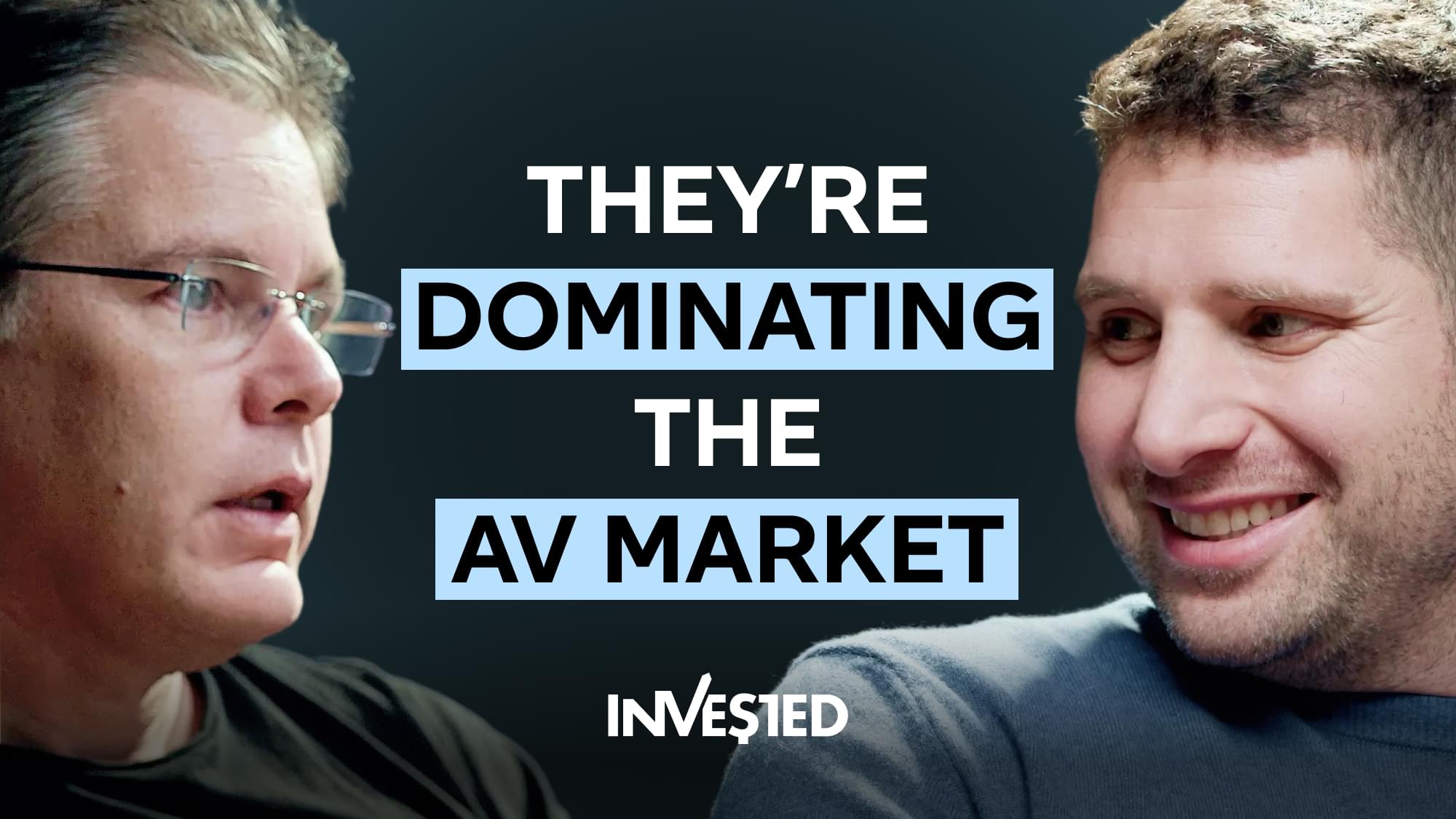
On this episode of Invested, Michael sits down with Eran Shir and Zach Greenberger of Nexar.
Eran Shir is the Co-Founder, CPO & Chairman at Nexar. He is a serial entrepreneur and investor. Previously, he served as Entrepreneur in Residence at Aleph, focusing on IoT, big data, cryptocurrencies, and network-driven market disruption. Before that, Eran led Yahoo's global Creative Innovation Center following the acquisition of Dapper, a dynamic advertising startup that he co-founded. He began his career as a physicist specializing in complex systems and networks, later founding the DIMES Internet research project and co-founding the machine learning company Cogniview.
Zach Greenberger is the CEO of Nexar, leading the company’s mission to build AI for the physical world using real-world driving data. Under his leadership, Nexar powers one of the largest connected vehicle networks, generating hundreds of millions of miles of data each month to advance mapping, mobility, and road safety. Prior to Nexar, Zach served as Chief Business Officer at Lyft and held leadership roles at Tesla, focusing on strategic partnerships and new growth initiatives.
Nexar provides a vehicle-to-vehicle (V2V) network that prevents road collisions and enables autonomous mobility. They do this through a global, connected, and intelligent network of mobile cameras on the road that use data to deliver valuable insights, so Nexar can ultimately build transformative products in vehicle autonomy and safety. Nexar's technology is being used by the public sector, autonomous vehicle makers, OEMs, fleets, and insurance companies.
Please rate this episode 5 stars wherever you stream your podcasts!
00:00 - Intro
02:10 - Uber Is 10 Years Too Late
05:20 - Fancy AV Fleets Were a Mistake
06:03 - Nexar Got Paid to Collect 1.2 Billion Miles of Data
07:39 - Nexar Dominates Waymo in Data Collection
09:19 - Google Burns $50 Per Mile
09:38 - Tesla and Nexar: the Only Market Players
12:48 - 100,000 Uber Drivers Already Use Nexar
16:40 - LLMs Won’t Solve the Real World
19:25 - Synthetic Data is Not Enough
21:55 - Rare Edge Cases Caught on Camera
24:09 - NVIDIA Needed Our Data
33:27 - Inside an “Agentic” Organization
40:51 - We Pay Employees to Use AI
52:44 - Nexar’s World Model Outperforms ADAS
01:05:27 - Leading a Cross-Global Team
Zachary Greenberger (00:00.162)
We’ve pretty much built the most valuable data collection engine for real world driving data.
Michael Eisenberg:
For how much money?
Zachary Greenberger:
For 150 million dollars.
Eran Shir:
Every dollar you spend is another dollar bonus to your salary.
Michael Eisenberg:
You're bonusing people to rack up token bills on Claude Code?
Zachary Greenberger:
Yes.
Eran Shir:
Crazy.
From a commercialization perspective, I should go and find someone that could be better than me.
I'm a data hoarder, so I never can get enough.
Michael Eisenberg:
You’re a data hoarder.
Eran Shir:
Yes.
Michael Eisenberg (00:41.08)
What is a data hoarder?
Welcome back to another episode of Invested. I am thrilled to have with me here, Zach Greenberger, CEO of Nexar, and Eran Shir, founder, and chairman, and former CEO of Nexar, but still very active at the company. And the reason we're getting together today is, the world of AI is changing right in front of our eyes.
And I think the ringing of the bell on that was an announcement by Uber over the last 48 hours., where all of sudden they say, “Hye, wait a minute, we've got this giant fleet of cars–kind of–they're not their employees, they're not their cars, they're other people's cars. And how come they're not collecting data like real world data, like Tesla has been? And Tesla's had that massive advantage.” In fact, what you'll hear from the Nexar team here is, this data has been collected by two companies, Tesla and Nexar.
And we're at this interesting transition point in the world of artificial intelligence from synthetic data and scraping all the digital data out there to try and figure out how we ingest all the real world data out there. And that's why I'm thrilled to have Zach and Eran with me. Welcome.
Okay, so Zach, why don't you kick us off? You wrote a LinkedIn post a couple of days ago about Uber's announcement. Tell us what the Uber announcement was and what your reaction was.
Zachary Greenberger:
Sure. Uber announced that they are going to start putting sensors on vehicles to collect real-world data, so they can train autonomous vehicles, or give the data to their autonomous vehicle partners. And our first reaction was excited, because it's been something that we've been telling the industry for quite some time is necessary in order to get to the final stages of autonomy. And while the industry has acknowledged that it's necessary, there's a level of maturation the industry needed to get to to be ready to start adjusting real world data.
So I think we felt super excited that it was a moment in time where the rest of the industry is now following suit and meeting us where we are, where the assets that we have, that we are ready to start continuing to deploy to our partners today is going to become of material importance and how they actually get to full autonomy.
Michael Eisenberg (02:53.186)
Eran, for disclosure purposes, was an Entrepreneur in Residence at Aleph, which is where Nexar got cooked up. I think it's important to tell the genesis story of how you got started and the insights you had when you got started.
Eran Shir:
So basically, this is like 2014 already. Oh my God, I'm old. But the point was–
Michael Eisenberg:
We are old.
Eran Shir:
Yeah, you don't look old, man. And the point was AI, then called deep learning, is going to move from the cloud to the edge. That was one key insight. GPUs are coming to the edge–what kind of problems can we solve with that? Driving and safety on the road is probably the most important. Autonomy is one of the most important. And we understood that in order to do that, you have to collect a lot of data in order to train. This was, even back then, it was obvious that in order to train models well, you have to collect a lot of data. But I think what we understood very early on is that the only way to collect the valuable data is through crowdsourcing.
Why? Because, what's valuable data? It's all of those crazy edge cases, right? Like if I have a fleet of very good professional drivers, and they're driving around on the highway, nothing happens. It's like I'm driving one car, one hour times 20. It doesn't really help. What helps is to get all of the auto distribution stuff, all of those collisions, near collisions. Bambis running into the road. All this kind of crazy stuff. And the only way to do that is to be there. You know, Chase Jarvis used to say, “What's the best camera? The one that you have in your pocket.”
In our case, and in collecting data, it's a hundred times more important. You need to be there. It doesn't matter what kind of camera you have, what kind of rig, what kind of sensors you have. You just need to be there to capture, and AI will take care of the rest. And that's what we're trying to do, is to figure out how could we get to scale, how to get to hundreds of thousands of vehicles.
And that was quite a journey that you and I went through over the last decade, of figuring out, you know, hitting our head in the wall. I think initially, we were so naive, right? Like in some sense, we thought, okay, we're going to bang on the OEMs doors, tell them how great the world will be if they do it. We walk with them, we'll give them software and stuff like that. And then it turned out that they're so far behind. Shit, we have to do it ourselves. We have to go build hardware. We have to go do sales of said hardware. It's been, you know, quite a journey.
Michael Eisenberg:
First you thought people were going to take their telephones and just mount them on a metallic, on a magnetic mount on the windshield, and then they melted in Las Vegas.
Eran Shir:
Exactly. Yes. Then we understood, we learned the physics of the sun in August in Vegas. And we said, “Okay, we need to get serious.”
Michael Eisenberg:
And how many miles of data do you have?
Eran Shir (06:03.704)
I think something like 12 billion.
Michael Eisenberg:
12 billion.
Eran Shir:
Something like that.
Michael Eisenberg:
How big is Tesla’s set?
Eran Shir:
Well, it's...
Michael Eisenberg:
We don't know.
Eran Shir:
We don't know, but it's significantly larger than ours, because they have millions of vehicles. The interesting question though, and this is where it gets a bit nitty gritty, is how much data per mile you manage to squeeze. And that's where I think we did some cool stuff, which is basically, we engineered our entire system as one single computer.
So all of those hundreds of thousands of cameras out there, with a little GPU and the sensor and connectivity, all that, they're actually part of the same mesh, the same kind of grid of compute. And we can go and know exactly what each of them has collected, and fetch it if it's interesting. So our signal to noise ratio is, how many important valuable bytes per mile or paid per data upload we have, I think is actually quite up there.
Zachary Greenberger:
And there is a metric that's pretty interesting though, beyond Tesla, which is, Waymo just celebrated collecting a hundred million miles ever, which is an incredible feat. We do double that on a per month basis. So it's a pretty significant data collection.
Michael Eisenberg:
So that's an important point. So cumulatively, Waymo celebrated 100 million miles. You just celebrated 200 million miles a month, or 100 million miles every 15 days. How is that possible? Like with all the money Google has and...
Zachary Greenberger (07:39.682)
Yeah. The crowdsourcing at scale. So 350,000 connected cameras traveling around at any given time, you know, that have been purpose-built for unique data collection. Everything from the AI models at the edge that are collecting interesting things, all the way to the orchestration methodology that is offloading data efficiently so we can collect the stuff that's interesting.
Michael Eisenberg:
What's the cost per mile for you?
Eran Shir:
Well, actually we make money on a per mile basis, and that's critical.
Michael Eisenberg:
You make money from other people who collect your data.
Eran Shir:
Yes. Yeah. That's a critical point that allowed us to say, as a frugal kind of startup from Tel Aviv. We had to figure out a different way than how the industry went. The industry went as, okay, we're going to raise a bunch of money, a bunch like billions. We're going to build a bunch of cars with lots of sophisticated sensors, and lidars, and cameras and all this kind of stuff. And we're going to do this fleet with expensive people and drivers in there. Like we're going to pay $50 an hour to do this thing. We had no chance in that. We went the other way. We're going to actually charge people on the benefit of buying our cameras, installing them, getting all the goodies we're going to give them, and supporting them, and helping them stay safe on the road, which is very important. But in essence, we actually get paid on a per mile basis, which allowed us to scale.
Michael Eisenberg:
And what does it cost Google per mile? Do we know Waymo?
Eran Shir:
Probably between $30 to $50 per mile.
Michael Eisenberg (09:19.128)
Per mile. You get paid pennies per mile, and you say they pay $30, $50?
Zachary Greenberger:
Yeah. Based on the business model, that means that we pretty much built the most valuable data collection engine for real world driving data,
Michael Eisenberg:
For how much money?
Zachary Greenberger:
For $150 million.
Michael Eisenberg (09:38.177)
For $150 million. When we started the conversation, you mentioned that Uber is now looking up and said, “Okay, we got to get real world data.” Why all of a sudden? What's changing that caused them to do this?”
Zachary Greenberger:
I think what's changing is that the rideshare companies recognize that, as of right now, there's two ways that they can provide value to autonomous vehicle companies. It's through demand generation or fleet management. And I think when you look at the success of companies like Waymo, the reality is that they actually can do it themselves to the extent that they want to. So really the only way to get into the value chain is to enable developers with tools, data, or other things that are going to empower the broader value chain of autonomous vehicles. So Uber actually is in a great position to offer data to their partners. The question is, can they offer enough? And we have a significant head start on that.
Eran Shir:
I think more than just a head start, I think the penny didn't drop there fully.
Michael Eisenberg:
What does that mean?
Eran Shir:
If you look at what they published, is, they’re starting with a single car, a Hyundai, one car, with this fancy rig of cameras and sensors on it. And they are talking about potentially scaling it to a hundred vehicles in some time in the future, over the next year or so. So it's still the old school kind of, we're going to invest in this fleet to collect data. So we'll have some data assets. So we'll give our partners–they announced the deal with Nvidia for a hundred thousand autonomous vehicles at some point in the future. So they need some quid pro quo with their partners and stuff. But I still think, like if I were Dara, I would go a totally different route. I would say, “Shit, I have access to millions of vehicles, I'm going to produce millions of these cameras that are just great for data collection. And I'm going to go and convince my drivers, even maybe give them benefits and perks and stuff, to install not a hundred, not even a hundred thousand,” like getting to–that's the benefit. I don't see them doing it yet.
Michael Eisenberg:
He's a smart guy, Dara. Why isn't he doing it? I mean, you’ve come out of Lyft. You were the Chief Business Officer of Lyft. Well, why isn't he doing it?
Zachary Greenberger:
I think there's, so at the end of the day, the model of drivers versus–it's a subcontractor model, right? So there is stickiness on how you think about how drivers actually use tools in order to do their commission, their job and data privacy and all those things. And I just generally think that historically it's an area that the ride share companies prefer to stay an arms’ length away from, which creates a unique advantage, whether it's–
Michael Eisenberg:
Because they’re W-2 employees?
Zachary Greenberger:
Correct.
Eran Shir:
Just to give you an illustration, they announced that one Hyundai car that they're now….We, Nexar, we have somewhere between 50 and a hundred thousand Uber drivers with our cameras collecting data for us. Right? Their drivers.
Michael Eisenberg (12:48.588)
No, they're not their drivers, because they're not their employees.
Eran Shir:
They’re not their drivers. They chose, out of all the cameras they could choose, they chose Nexar's camera.
Michael Eisenberg (12:56.952)
Google, or Waymo, has got these fancy lidars on the top of the car, or Uber's going the same way. These are not stupid people. These are very smart people. What do they see that you don't see?
Eran Shir:
Well, first of all, think when it comes to autonomy, no one could kind of guess in 2014, 2015, that when the AI end-to-end playbook will work. So the Play It Safe playbook was put as many sensors as you can on the vehicle, build it low, low and slow, invest in each and every component of its own, build lots of, write lots of code, follow this kind of stuff, because you don't know when the AI kind of shift will happen. So I think the only two people that believed in that way back when was, one was Elon–
Michael Eisenberg:
Musk.
Eran Shir:
Elon Musk, that says, no, I'm not going to go that route. I'm going to, first principles, think about this problem. At some point, AI is going to catch up. And in the meantime, I know how to do marketing. I'm going to convince people to stay with me year after year. I'm going to tell them a story. And us, that we believe that that will happen.
Zach Greenberger:
Yeah, I think in many ways, the vision of the company was solving the last one percent of autonomy that's most critical. So Elon had the vision, but when you think about Waymo and other AVs, you have to go from zero to 99% autonomy before you get from 99 to 100. So when you're thinking about it in terms of, how do you make the most impact in the shortest amount of time, you are still thinking about what is the short way to get there versus focusing on the long tail of events that's critical.
So I think, when you put it into that perspective, you've now fast forward 10 years, you haven't been focused on the long tail of data. And here is Nexar and Tesla who have been focused on it for the last 10 years. And it makes far more sense to look at where that asset has been mined, versus trying to go deploy a ton of assets to collect it yourself.
Eran Shir:
By the way, it's a very typical Israel versus America kind of game. Like if you think of the ballistic missile defense, right? Like we built the Arrow, the Americans built THAAD. THAAD is way more advanced, way more fancy missile, way more expensive and 10 years late compared to the Arrow. We built it scrappy, we built it the way that it could walk quickly, because we needed it and we didn't have as much money as the Americans. I think that's like the typical kind of evolutionary pressures.
Michael Eisenberg:
Disruptive country versus building it right and wholesome. And so we're at this moment in AI right now, which is Nexar and Tesla, and not many others, in this interesting place, which is over the last four or five years since the ChatGPT moment and obviously what built up to it. The internet has been scraped dry of any piece of digital data that's out there, and they're competing on improving the models, et cetera. There isn't really fresh digital data from out there. And now you've got this discussion about real data versus synthetic data and real world AI, call it, versus just what we call AI at this point, I guess, or LLMs. How do you think about that moment that we've arrived at now?
Eran Shir (16:40.238)
Yeah, I think this distinction between LLMs, VLMs and world models is going to be an important theme over the next few years. You of course know that we just brought in Yann LeCun to join the board. He's the manifestation of that rift between the great work that LLMs doing versus what the future really needs, which is world models, and we're just in the first innings of world models.
Michael Eisenberg:
So what is a, tell the audience what a world model is.
Eran Shir:
So a world model is a model that can actually understand reality as good as we, hopefully, understand reality and even better. You know, when your son plays soccer, and he's standing in the–
Michael Eisenberg:
Baseball.
Eran Shir:
I'm going to go–
Michael Eisenberg:
With soccer?
Eran Shir:
I know soccer. Sorry, man. And he's standing in the goal, right? And he jumps to the ball and he catches it. His mind doesn't calculate the Newton equations of motion, right? But he understands intuitively where the ball is going to end up, and he catches it. That's a world model. We have in our mind sort of an intuitive understanding embedded in our neural net of how the world works. And that's what you're trying to create, to recreate when you create a world model. The real understanding is that you need real world data in order to create those.
Zachary Greenberger:
I'll jump in on this, that, when we first met, Michael, I remember saying to you that when you think about the manifestation of physical AI applications, and you think about what goes into it, you think about the need to mine an asset that nobody really mines today, with the exception of a few companies. And that is the ability to capture real world data in real time at scale. And I think that is actually the single greatest asset that Nexar has accumulated over the years, because that is the core input to building the real world models that can actually make the physical AI applications run from autonomous vehicles to humanoids to delivery robots to flying cars to what, you know, name it. They're all going to follow the same exact trajectory of what is required in order to coexist with humanity.
Michael Eisenberg:
Does the next 100 million miles matter? Like every 15 days you're collecting 100 million miles. Like you've already collected 12 billion.
Zachary Greenberger:
1.2 billion.
Michael Eisenberg:
Alright, 1.2. That means by the end of this year, you'll collect another, I'm doing the math, two billion miles, right? Does the next one billion miles actually matter?
Zachary Greenberger (19:25.368)
So the way I look at it is, we have such a head start on the edge cases that are critical to effectuating autonomy, that it's not really the incremental miles that matter. It's the coverage and understanding of the real world around you that matters.
Michael Eisenberg:
Which is changing.
Zachary Greenberger:
Which is changing, always. So the fact that we have 350,000 cameras traveling around the world at any moment in time, and I'll give you a great example. In Manhattan, we cross every street of Manhattan four times a day. It means that every time there's a construction zone that pops up, every time there's a pothole, a stop sign that's down, those are–
Michael Eisenberg:
The once-in-a-decade snowstorm like happened this week, thank God you were in Tel Aviv for it.
Zachary Greenberger:
Exactly. Those are the kinds of things that are going to be critical for autonomous vehicles even after they're fully trained to understand in real time so they can navigate against obstacles. So it's almost as if, the last 10 years, Nexar has built up a data lake that has created this massive mode. And now every incremental mile that's driven, it's actually more important that the observation of the real world around it is more important than the more miles that it's driving. So it's a very interesting dynamic.
Eran Shir:
I'm a data hoarder, so I never can get enough.
Michael Eisenberg:
You’re a data hoarder.
Eran Shir:
Yeah.
Michael Eisenberg:
What is a data hoarder?
Eran Shir:
Exactly what it is. Someone that collects 50 petabytes just for the fun of it. But the point is this, you have a distribution, right? A long tail distribution of what could happen on the road. And some events happen once every hundred miles and some once every million miles and some once every a hundred million miles. And basically, what you want is to go down that distribution as much as you can, because you can never know when that once in a hundred million mile event will happen.
Michael Eisenberg:
What are some examples of either 100 million mile events, or odd changes that you've picked up just by driving around the cities or important tidbits of information or surprising things so people have an understanding?
Eran Shir:
Okay. So how about flying cars? Not flying cars that want to fly, but flying cars that just happen to fly.
Michael Eisenberg:
I don't understand what that means.
Eran Shir:
Well, if you have a collision and a car kind of comes in the right moment, it can do like a back to the future thing and just fly in the air.
Michael Eisenberg (21:46.254)
I thought it only happens in the movies.
Eran Shir (21:55.202)
No, no, it happens. We have the film.
So you have that. You have people driving in the forest, meeting a gazelle, right? But that doesn't happen very often. You got events at night when it's snowing, when you hit a tree. So you got all this kind of crazy stuff that happens.
Michael Eisenberg:
That’s the most crazy things? Nothing else? No changes on the road?
Zach Greenberger:
Kangaroos.
Michael Eisenberg:
Kangaroos?
Eran Shir:
So the one thing, the one cool thing about selling those cameras is that people will buy them from all over the place. Like even if we're focused on the US, we get events from Australia and Morocco and all kinds of crazy places.
Michael Eisenberg (22:39.766)
What are your strangest changes or events?
Zach Greenberger:
So what strikes me all the time is, a little girl rolls a ball across the street, or a car passes a stop sign from a school bus that stopped. All of the things that you wouldn't really think would be something that's critical to train or experience in order to be a good driver, but just happen. And they happen every 50 million, every 100 million miles. And there are things that you can't just simply recreate with synthetic or fake scenarios.
Eran Shir:
I love the action movie scenes, right? Like, you know, the 360s, all this kind of stuff where...
Michael Eisenberg:
This last week must have been great for you with the storm across America.
Eran Shir:
I’ll give you an example, a piece of car boat, right, falling off a truck and flying into your route, okay?
Michael Eisenberg (23:30.454)
Like on your windshield? Like covering your eyes on the windshield?
Eran Shir:
Right. We had a bunch of those. Think of what kind of coordination of events need to happen in order for such events to transpire. So all these kind of really edge cases that happen in the real world, and you want your Waymo to actually know how to react to it in real time, and it needs to kind of be trained on it.
Michael Eisenberg:
Doesn't NVIDIA have a model called Cosmos that does this?
Eran Shir:
Haha.
Michael Eisenberg:
That was an evil laugh.
Eran Shir (24:09.038)
Yeah, that was amusing because you know, they recently, at CES, which was just a couple weeks ago, Jensen was on stage presenting Cosmos 2.0, showcasing how well it does in kind of collisions and events, and how it's better than Google's model and stuff, and much of it was trained on our data.
Michael Eisenberg:
Why did he need your data?
Eran Shir:
You know, they had Cosmos 1.0 a year ago, and you can go download it, play with it. And what you'll see, and we've seen, we actually built that analysis for them, is how bad it was in collisions and high-dynamic events. It's actually super hard to do without pyre, without getting the data. So they understood it as good as we did. They're, you know, probably some of the most clever people on the planet. And they understood they need that long tail of events, and that's why we partnered with them to help them train the real production versions of their models.
Michael Eisenberg:
What's the equation on your shirt?
Eran Shir: (25:24.741)
That's the equation that governs your life. It's a standard model from physics. You know how they have gift shops everywhere when you go places? So I took a bunch of school students to CERN, the large–
Michael Eisenberg:
Particle accelerator.
Eran Shir:
Yeah, there was a shop there. Yeah, so how could I not buy the standard model on a shirt?
Michael Eisenberg (25:52.334)
Zach, can you read the model?
Zach Greenberger:
No.
Eran Shir:
By the way, this is the shorthand version of the model.
Michael Eisenberg (25:58.06)
Oh good, perfect. I feel much better now. I feel like I'm much more complex than the model on your shirt. Eran, you mentioned the Arrow missile before, was one of developers of the navigation system on the Arrow missile many, many years ago.
Eran Shir:
I was just a soldier, I wasn't….
Michael Eisenberg:
Okay. And what's your background, Zach? I want you to take a couple seconds talking about the transition.
Zach Greenberger:
My background is largely in commercial and supply chain. So I spent time at Tesla. I was the chief business officer at Lyft for some years. And I've always had this passion for taking new technologies that exist and figuring out how to bring them to new people. So yeah.
Michael Eisenberg:
Hang on. Do you have any technical background?
Zach Greenberger:
Nope.
Michael Eisenberg:
There are, like, funds today called Founders Fund. And no disrespect to Peter Thiel and Trey Stevens. I love those guys, et cetera. But there's a notion, I think, in the market today, the founders kind of need to go all the way. Here we are 10 years into Nexar. And like you said, it was a grind, right? Against the grain, no one really understood why the hell you were a data hoarder for all those years and why this was actually important.
Everyone looked at a company that was raising like 80 or $100 million and said, “What a piker. These people don't matter. Go to the companies that raise $400, $500, a billion dollars.” And then you make the decision that you need to bring on a CEO. What causes that? And what were the challenges?
Eran Shir:
Yeah. I think that the key insight for me was, I think things are getting real, and I want to give Nexar the best chance it has to succeed. And that means that, you know, from a commercialization perspective, from taking Nexa to the next level, I should bring in someone to be the CEO of the company.
There was also an element of like, I need to either do that or move to the U.S. you know, and I really wanted to stay in Israel. And so I think, I think it was the right time for me to go and find someone that could be better than me in those aspects of the business. And that will also give me the freedom to focus on this really AI revolution that's brewing, and allow me to really focus on taking Nexar to that next level from an AI perspective.
Michael Eisenberg:
What are some of the things you have to do when you come in as a CEO and replace the founder in the CEO seat that are maybe not obvious to other people out there?
Zachary Greenberger (28:35.778)
So I think what I'm most grateful for when I started was ruthless transparency, in the form of being very upfront with Eran and Bruno that the only way I was going to be successful is if I had their full support, but if I also had their full engagement. So I think what I learned was low ego, high curiosity, and also a deep appreciation for the things that have been built, and perhaps the areas that we need to find deeper focus.
And I think we built a really great partnership very fast, because we were able to divide and conquer, and complement each other on areas that were our strengths. So even today, I focus a lot on telling the story on how we take this very complex technology into a ay that the market can really understand, and Eran and Bruno focus on what strategic growth looks like for our technology, how to deepen our data modes, how to do all of the things that are going to be critical long-term.
Michael Eisenberg:
What was hard?
Zachary Greenberger:
What was hard? I think the hardest part was realizing that there was something very special within Nexar, but also realizing that the market timing had to be right in order for us to really become the foundational company that I believe we should be. And I feel really fortunate that, you know, we've pushed really hard to get our customer base and new partners to start using our products and tools, but even more importantly, that the market at the same time has started to recognize and understand the importance of data and the things that we’re building.
Michael Eisenberg:
Yeah, so Moses had 40 years in the desert, 10 years in the desert until the market finally….
Eran Shir:
It was a fun desert, I'm looking at Zach doing things with wonder. Like, I'm looking at him with wonder doing things that I don't see myself doing, or being able to do, that have such massive impact. Right? Like going and weaving in this, you know, highly strategic deals with, you know, with ease and finesse, right? In that respect, I think I'm very fortunate, we're very fortunate to have him as our leader and think...
Michael Eisenberg:
This is so touchy feely and so nice. It's so unusual for this podcast, it's like–no, it's very good.
Eran Shir (31:03.318)
We need to start mud wrestling so that, lighten the mood.
Michael Eisenberg:
One of the things that, when you were cooking up Nexar inside of Aleph that I found attractive, the point you mentioned earlier, which is that the cost per mile could be net positive, rather than net negative. This company has always been way ahead. By the way, apropos the timing comment, it took a long time to build this moat, and then the market to kind of come around. But this company has always been ahead of the curve in trying to uniquely figure things out. So I asked you before, Zach, do you have a technical background? And you said, no.
Zachary Greenberger:
No.
Michael Eisenberg:
But you're writing code now?
Zachary Greenberger:
Yes. Claude Code.
Michael Eisenberg:
I think this is important about, how like, how Nexar has transformed over the last 12 weeks into, what are you calling it?
Eran Shir:
Agentic organization.
Michael Eisenberg:
Agentic organization.
Zachary Greenberger:
Yeah. So I'll start with saying that, you know, Bruno and Eran are of probably the top 0.001% on the planet with agentic transformation. And I would put money on that. And the main reason being is, we are small and nimble enough to try new things and really put our company in a place where we can build agentically and make sure that we're not sacrificing product integrity, but we're also increasing velocity.
What that means in terms of someone that doesn't have a technical background, is the tools are now available today to be able to go build things that historically I would have needed to lean on engineers for. So I've always tried to lead from the perspective of one, I will never ask someone to do something that I'm not willing to do myself, but out of genuine curiosity that I didn't want to rely on anyone to build certain tools and applications that I needed personally. So, this was me sitting down with Bruno and Eran for an hour, and them both telling me, “No, you're going to go suffer, and you're going to figure out how to do it yourself.” And I did. And I think that us leading from the front–and by the way, that means that Eran and Bruno, even as, you know, co-founders and leaders of the company, are still producing and deploying more code than mostly all of the company. And that's because of their ongoing and scaled curiosity of how these tools can manifest themselves.
Michael Eisenberg:
What have you built actually? Have you built something?
Zachary Greenberger:
Me? Yeah. yeah.
Eran Shir:
His app is the number one in the charts at Nexar.
Michael Eisenberg (33:27.086)
Your charts. Internal charts. Not because he’s the CEO, because–
Zachary Greenberger:
I built an RFP scraper that went and looked at all of the publicly available RFPs that had been launched by any government agency, and basically filtered them to the products and tools and services that we could provide in order to win them. So we've now built an automatic RFP responder where these RFPs present themselves, we respond to them, and it's very little human intervention. So it's accelerated sales velocity and all.
Michael Eisenberg:
Have you won any?
Zachary Greenberger:
Not yet.
Who gets the sales commission if you win that? Is it the agent, is it you, is it..?
It’s the agent. It’s a really interesting philosophy that we've started to adopt, which is, you know, everyone talks about resources in terms of people, but resources are now being talked about in terms of agents. So you don't necessarily need to scale your human capital. You can scale your agent capital. So we have agents running across the entire company that are doing everything from product design to product deployment to creative to, I mean…
Michael Eisenberg:
You have another example of someone who's non-technical at the company that's joined the agentic…?
Eran Shir (34:39.989)
So I'll give you the stats on that. More non-developers are now on Claude Code, both absolute and relative percentage, than developers.
Michael Eisenberg:
Why aren’t the developers on Claude Code?
Eran Shir (35:10.186)
No, they are, but the non-developers rushed into it. So 70% of all non-developers have built an app, full app in the last month on Nexar, multiple deployments, over 70%.
Michael Eisenberg:
Give us more examples.
Zachary Greenberger:
Okay. Apps. Our CFO built a budget prediction and analysis app, so that he can do his job, like with all the goodies that he wanted. We got a complex support kind of overhead, tier one, tier two, tier three, all this kind of stuff. You know, we actually deal with hardware and inventory stuff that used to be done in Excel. Not anymore. Now you can identify ELP mishaps, changes, and stuff like that, and get it all sorted out, or at least be alert on it. And also lots of fun apps.
Zachary Greenberger:
We have our sales team, who all of them are actually building prototypes for customers on the call.
Michael Eisenberg:
Live building prototypes for customers on the call?
Zachary Greenberger:
Live building prototypes for customers. So instead of pitching a customer something that may be useful to them, that you can actually do a live collaboration, build the prototype, suggest to them, present it to them, and then go back and think through if it makes its way into your product lifecycle.
Michael Eisenberg (36:32.78)
That's cool.
Zachary Greenberger:
It’s real.
Michael Eisenberg:
Does it help close deals?
Zachary Greenberger:
Yep.
Eran Shir:
Yeah, like for example, you know, there's a big company that we're, a very big company that we’re now working on a sort of a joint partnership, and they have their kind of sales team and embedded everywhere, et cetera, et cetera. And when you, on a call, kind of show those people, they're eventually a channel, right? So they're going to be as good as how you empower them.
And when you go and show them on a call how they could kind of build an app that's custom for that customer or that customer, that's extremely powerful. That's exciting.
Zachary Greenberger:
This is a really important point though on the power of unique data moats, is because the ability to build a genetic tooling and applications that are all powered by the same underlying data moat create a level of flexibility for customers that is pretty unprecedented.
Michael Eisenberg:
Explain that better.
Zachary Greenberger (37:45.962)
So if I'm a department of transportation, and I'm looking for a certain tool or product that predicts damage to roadways, right? I've now as Nexar built a product for them, presented it to them. Great. They purchased it. We're managing the relationship. But let's say another department of transportation comes down the road and says, “That's great, but I also need stop signs and I also need potholes and I also need X, Y, and Z.” We have the underlying data, but historically, because of limitations on agentic tooling, you had to spend product life cycles going and building those additional features. That’s not, that's not an issue anymore. Cause now you can actually just–
Michael Eisenberg:
Roll the app on stop signs.
Zachary Greenberger:
Exactly.
Eran Shir:
That was actually a huge issue for us at Nexar over the years, because you say, “Okay, we can't build a hundred apps. We don't have the people for that.So what are we going to do? We're going to build things that are common denominator, Potholes, stop signs, all the things that everyone need to…” The problem with that, and thing that we kind of suffer through is that those things, yeah, everyone needs them, but no one is willing to commit suicide on them. Right. Like no one is like, this will change my life forever. So it's a bit like, you know, Amazon versus the traditional bookstores, right? Yeah, you can go and buy the bestsellers, but what you really care about is something that you and a hundred other people across the world interested in until Amazon came along. You couldn't get those books. Same thing here. We couldn't go and build a thousand different apps for all the thousand different DOTs that each, you know–in Columbus, Ohio, it's about black ice. In LA, it's about tens of homeless people, right? And trees that fall. In fact, there's this long list and we can't do it, but now we can, right? Or they can, which is even more powerful.
Michael Eisenberg (39:28.12)
So what you're saying, basically, if I put it in different words, is the software layer, the application layer has both become a commodity, and you're able to specialize it per customer much more. And the key is the data and the frameworks in which you think about this and you can custom roll.
Zachary Greenberger:
Yep. And this is why, before, what I said, I said before that Nexar is mining the future, the single most valuable asset class that doesn't exist today, which is, well, until now, which is real world data on scale. And the reason for that is because after you've been able to capture that really unique asset, you're able to create the software and application layer agentically that allows you to service your customers however you want.
Michael Eisenberg:
Is everybody in the company basically trained on Claude Code?
Eran Shir:
Yeah. And more than that, everyone are encouraged and incentivized to use it. We actually did this quarter, we did a thing where, you know, Claude Code gives you a certain amount of tokens. Then above that we have to pay hard money, you know, to get it. So we said, “Okay, if you get beyond that base layer and you start spending money, every dollar you spend, it’s another dollar bonus to your salary.”
Michael Eisenberg (40:51.522)
You're bonusing people to rack up token bills on Claude Code?
Zachary Greenberger:
Yes. Yeah. Correct.
Eran Shir:
Crazy. Right?
Michael Eisenberg:
So the incentive is to create as much code as possible, whether it works or not?
Eran Shir:
Well, that's phase one.
Michael Eisenberg:
Why do you have this bonus structure?
Eran Shir:
Because we have a bunch of ceremonies around that. That's not the whole, that's actually the last thing that we introduced. But the reason for it is very, is the following. The way Anthropic kind of budgeted your account is that, if you're just walking linearly, just you and Claude Code kind of building software, you want to max it out.
The only way to max it out is if you switch from working linearly to working agentically. That is, you spin out a bunch of agents that work in parallel, that work on your behalf while you sleep, et cetera, et cetera. So the only way for you to actually spend money is if you were red-pilled. If you took the pill, if you kind of moved to an agentic buildup. And so that's a signal for that.
Zachary Greenberger:
You essentially replicate yourself.
Michael Eisenberg:
How has it changed the way you operate? You come from a much more traditional operating background, at least Lyft I think is more traditional than, certainly, these guys at Nexar, or you guys at Nexar. How has it changed the way you operate the business?
Zachary Greenberger:
Almost everything about the way we operate has changed. And it's, I think the biggest, the biggest takeaways were, there's way less need for planning, because everyone can move very fast, very quickly. There's way more need to empower agency and ownership. So when people own things end to end, they can build a lot quicker instead of having to manage interoperably across teams. So I think the biggest changes have just been the way that you manifest projects within organizations, because they now don't pass across organizations hand to hand, they just kind of sit.
So I think that's been the biggest adjustment. But I would also say coming from, you know, a major publicly traded company to a startup, I think the exciting part about being where we are is the ability to just ask for forgiveness, like just go build cool stuff. Everyone that works here understands what our mission is. They understand what our customers need. Go build cool shit, break stuff, and let's figure it out. And I think that's been probably the single biggest transformation that I've had from a leadership perspective is expecting a level of failure that is only, you know, that only kind of presents itself when you've had enough success of continuing to build as quickly as you can.
Eran Shir:
Yeah, I’ll add something hypey to that. I think in the future we'll celebrate, humanity will celebrate the 27th of November, the day that Anthropic announced the Opus 4.5. And I would say the following, is like, every company that was launched before November 27th, 2025 has a debt that it needs to close, or it risks its business. Because once we got software figured out, and that's basically the signal of Opus 4.5 now, Kimi K 2.5 came out, same thing. It's going to spread like wildfire. Every aspect of the economics of building a tech company has materially changed.
And you have to rethink it. I’ll give you a small example. Typically, how do you define and design products? You have product managers define it, all kinds of stuff, designers design it, you do iteration until you're ready and then you pass it on to developers, right? Today at Nexar, these designers are coming to the product after the fact, and they work not in Figma, they work in Git and GitHub.
They actually go and change the product that was built to meet the standards, the branding standards. They build agents that would go, and basically when developers develop, they will critique their work based on Nexar’s design standards, and change it on the fly. So the whole process went upside down. And this is a small example. There are lots of examples around that.
The most important of which is, an organization needs sort of, I can call the production immune system. Basically a system that allows developers and non-developers to safely kind of deploy code, build it, make it happen without the CISO getting a heart attack, without DevOps kind of committing suicide, without all these kinds of problems.
Michael Eisenberg:
That's what I was going to ask you because I think many companies think about, oh my God, you got all this code and all these applications, get completely out of control. I don't even know how to manage this. It's going to become tech debt, you know, in three years, that's just unmanageable.
Eran Shir:
Three months.
Michael Eisenberg:
And in three months, it's unmanageable. And I'm not even sure exactly how to measure whether I'm being successful or not. It feels like an unmanageable….
Eran Shir (46:14.926)
Until you manage it.
Michael Eisenberg:
So how do you manage it? Like, that's what's–you know, CFO's building a new budgeting until you've got no idea if that's compliant or not compliant. He just built it.
Eran Shir:
So that's what we actually built. And that's even more important to all the agent agents and there's what I said, we call the production immune system, which is, and this is what Bruno, my co-founder built. Think of it like this, right? The only way to deal with AI is AI. That's like the only way to deal with missile is with missile.?So what we have in store at Nexar is a full on AI system that treats everything that anyone built as a suspect–as faulty code, malicious code, a bunch of AI slop, et cetera, until proven otherwise.
And all of these agents, what they do is they go, they review any kind of piece of code that was deployed, regardless of who did it. They reject it, they fix it, they do all this kind of stuff, so that what ends up getting to production is an integrity. Kind of very, very nice, working very well. And I think that's the future. If you think of organizations going either, we let everyone do their thing. We can't stop it. And then like you said, tech debt is being built. Or no, no, we have to maintain our standard, and we'll put the person to review everything, and then it's a bottleneck and nothing moves and people are like–it took me two minutes at home to vibe code this cool app and in my job, I cannot really do that. Now these two solutions are not the right way. The right way is to build a living system that understands the organization, understands its standards, and employ them in an agentic way.
Zachary Greenberger:
And I think our deployment of this immune system has actually been what's accelerated us to be able to empower everyone to use the tooling. So a lot of the people that I talk to in the industry all reference the notion that because of the DevOps compliance standards you have in the CISO, you have to make small incremental changes in order to actually deploy agentic tooling. And we kind of handled the hard part first, which was how do we make sure that anyone that builds anything meets the compliance standards that we have?
Michael Eisenberg:
When you think about budgeting over the next 12 to 24 months, how has the agentification of Nexar changed your mind around budgeting or changed anything you think about budgeting?
Zachary Greenberger:
So I think my hope is that, as you think about planning and budgeting holistically, the pie just grows, which means you can grow revenue faster and you can use leverability on if you want to grow your OPEX faster. If you add more people, you could generate more code or you can maintain your human capital and grow agentically.
Michael Eisenberg (49:19.702)
Have you seen any of this, like, on the fly agentic stuff either in sales, or does it actually produce a customer?
Zachary Greenberger:
Yeah.
Michael Eisenberg:
You can point to it.
Eran Shir:
Yeah, I'll give you one simple example. We built something called CityStream Intelligence, back in December, not long ago. And that's something that was exactly that, unlocked, or taking our data and allowing you to do anything with that. All right. So that's the thing that when I talk about that partner, that we just closed that allows them to really go into that long tail of use cases. That's what–
Zachary Greenberger:
So let me, I'll tell a story for this. So we had our executive offsite. This is, right, December. We spent two hours arguing over this tool that we wanted to build, which was CityStream Intelligence. It was basically an information layer over our CityStream product that would allow you to derive interesting insights, whether for insurance purposes or for smart city purposes, or whatever. And we literally argued for two hours. Eran sat there, after lunch, came back and said, “Here's a prototype. It's done. Can we move on and stop talking about it?”
And I'm not kidding, two weeks later, we produced one major distributor who's gonna be distributing this product. We produced advanced discussions with two insurance companies that are using the layer of intelligence to predict risk. And we enhanced the product with one of our Departments of Transportation that's already using our CityStream product today. So it is, like, very real.
Eran Shir (51:00.462)
I think that the thing that blew my mind though, was another story. You know, BADAS, our foundation, our world model. We had our first customer for BADAS three weeks after we launched it. Like, we couldn't believe it, but it needed to be real time for them to use it. When we launched it, every prediction, two and a half seconds, 2,500 milliseconds. Then we say, “Okay, we need to build a roadmap to get it to real time.” Real time, let's say 40 milliseconds is a good number. And we were kind of planning that, and then Rony, one of our researchers, the lead researcher for the project, comes after a couple of days, “Okay, I'm done. We can deploy it.” Three days after that, it's deployed.
I'm pretty red-pilled, but that was, like, crazy for me. Then when you deep dive into how it's done, it's like, Claude Code actually went in–we use an architecture built by Meta–and actually went in layer by layer, analyzed the neural network. We found a bug in Meta's code. It turned it from CPU to GPU, all kinds of stuff that would have taken Rony or any capable researcher many weeks to figure out.
Michael Eisenberg.
Wow, it's a new world.
Zachary Greenberger (52:34.764)
It’s a new world.
Michael Eisenberg:
So talk about your decision to take the data and actually build a world model, and speak about the world model.
Zachary Greenberger (52:44.302)
Yeah. Well, let me talk about the decision first and then I'll let Eran talk about the world model. So it was probably about six months ago now where–
Michael Eisenberg:
You’re at the company now 12 months?
Zachary Greenberger:
14 months.
Michael Eisenberg:
14 months.
Zachary Greenberger:
Probably about six months ago, we had been through so many cycles with customers, and I mentioned before, getting the market to meet us, and our argument had always been, you need real world data. You need to train on edge cases. Synthetic data is not going to cut it. And we were still running into this wall of either historical ways of buying data, or defaulting into your typical development cycle of using synthetic data to simulate autonomy. So, Eran and I looked at each other and said, “Why don't we just build our own model and prove for the market that you can actually get better autonomy results by training on real world data?” We went and built it, and we ended up producing a state-of-the-art world model that does collision and crash prediction that outperforms many ADAS solutions that are on the market today.
And that was trained off of a very small corpus of our data. So it ended up creating so much virality that we now have customers that are using it in production. And we are building an entire family of models that are surrounding the same methodology. And our hope and our conviction is that we'll be able to deploy this at scale, and help companies reach their autonomous goals way faster.
Michael Eisenberg:
You deployed the model on Grand Theft Auto?
Zachary Greenberger:
Yeah.
Michael Eisenberg:
Right, I think you, that was...
Eran Shir:
Yeah, that was one of the fun ones. Because if you think about it, Grand Theft Auto is a great environment to test this kind of thing, right? Like you have all kinds of things coming at you. And also, it's super legit to crash into things there. So you can actually test the model that's supposed to.
Michael Eisenberg:
But is it real?
Eran Shir (54:37.646)
So the question is, is it real in the sense of what we see? No. But is it a good test case for such a model? Yes, exactly because it's not real. Because we train it on real-world data. So obviously, if we put a real world video on it, it will work well. But that's easy to test. We have millions of videos, we can test it. Where it's starting to get interesting is when you sort of stretch it out of the ODD you've trained on. And GTA, Grand Theft Auto, is one way of stretching it. Will it work on it, on a game? Well, apparently yes. It turns out yes. And then we're like, someone did a video to ASCII Transformer, where you can take a video and it turns it into ASCII video, ASCII imagery. Will it work on that? That's like, you know, very low resolution ASCII kind of stuff. Well, it turns out it works on that as well. And then kind of the floodgates opened up, because we started testing it on all kinds of crazy stuff, like with spaceships, and dragons, and chariots in the woods, and all kinds of stuff. It turns out it generalised extremely well for all things that could happen.
Zachary Greenberger:
So this point is significant. And it's because where we started as a company was pushing the envelope that real-world data could be used to create a model that could help accelerate autonomous vehicles. And now where we're going is this model can actually manifest itself in all physical AI applications that need to understand physics. So industrial applications, agricultural applications, defense applications, really anything that has physical movement that is in anticipation of a collision, risk prediction, crash prediction, this model can understand and help train.
Eran Shir:
And that's exactly the definition of a world model. It actually understands the world. It doesn't understand what to predict in a very confined situation, but actually understands the underlying world behind it.
Michael Eisenberg:
And why is it able to generalize this from road data?
Eran Shir:
So that's a fascinating thing that we're still, I think, thinking of. First of all, we should give credit where credit is due. Our model is based on an architecture called V-GEPA that was pioneered at Metra, Jann LaCun's work. And that's an architecture that does something very interesting. It works in what's called latent space.
Michael Eisenberg:
Like latent space?
Eran Shir:
Latent space. Thank you for correcting my English.
Michael Eisenberg (57:33.624)
Just making sure I understood.
Eran Shir:
So latent space means that it doesn't work at the pixel level. It transforms the pixel, you know, how AI, it transforms the pixel into some representation space. And then it does its thing, and then it transforms it back to whatever, text, pixels, whatever it is. The thing about JEPA is that it works at a latent space. And it comes to the conclusions that are void of any details that the pixel hold. He doesn't care about that. He generalizes into it. So that's point number one. JEPA is a great place to start for a world model. But point number two, I think that we’re just realizing is, if you want to collect lots of data to train a model on physics, what would you do? Would you go and put cameras on rockets? Great. But that's a very thin sliver. Would you go and put them in factories? Okay, but that's a very thin sliver as well. It turns out that–and this is not planned by us, like 10 years ago, I didn't see all that future ahead–that collecting real-world data from the public space, from the physical world, using dash cams is probably one of the most efficient vectors in collecting data for physics in general, because of those flying cars, and because of all the things that could happen on the road, and it just works really well. It generalizes really well.
Michael Eisenberg (59:12.526)
What is the craziest thing that you can imagine to yourself right now, that over the coming years, these models across all these areas of physics will enable?
Eran Shir:
I don't know the craziest. The thing I'm most hopeful is an uncrashable car.
Michael Eisenberg:
Explain. What does that have to do with an uncrashable car?
Eran Shir:
Well, today, it's still 1.5 million people die every year from car accidents. And 99.7 percent of all miles, even in the U.S. are not autonomous miles. And we are as humans, we're really bad at making decisions in those, the fraction of seconds that’s something really bad that's happening. So I think the really cool thing that we could do with BADAS is have it engaged at the right moment and get you out of a dangerous situation safely.
Michael Eisenberg:
It's not an un-crashable cars, it's more like, hey, let me get you out of here so that you don't get crushed.
Eran Shir:
Yes, exactly.
Michael Eisenberg:
What's another crazy application? That feels like what we thought of doing at the beginning. The crazy thing, that, the kind of generalization of the physics model.
Zachary Greenberger (01:00:29.87)
So when you think about the generalization of this model, a lot of it is because of physics, right? Now, when you think about the future of AI applications, physical AI applications, where it's an autonomous vehicle, a robot, or whatever it might be, and they're coexisting with humanity, there is this notion that you're going to get to a certain place where making these objects more human is actually core and essential to them effectively coexisting.
Michael Eisenberg:
I don’t understand.
Zachary Greenberger:
What I mean by that is you can make a humanoid robot, you know, manage against collision and crash or, you know, prevent a collision and crash against another human, but it will be very difficult to make it coexist in, like, an emotional and humanity time loop scenario. However, if you've been able to solve the physics problem and you can generalize these applications into a place where you can now start ingesting human data, you actually create a far more, real type of feeling in an application.
So when I think about the applying the BADAS or family of Nexar models to other applications, I think about it in terms of how it ends up manifesting itself in humanoid robots, or in actual flying cars or, you know, not the flying cars that you would want to have, in ways that are just not even foreseen yet, because right now everybody trains these on static real-world data that doesn't really have any human feel towards it.
Michael Eisenberg:
The real world is 3D. Dash cams are 2D. Like, how does this actually translate into physics?
Eran Shir (01:02:06.614)
That actually, AI solves that really well. Moving from like a 2D video into 4D actually.
Michael Eisenberg:
4D. What's the fourth dimension?
Eran Shir:
Time, right? Like because it changes over time. So that's something that turned out AI can, can do really well.
Michael Eisenberg (01:02:29.102)
When you think about time, it just reminded me now–what's a video we saw nine years ago and we see today and looks vastly different? Feels like the buildings in Manhattan have changed a little bit, but what else, right?
Eran Shir:
It's actually fascinating how things can stay constant, right?
Michael Eisenberg:
But you think the world's gonna change a lot in the next nine years?
Eran Shir:
Yeah.
Michael Eisenberg:
Even though the last nine years it looked the same?
Eran Shir:
Yeah. But because we're really bad at understanding exponents. And this is this kind of the inflection point where things will get compounded and get, you know, crazier and crazier from here on out.
Michael Eisenberg:
Last two questions. Who named the model BADAS?
Zachary Greenberger (01:03:10.638)
I'll take credit for that one. No. Well, we actually, we played around with a lot of names, but actually, I remember a bunch of people telling me that it was really stupid to name it that, and I was like, “Why?” And they were like, “‘Cause it's gonna sound way too edgy and a little too not serious.”
I'm like, yeah, but–
Michael Eisenberg:
Because it's missing an S.
Zachary Greenberger:
It's missing an S, so it's not technically….
Eran Shir:
What else could it be? What else could it be? It's the most natural name for, you know, originally an ADAS model. Really, I don't understand how no other company took it on before us.
Zachary Greenberger:
Yeah, Beyond ADAS, it's the most–
Michael Eisenberg:
Did you trademark it?
Zachary Greenberger:
Yeah, of course.
Michael Eisenberg:
Yeah, of course you did. Without the S.
Zachary Greenberger:
Yeah, without the S.
Michael Eisenberg:
What's been, last question, what's been the hardest part about this transition for you as a founder?
Eran Shir (01:03:58.264)
For me, I think it's about worrying about the people. At the end of the day, I'm like, these people have gone with me for a long time, some of them eight years, nine years even, and I'm putting them through this transition. Forget about my transition. They're to be kind of, they're along for the ride without having a lot to say about it.
And so, I was really worried about them really fitting well with it and getting the right treatment, knowing that they matter, even though the CEO is now in New York and not in Tel Aviv. And that's why, by the way, Zach is here in Tel Aviv.
Michael Eisenberg:
What’s been the hardest thing for you about managing an organization whose headquarters was previously in Israel and now in New York?
Zach Greenberger:
The hardest part certainly has been not being able to be here physically all the time. I think that, you know, I come from places, and I strongly believe in the work or any in office culture. I don't subscribe to the whole, I could be productive everywhere. I agree you can be productive everywhere, but there are magic moments that happen in the office that you cannot replicate virtually. And I think that being in New York where, by the way, even though we're headquartered in New York, we have the smallest employee base in New York.
The largest is still in Tel Aviv, and the second is in Porto. So there is still a need for me to figure out how to create the physical presence with the team as much as I can, so we can create those magical moments.
Michael Eisenberg (01:05:27.63)
World model, Tel Aviv, Porto, New York.
Zachary Greenberger:
There you go.
Michael Eisenberg:
And other points around the world. Zach, Eran, thank you for coming on to Invested. If you enjoyed this episode of Invested, please rate us five stars on Apple Podcasts, Spotify, subscribe on YouTube, and those other great things. And if you want to follow Zach or Eran, Eran is, what is your?
@eranshir on Twitter.
Michael Eisenberg (01:05:57.506)
That's at E-R-A-N-S-H-I-R.
And Zach posts much more on LinkedIn. So find them there. Z-A-C-H-G-R-E-E-N-B-E-R-G-E-R.
Zachary Greenberger:
There you go.
Michael Eisenberg:
I gotta go with the extra E-R on my own name in order to get there. Thanks. Thanks for doing this.
Zachary Greenberger (01:06:10.07)
Thanks a lot.

Follow Zach on Linkedin
Follow Eran on Linkedin
Subscribe to Invested
Learn more about Aleph
Subscribe to our YouTube channel
Follow Michael on Twitter
Follow Michael on LinkedIn
Follow Aleph on Twitter
Follow Aleph on LinkedIn
Follow Aleph on Instagram
Executive Producer: Erica Marom
Producer: Sofi Levak, Myron Shneider, Dalit Merenfeld
Video and Editing: Nadav Elovic
Music and Creative Direction: Uri Ar
Content and Editorial: Kira Goldring, Jackie Goldberg
Design: Rony Karadi
Follow Zach on Linkedin
Follow Eran on Linkedin
Subscribe to Invested
Learn more about Aleph
Subscribe to our YouTube channel
Follow Michael on Twitter
Follow Michael on LinkedIn
Follow Aleph on Twitter
Follow Aleph on LinkedIn
Follow Aleph on Instagram
Executive Producer: Erica Marom
Producer: Sofi Levak, Myron Shneider, Dalit Merenfeld
Video and Editing: Nadav Elovic
Music and Creative Direction: Uri Ar
Content and Editorial: Kira Goldring, Jackie Goldberg
Design: Rony Karadi
Follow Zach on Linkedin
Follow Eran on Linkedin
Subscribe to Invested
Learn more about Aleph
Subscribe to our YouTube channel
Follow Michael on Twitter
Follow Michael on LinkedIn
Follow Aleph on Twitter
Follow Aleph on LinkedIn
Follow Aleph on Instagram
Executive Producer: Erica Marom
Producer: Sofi Levak, Myron Shneider, Dalit Merenfeld
Video and Editing: Nadav Elovic
Music and Creative Direction: Uri Ar
Content and Editorial: Kira Goldring, Jackie Goldberg
Design: Rony Karadi
.jpg)
.jpg)
.jpg)
.jpg)
.jpg)
.jpg)
.jpg)
.jpg)













.jpg)
.jpg)

.jpg)
.jpg)
.jpg)
.jpg)

.jpg)
.jpg)
.jpg)
.jpg)
.jpg)