Fay Goldstein
.jpg)

How can values create value? On this podcast, Michael Eisenberg talks with business leaders and venture capitalists to explore the values and purpose behind their businesses, the impact technology can have on humanity, and the humanity behind digitization.




Fay Goldstein
Fay Goldstein
Fay Goldstein
.jpg)
Fay Goldstein
Fay Goldstein
In this episode of Yalla, Let's Go!, Erica and Abbey sit down with Fay Goldstein — co-founder and CEO of Bardin, and an olah from the United States — for a candid conversation about talking her way into the IDF at 28, building a startup during wartime, and what it really means to become Israeli.
Fay grew up in a Chabad family that moved constantly across the US before settling in Florida, and first connected to Israel through religious seminary and the Tel Aviv beach and party scene she snuck out to see. She made aliyah at 27, then convinced the IDF's head of recruitment to let her draft at 28 — a decade older than her fellow soldiers — after being told she was “a liability.” After her service, she left politics for tech, working in a startup and in VC before founding Bardin, a company she built while serving reserve duty and guiding tech missions through southern Israel in the wake of October 7th.
Also in the episode:
- Growing up in a nomadic Chabad family and finding Zionism before religion
- Talking her way into the IDF at 28 with a handwritten exemption override
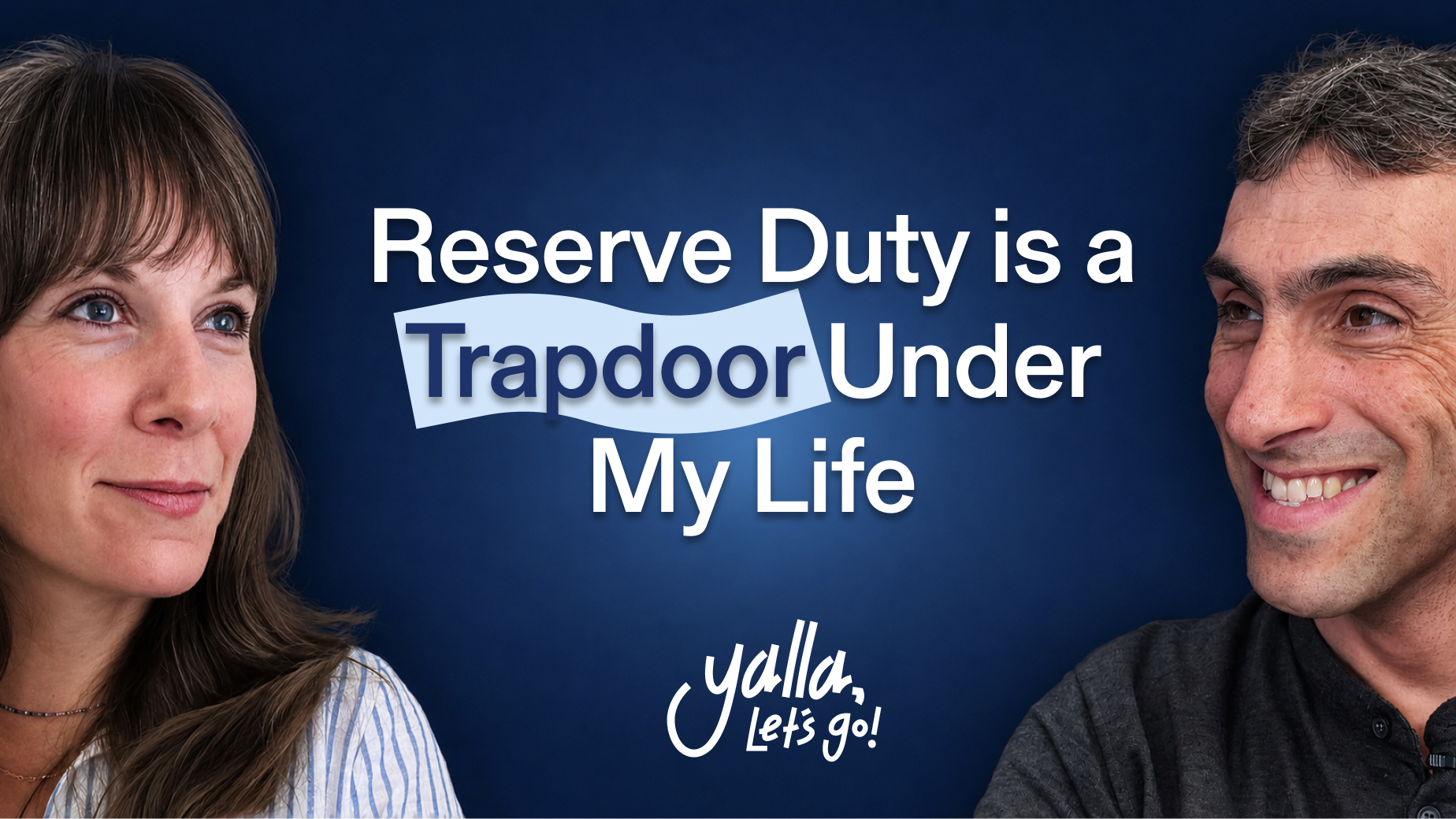
- Raising angel investment from the Gaza border while on reserve duty
- How guiding tech missions after October 7th led to her first investors
- Leaving VC and startups behind to become a founder herself
- Rejecting the “lost olah” identity and choosing to become fully Israeli
- Building chosen family and community as an immigrant without family in Israel
- Aliyah advice: learn Hebrew and seek out community beyond other olim
This is a conversation about grit, identity, and what it means to build both a life and a company in Israel, on your own terms.
Subscribe for more conversations with people who live, work, build, and stay in Israel.
#FayGoldstein #Bardin #Israel #Aliyah #IDF #TechInIsrael #StartupIsrael #October7 #OlahChadasha #JewishIdentity #YallaLetsGo #LifeInIsrael #WomenFounders #MakingAliyah #IsraeliTech
0:00 - Intro
0:55 - Meet Fay Goldstein: Bardin Co-Founder and CEO
2:42 - Life Story in 60 Seconds: 27 Houses and a Chabad Upbringing
4:01 - Why She Made Aliyah: Zionism Before Religion
6:32 - Talking Her Way Into the IDF at Age 28
8:24 - “You're a Liability”: The Exemption Letter From Yossi Matzliach
8:55 - Building Bardin: An AI Startup Born From ChatGPT
9:18 - Raising Money From the Gaza Border During Reserve Duty
11:42 - How Reserve Duty Led to Her First Angel Investors
12:10 - Leaving VC and Startups to Become a Founder
13:11 - Building Chosen Family and Community as an Olah
15:08 - Rejecting the “Lost Olah” Identity
18:25 - Aliyah Advice: Learn Hebrew and Find Real Community
20:30 - Rapid Fire: Chicken Kebabs, “Em,” and the Golan
[Fay Goldstein — 0:00]
He's like, "Okay, well, how old are you?" I was like, "Well, I'm 27 years old." And he's like, "No, no, sorry, you're a liability." And I show up and I'm 10 years older than every single other person in my unit — so older than the commanders. And that was my start of the military here in Israel.
[Erica Marom — 0:16]
You were raising money for this company after October 7th, while you were actually serving in reserve duty back in the IDF. Can you talk a little bit about what it's been like to build a startup in this kind of environment?
[Fay Goldstein — 0:28]
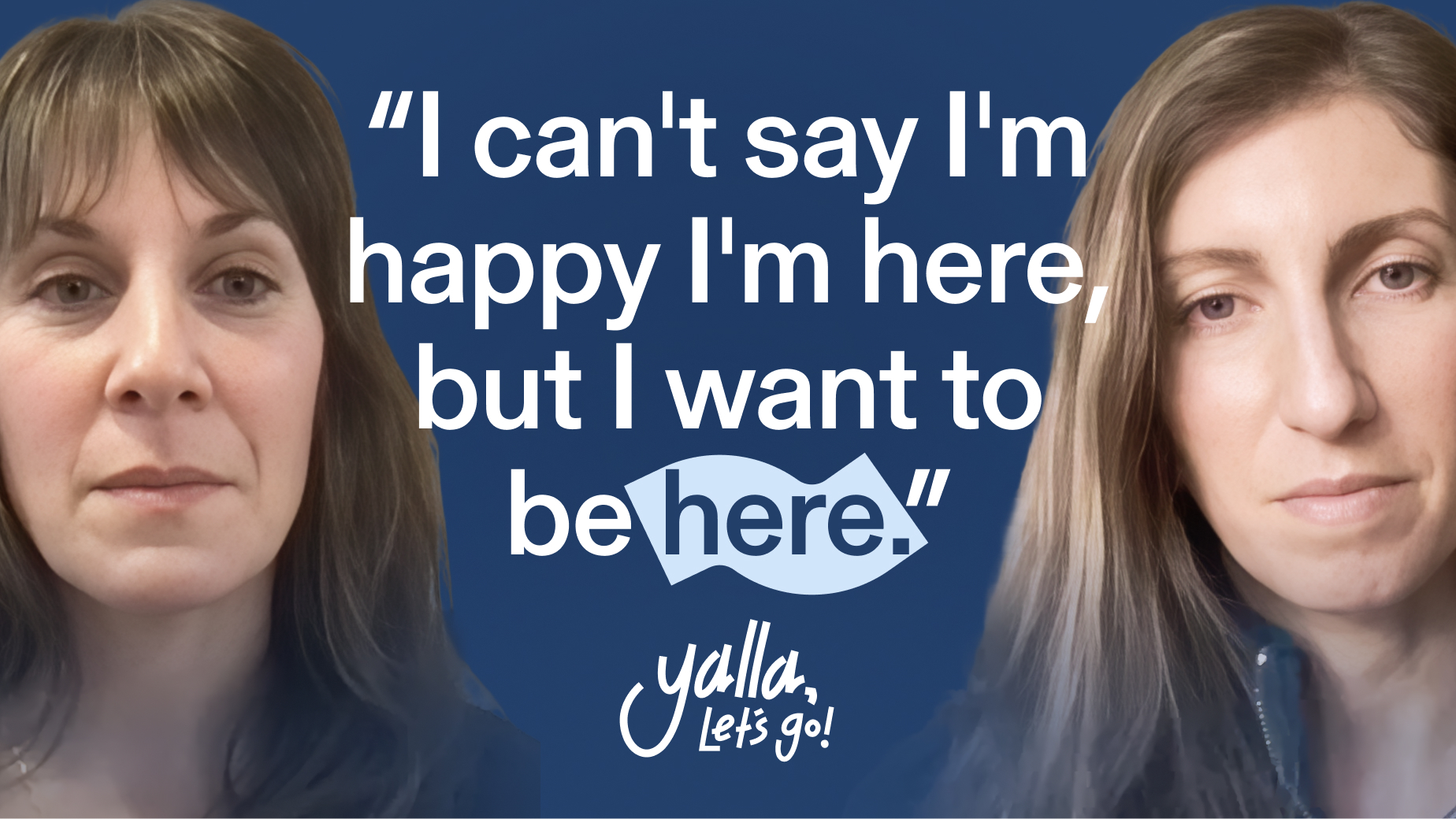
I still believe that if you want to make it in this country, you need to learn Hebrew. You need to not make excuses why you're not learning Hebrew. I moved to Israel for the Israelis. I didn't leave New York so I could be surrounded by New Yorkers. Why did I choose to move here? To be an Israeli, not to be an American living in Israel.
[Abbey Onn — 0:55]
Welcome back to Yalla, Let's Go! — the podcast that Erica and I started to remind ourselves, and hopefully some of you, why we made aliyah [immigration to Israel] and why we are building our lives in Israel. The podcast is a conversation with a ton of different people — chefs, athletes, people that work in tech, journalists, you name it — to learn about why they made the decision, what's keeping them here, and what the challenges are. We're super excited to jump into a conversation today with Fay Goldstein, the co-founder and CEO of Bardin, an AI company that she's going to tell us more about. But before we jump in with Fay, Erica, pulse check. How is it to live in Israel right now?
[Erica Marom — 1:35]
So I had a really interesting conversation with my 10-year-old yesterday. He's in a play for Memorial Day, and he's practicing his lines, and the whole school is going to be there to watch. And he's so proud of this part that he has, playing a fallen soldier. And he said to me, "When you were growing up in America, mommy, did you also have plays about Israel?" And I was like, "No." He's like, "Well, what were your plays about?" And I was like, "Well, we had plays about Thanksgiving or the Pilgrims, maybe holidays, but we didn't have any plays about Israel." It just wasn't a part of the narrative or the conversation, even in our Jewish community where I grew up. And it just made me feel for a moment how even growing up Jewish in America, in a Jewish community, there's still such a disconnect. And it made me feel for him — so happy that I'm actually raising my kids here, and that they're really part of the fiber of every aspect of this country and what's going on. And they're so connected to it.
[Abbey Onn — 2:37]
Yeah. Even in the hardest moment.
[Erica Marom — 2:39]
Even in the hardest moments.
[Abbey Onn — 2:42]
Okay. Excited to welcome Fay, who is an olah [female immigrant to Israel] from the United States, a dear friend, and a founder. I want to ask you to tell us about you — we'd love to hear your life story in less than a minute.
[Fay Goldstein — 2:54]
All right, I'm on the clicker, on the clock. All right. So I was born in New York, moved to Pennsylvania, moved to Iowa, moved to Minnesota, moved to Boca, moved to Florida, and Miami. I think in total I've lived in 27 different houses — not including the multiple apartments I've lived in here in Tel Aviv, which I still am unsure of what the length of time is you have to live in a place in order to call it your permanent dwelling, in a sense.
[Abbey Onn — 3:17]
Right.
[Fay Goldstein — 3:18]
I grew up religious. My family's Chabad. My parents were teachers in Jewish day schools. They just wandered to different places that needed early-education teachers. And then we finally settled mostly in Florida. So I guess my primary growing up happened starting at around — I think 11 was when I stayed in the same place. So all of those places and those moves happened earlier on. Every summer came to Israel, every winter with students came to Israel. Decided it was time for me to move to Israel. Made aliyah at the age of 27, joined the military at the age of 28, finished my service, decided to leave the world of politics, joined the world of tech, worked in a startup, worked in a VC, decided I needed to be a founder. And here I am now, 35 years later.
[Erica Marom — 4:01]
So why did you decide to make aliyah?
[Fay Goldstein — 4:04]
I think it comes from two different places. Number one, really, Zionism — because I grew up religious, my first relationship with Israel was through — obviously, this is my homeland. This is the place that I have all these histories, like the stories of Tanakh [the Hebrew Bible] that I grew up learning about. I felt them come alive here, very much so. And that was my first relationship with Israel. I had spent a year here in midrasha [religious seminary], an all-girls religious seminary after high school. And that was when I realized actually my relationship with Israel wasn't necessarily through the religious lens. It was through the parties I would sneak out of seminary to go to, at that point. It was the beach in Tel Aviv that I would also sneak out to go to. And it was very much the life — the fact that Judaism here wasn't just biblical stories, it was really the existence. And I really had that shift, which is at the same time I started becoming less rigid with my religiosity. And this is maybe not the greatest thing to say, but I found a replacement almost — my religious identity became a Zionist identity, in a sense, and my connection to Jewish history became about peoplehood and nationality and nationalism, almost, in a sense. And so I studied for the year, and then, honestly, had a full scholarship back in the States. I had no money whatsoever, so moved back to the States, promising myself one day I'd have enough money, enough connections, enough power, and enough ability to move here that I would stick it out. And then 10 years later I picked up and I moved here. And I think — sometimes, about two years ago, I would have said I never looked back. I think now it's an interesting question, especially as a founder, of the role Israel plays as part of building a company. And I'm actually debating this really internally. It's a huge internal debate, because there's a level of shame almost when I'm thinking to myself I might have to relocate, like every Israeli does, for three years to build Bardin to the next level. And it's interesting, because I know as an olah, so much of my identity is: I picked up and I moved here, and I broke all those boundaries, and I built a life here, and I succeeded in my life here. It's almost now the struggle of being a regular Israeli — meaning I could pick up and relocate for three years to New York to live the Israeli-founder lifestyle there for a little bit. It's a very interesting debate I'm having with myself right now.
[Abbey Onn — 6:32]
I want to ask you a different question, because in the very packed 60 seconds you talked about moving here and joining the military at 28.
[Fay Goldstein — 6:40]
Yeah.
[Abbey Onn — 6:41]
Can you talk to me about why you decided that that was a critical part of your journey? And it's not an easy thing to do, to convince them at 28 years old to let you draft even. So can you talk a little bit about that process?
[Fay Goldstein — 6:52]
So I was a managing director of a nonprofit back in New York that dealt with Israel-related things. And I had enough friends in the consulate there that I got a message from one of them saying, "I know you wanted to move to Israel, you were thinking of trying to figure out ways to get into the military when you moved there. By the way, this guy named Yossi Matzliach, who is mefaked meitav — meaning, he's the head of all of the recruitment office — is coming to the consulate here in New York for three days. His core focus here is to give a ptor [exemption from military service] to all the Israelis that are in New York that don't want to serve, or that want to stay there and delay their recruitment. I can get you a meeting with him, because I know you want to try to figure out how you can get in." So I show up in this office, and there's this general there, right, sitting there, and I say, "I want to draft." He's like, "Okay, well, tell me a little about yourself." And I told him about myself. "Sounds good." He's like, "Okay, well, how old are you?" I was like, "Well, I'm 27 years old." And he's like, "No, sorry — really nice, you want to do this? You're a liability." And I was like, "What are you talking about? I am the best thing you're going to have. I mean, I worked in politics. I'm fluent engaging with international media. The IDF needs somebody like me. Here's my CV. Your rules are stupid, because I'm not about to go be a combat soldier." And he was like, "I wouldn't use the word stupid" — this is what he said — "I wouldn't use the word stupid, think of another term to use. But let me think about it." A month later, I get from his assistant a letter — a handwritten letter signed by Yossi Matzliach — that says, "When Fay makes aliyah, lo meshaneh [it doesn't matter], no matter her age, she can draft into the IDF."
[Erica Marom — 8:24]
Wow.
[Fay Goldstein — 8:25]
I got my stuff, showed up to the Bakum [IDF induction base], and I am 10 years older than every single other person in my unit — so older than the commanders I was with. And that was my start of the military here in Israel.
[Erica Marom — 8:39]
Wow.
[Abbey Onn — 8:40]
It's like an entire other universe.
[Fay Goldstein — 8:42]
Yeah, yeah. It's weird when you have to raise your hand to go use the restroom, or if in the middle of the night you need to go do something, you just can't do it.
[Erica Marom — 8:49]
Yeah.
[Fay Goldstein — 8:50]
Worth it. Every part of it was worth it.
[Abbey Onn — 8:53]
Wow.
[Fay Goldstein — 8:54]
Yeah.
[Erica Marom — 8:55]
Let's talk a little bit about Bardin. So you founded this company. The last couple of years that you've been building this company has been also while this country has been at war. You were raising money for this company after October 7th, while you were actually serving in reserve duty back in the IDF. Can you talk a little bit about what it's been like to build a startup in this kind of environment?
[Fay Goldstein — 9:18]
I think that actually serving in the reserves has helped my startup succeed in more ways than one, looking back at it. I remember my first angel investor meeting — truly, the meeting. I had posted a LinkedIn post talking about how difficult it was to really raise money, to do it all. Because essentially I was leaving at 6am to go down south to lead the journalists through the horrors of October 7th, getting back up at around 10pm at night. I didn't want to stay in the bases down there, I would go back home and have my meetings — as many as I could between those hours that I was able to function. And there was one point that I kept on having to push up a meeting, and it was actually the day of the second hatufim [hostages] exchange, where they were supposed to do the exchange earlier in the day and Hamas kept on pushing it off, pushing it off. So that meant that while I was supposed to be home at that point by 10pm to have my investor meetings, I was actually still down south with the journalists at the crossing, and it kept on pushing off. And I said, "You know what? This is a potential." I had already built a relationship with this person who had connected with me because he saw this post, and I'm sitting there in the car down south on the border in my uniform, having the Zoom conversation with a, at that point, still-potential angel investor, trying to explain to him what my vision was, what we wanted to do. And he was the first person that believed in me. And I think a lot of it came to fruition because I was public about the difficulties, I was public about wanting support, I was public about my pride in doing both of the things at the same time. And that also led to me — while my core focus was journalists, I also spent a lot of time bringing around tech missions, in the end, because I had this multiple identity of being spokesperson but also a founder, also having worked in VC. And so a few missions I did were tech executives and VC executives that had come down that needed someone to explain what was going on. And that ended up at the Israel tech mission. So shout out really to them, to David Siegel, who was a first believer, ended up really, really connecting me to so many incredible people. And I would say that a very large majority of my angel investors today are people that I've met because of that mission, because of the people I had the opportunity to guide while in miluim [reserve duty].
[Erica Marom — 11:42]
So actually your reserve duty, in the end, kind of helped you in a way, building your company.
[Fay Goldstein — 11:48]
Very much so.
[Abbey Onn — 11:49]
It's amazing. We hear often from investors that they invest in the person rather than the product. And I think this is a great example of investing in both.
[Fay Goldstein — 11:57]
Oh yeah — if they invested in the product, they'd be screwed, because we've changed, we've pivoted so much. Now we're in a sweet spot, in the right time, in the right place, and we're exactly where we need to be. But it's been a journey.
[Erica Marom — 12:10]
So what made you want to — you had said that you worked in startups and you worked in VC, which actually is when we met. What made you want to leave that world and go build something yourself?
[Fay Goldstein — 12:20]
November 2022, when I got my hands on ChatGPT — it was really just kind of an aha moment. That, and I also was, truly, to be blunt, never that great of an employee. I always too datani [opinionated], I always had my own opinion, very opinionated about the way things should be done. And I also realized I needed to be my own boss in many more ways than just wanting to succeed in things. I needed to be the one to really determine my own destiny. And I think that's something that has brought me through life in general — I needed to be the one that decided how I wanted my life to look, and what I wanted to do, and how I wanted to do it, and that I was the one that could determine my success or failures, and no one else.
[Abbey Onn — 13:11]
I want to transition a little bit into the personal side of building life in this country. You are someone who builds community really beautifully. You're not only part of Nevo, which I'm grateful for, but you're also someone who builds community of women in a really lovely way. So can you talk about how you made the decision to do that, and how that is paying it forward for you?
[Fay Goldstein — 13:37]
I think a lot of it has to do with the fact that when you don't have family here, you need to build family, in a sense, right? So when there are times when I don't have a holiday dinner or Shabbat dinner automatically entrenched — obviously I'm gonna go back home for this thing — you need to build those things here. And I also just think it's not fun doing it alone. It's not worth it. It's not even not fun or not worth it — you can't. There's so much in this country that you need to ask for help. There's so much that you need someone else who knows their uncle, who knows this, or the person that has the connections here that can do this. And there's already so many things that are stacked against the newcomers here, right? There's already so many things stacked against — the fact that it takes me five times longer to deal with my taxes, right? It takes me X amount of time longer to see if I'm being screwed over when I'm talking to the real estate agent. Those things. I need those people around me. I think we need each other in a way that is very much not obvious to Israelis, who have an already built-in, obvious ecosystem, in a sense. I needed to know the right people to get into the unit that I wanted to get into. It happened to be that I was able to find the olim [immigrants to Israel] that were in that unit, that knew what I was going through, that helped me pull in, that walked me through the navigation system, that explained things.
[Abbey Onn — 15:08]
One of the things — you and I have known each other for a number of years, and I run a community for olim. And when I first invited you to apply, or to consider it, you said, "It's not an identity that I like acknowledging. I prefer not to be known as an immigrant in this country. I've worked really hard to — not to be Israeli, but to be a part of Israel that is seamless." And you have embraced your olah identity more in recent years. And I'm just interested in hearing why you felt that way initially, and how you came to embrace it a little bit more.
[Fay Goldstein — 15:44]
I still think about it. I still believe that if you want to make it in this country, you need to work for it. You need to learn Hebrew. You need to not make excuses why you're not learning Hebrew, right? You need to do whatever you can to be part of this country — to be an active member of society, not an active outsider member of society — but to be very, very intentional about: what are you doing here, why am I here, and why did I choose to move here? To be an Israeli, not to be an American living in Israel. And for me, I felt, when I first moved here, all of the olim that I had met, or that I had heard of, or that I had seen, were these Facebook groups of everyone complaining about how hard life was here, and how they moved here but they don't know anything. And it was — I call it the Lost — I'm not going to say groups, but the Lost Girls of... right? And I just never identified that. I never identified as — I am not able to succeed if I choose to want to succeed. And so for me, when I moved here, an oleh was, like, "Oh, those cute little lost people that don't really know what they're doing." And I wanted to make sure I wasn't part of that. I didn't identify as that. I moved to Israel for the Israelis. I didn't leave New York so I could be surrounded by New Yorkers. I didn't leave Miami so I could go hang out with people that I would have hung out with in Miami. And so I had a very firm, "I don't want to be part of this. I want to speak Hebrew. I want to be involved in Israeli things." Unless you got into a deep, deep conversation with me, would you know that I was an olah? I wanted to sound, speak, think — I listened only to Israeli music, I watched Israeli TV shows — I wanted to be it. And then I think, as I became more confident in my abilities to live in both worlds at once, that I didn't need to replace one with the other, and the fact that my Israeliness stood for itself and my Americanness was power in and of itself — and the fact that, no matter what I do, Fay is not an Israeli name, so I gave myself away, really, in the first part of the conversation, in any case. But I realized the power it has. And I think even now, as a founder also, I have a power that Israeli founders don't have. I can walk into a conference and I can speak about American football Sunday, wish them happy Easter, without trying to forget about it or notice it. And I think there's a power in it. And I think once I was able to l'hashlim [come to terms with it] — to really feel confident in the fact that if I wanted to only be Israeli, I could only be Israeli — I was then able to re-embrace the fact that I was a successful olah, that was an Israeli, that had moved here from somewhere else. And I think there's a balance.
[Abbey Onn — 18:25]
So given all that you know at this point, and all that you're considering, what is one piece of advice you would give to someone considering aliyah — whether they're a founder or just a regular person considering this?
[Fay Goldstein — 18:37]
Learn Hebrew. Really learn Hebrew. Learn cultural nuances. Understand that your goal here is not to change society necessarily to be more American, but to bring those things, obviously, into the way you want to raise your family or the way you want to exist in this space. But don't battle becoming part of this place that you love. You love it for a reason, you love being here for a reason — embrace that, and work hard. It's not easy. It's not easy to learn a new language. It's not easy to make new friends. It's not easy to not have only Shabbat dinners with only your core circle of olim. Yesterday, actually, there was a Zikaron BaSalon [Memory in the Living Room — a grassroots Memorial Day remembrance gathering], right? And at first I messaged into the Nevo group and I was like, "Is anyone going to Zikaron BaSalon?" And then someone posted just the Zikaron BaSalon website. And I went to it, and I was intentional — I was like, "I don't want to find one in English, I want to find one in Hebrew." And there's so much going on in this country in community building that is not oleh community building, that I think we as olim forget that we have access to, that we can go to. So I went and I found a Zikaron BaSalon in Hebrew, because thank goodness I speak Hebrew. And it was a community I'd never even heard of, that I was never really part of. And I showed up at this community center and listened to incredible stories. And I think we forget about that, as olim, that there is a world here — we're in a country that has built ecosystems for communities. Just because it's not exactly your community, there are things that you can be involved in. And I suggest that people spend time seeking that out, making an effort to be part of it — because then you truly are a contributing part of this country, and not an outsider trying to make a change, but an insider trying to make a change. And it makes a big difference.
[Erica Marom — 20:30]
Okay, we're going to get into some rapid-fire questions.
[Abbey Onn — 20:33]
I'm ready. You ready?
[Abbey Onn — 20:34]
All right.
[Abbey Onn — 20:34]
Favorite Israeli food or snack?
[Fay Goldstein — 20:40]
Pargit al hashibud [chicken kebabs].
[Abbey Onn — 20:41]
Chicken on a kebab, yeah.
[Erica Marom — 20:42]
What's your favorite Israeli slang?
[Fay Goldstein — 20:45]
Em [um].
[Abbey Onn — 20:47]
I was about to say em. Favorite place in Israel?
[Fay Goldstein — 20:50]
I really love the north. I love the Golan.
[Erica Marom — 20:53]
What does Shabbat look like for you?
[Fay Goldstein — 20:54]
I always try to make kiddush [blessing over wine]. Some Shabbats are different. This Shabbat I'm going to a festival, so I'll probably sound silly, but I'll make kiddush randomly in between music sets. Sometimes it's with family of my partner, sometimes it's with friends — very different. I try to have different Shabbat experiences as often as I possibly can.
[Abbey Onn — 21:19]
What do you miss the most from home?
[Fay Goldstein — 21:20]
I miss the ease of being around my mom. Yeah. I just miss showing up and the quick access to unbounded love.
[Erica Marom — 21:31]
What's your only-in-Israel moment, in one sentence?
[Fay Goldstein — 21:34]
My friends called me sappy when I told them the story of my Israeli friends. I remember the first Hanukkah here, when I was driving the highway and I saw a big, huge, massive menorah on the highway. And all of the flags were Hanukkah-related flags. And they were our holidays. And the fact that it's our holidays — and the fact that on Pesach [Passover] you see the Coca-Cola and it says Pesach, and there's messages of our holidays, and on the buses it says Chag Sameach [happy holiday] — Israelis, I think this is something that, until they move to the States, don't understand: the brilliance and the beauty and the warmth of "this is my place, these are my holidays, these are the things I celebrate."
[Fay Goldstein — 22:21]
Right?
[Fay Goldstein — 22:21]
This is not me having to go and politely be part of someone else's culture — this is me. And I think we shouldn't take that for granted. And I think that's a really important part of continuing to find this level of Israel as a secular, proud, let's say, country, but also Jewish identity. And I don't want to get too deep into this, but this is such a core part of why we have an opportunity to thrive here — the chag sameach, it's those small, subtle things: the menorah on the highway and the flags of the holidays. And I think it's beautiful. Only in Israel.
[Abbey Onn — 23:01]
Thank you, Fay. Thank you so much for joining us. We're so grateful.
[Fay Goldstein — 23:05]
My pleasure.
[Erica Marom — 23:06]
Thank you. Thank you so much for listening. And if you enjoyed this podcast, please share with everyone you know.

Follow Fay on Linkedin
Subscribe to Yalla, Let’s Go
Learn more about Aleph
Sign up for Aleph’s monthly email newsletter
Subscribe to our YouTube channel
Follow us on Instagram
Follow us on TikTok
Follow Aleph on Twitter
Follow Aleph on LinkedIn
Follow Aleph on Instagram
Hosts: Erica Marom, Abbey Onn
Executive Producer: Sarah Bard
Producer: Sofi Levak, Dalit Merenfeld, Myron Shneider
Video and Editing: Nadav Elovic
Music and Creative Direction: Uri Ar
Content and Editorial: Jackie Goldberg
Design: Nimrod Sapir
Follow Fay on Linkedin
Subscribe to Yalla, Let’s Go
Learn more about Aleph
Sign up for Aleph’s monthly email newsletter
Subscribe to our YouTube channel
Follow us on Instagram
Follow us on TikTok
Follow Aleph on Twitter
Follow Aleph on LinkedIn
Follow Aleph on Instagram
Hosts: Erica Marom, Abbey Onn
Executive Producer: Sarah Bard
Producer: Sofi Levak, Dalit Merenfeld, Myron Shneider
Video and Editing: Nadav Elovic
Music and Creative Direction: Uri Ar
Content and Editorial: Jackie Goldberg
Design: Nimrod Sapir
Follow Fay on Linkedin
Subscribe to Yalla, Let’s Go
Learn more about Aleph
Sign up for Aleph’s monthly email newsletter
Subscribe to our YouTube channel
Follow us on Instagram
Follow us on TikTok
Follow Aleph on Twitter
Follow Aleph on LinkedIn
Follow Aleph on Instagram
Hosts: Erica Marom, Abbey Onn
Executive Producer: Sarah Bard
Producer: Sofi Levak, Dalit Merenfeld, Myron Shneider
Video and Editing: Nadav Elovic
Music and Creative Direction: Uri Ar
Content and Editorial: Jackie Goldberg
Design: Nimrod Sapir
.jpg)
.jpg)
.jpg)
.jpg)
.jpg)
.jpg)
.jpg)
.jpg)















.jpg)
.jpg)
.jpg)
.jpg)
.jpg)
.jpg)
.jpg)
.jpg)
.jpg)
.jpg)