The Great AI Debate


How can values create value? On this podcast, Michael Eisenberg talks with business leaders and venture capitalists to explore the values and purpose behind their businesses, the impact technology can have on humanity, and the humanity behind digitization.




The Great AI Debate
The Great AI Debate
The Great AI Debate
.jpg)
The Great AI Debate
The Great AI Debate
On this special episode of Invested, Michael Eisenberg pulls together the sharpest AI arguments from the last year of the show and puts them in conversation with one another. You'll hear from Gavin Baker, Sarah Tavel, Micha Kaufman, Elad Raz, Eran Shir, Zach Greenberger and David Magerman - seven investors and founders who disagree about almost everything except the stakes.
This is not a group of people arguing over the same set of facts. Because the field is moving so quickly, each of them is describing a different epoch of AI. Compute was supposed to depreciate quickly - instead, demand is growing. Inference wasn't supposed to be profitable - today it is wildly profitable. AI was supposed to be a game for frontier labs only - open source models are now competing with them. And AI was supposed to trigger mass unemployment - the latest numbers suggest the companies going all in on AI are hiring more people, not fewer.
From David Magerman calling the financial bubble 10 to 50 times the size of the internet bubble, to Gavin Baker walking through the ROI math on trillions of dollars of GPU spend, to Micha Kaufman arguing that AI gives everyone the same superpowers and therefore gives no one an advantage, to Elad Raz on why the age of compute has replaced the age of energy - this is a fast, honest map of where the debate actually stands.
They discuss:
- Whether AI is a financial bubble - and whether that even matters
- The $200 billion, $600 billion and now trillion-dollar ROI question on GPU spending
- What actually improved (and what didn't) between Hopper, Blackwell and Rubin
- Why inference is gross-margin profitable while model training amortization isn't pretty
- The employment debate: replacement, augmentation or temporary dislocation
- What AI does to junior work, mentorship and the pipeline of senior engineers
- Scaling agent capital instead of human capital - and paying developers to spend tokens
- Why building a "bridge" the labs will bulldoze is a treacherous strategy
- Why data and information theory still beat throwing everything into an LLM
- The unknowable economic returns to superintelligence
- Why the world moved from fighting over food, to energy, to compute
Featured in this episode:
Gavin Baker is the Managing Partner and Chief Investment Officer of Atreides Management, LP. Prior to founding Atreides in 2019, Gavin was at Fidelity Investments from 1999 to 2017, most recently as the portfolio manager of the Fidelity OTC Portfolio.
Sarah Tavel is a Venture Partner at Benchmark, where she invests in network effect businesses and applications leveraging AI. She was the first female General Partner in Benchmark's history. Prior to Benchmark, Sarah was a General Partner at Greylock Partners, and she joined Pinterest in 2012 after co-leading the Series A investment while at Bessemer Venture Partners.
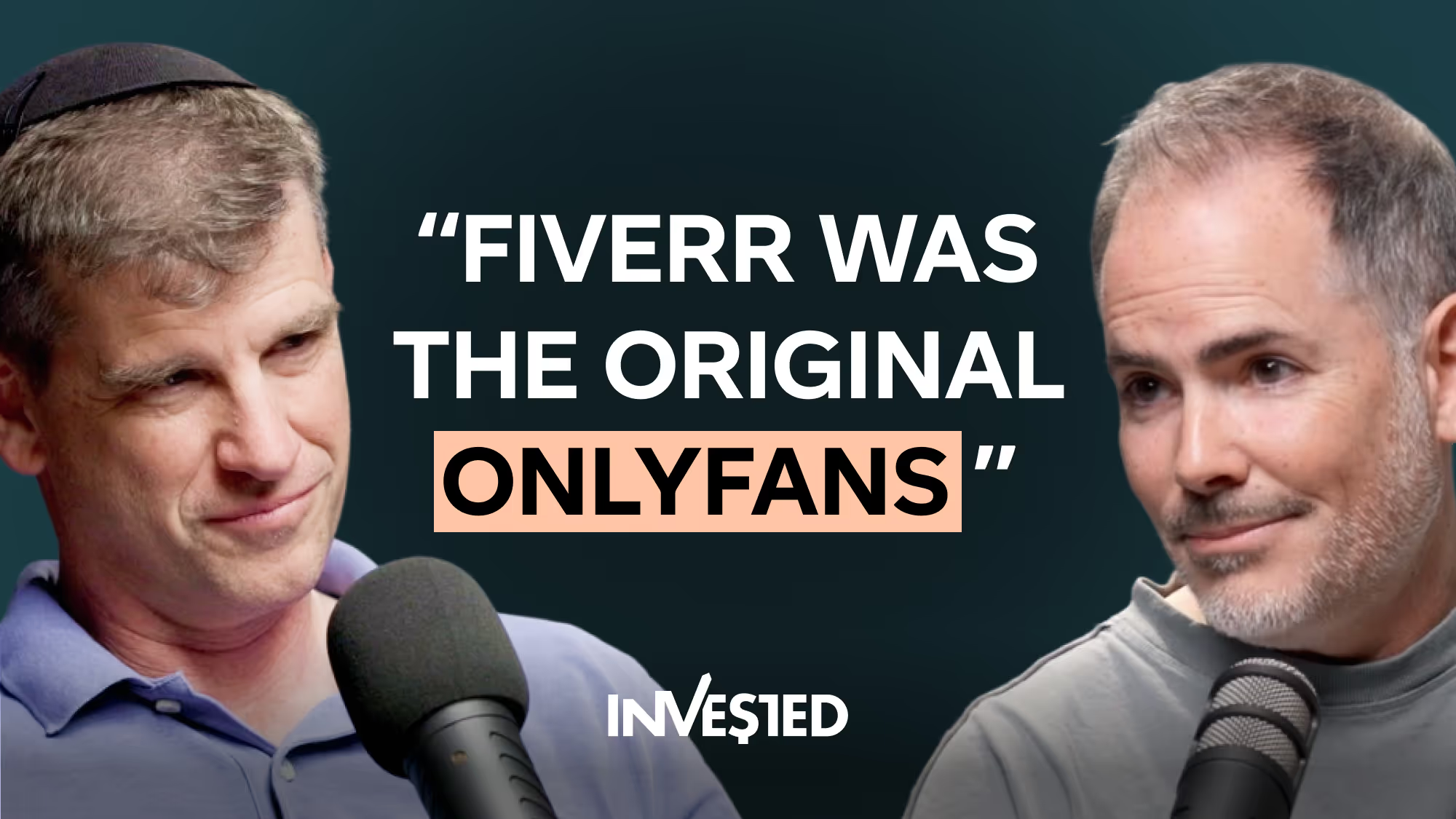
Micha Kaufman is the founder and CEO of Fiverr, the global freelance marketplace that helped define the gig economy. Since launching the platform in 2010, Micha has led Fiverr from a scrappy, bootstrapped startup into a publicly traded company offering millions of services across hundreds of categories.
Elad Raz is the Founder and CEO of NextSilicon, a deep-tech company redefining high-performance computing and AI infrastructure. A graduate of the IDF's elite Unit 8200, Elad brings more than 20 years of experience in technology, entrepreneurship and executive leadership.
Eran Shir is the Co-Founder, CPO & Chairman at Nexar. He is a serial entrepreneur and investor, and previously served as Entrepreneur in Residence at Aleph. Zach Greenberger is the CEO of Nexar, leading the company's mission to build AI for the physical world using real-world driving data. Prior to Nexar, Zach served as Chief Business Officer at Lyft and held leadership roles at Tesla. Since their episode aired, Nexar and Nauto have agreed to merge, with Zach leading the combined company.
David Magerman is a co-founder and Managing Partner at Differential Ventures, a New York-based venture capital fund investing in deep technology companies that help power the data-driven economy. Previously, he spent the entirety of his career at Renaissance Technologies, widely recognized as the world's most successful quantitative hedge fund management company.
If you want a clear-eyed view of the bull case, the bubble case, the labor case and the compute case - all in one sitting - this compilation is essential listening. Michael's hope is that you finish it with more questions than answers, and that you go deeper on the full episodes.
Please rate this episode 5 stars wherever you stream your podcasts!
00:00 - "AI Is a Machine Gun We're Giving Children"
00:43 - Same Topic, Different Epochs
02:10 - How Wrong We All Were a Year Ago
03:12 - A Bubble 10 to 50x the Internet Bubble
03:46 - "OpenAI Isn't a Functioning Business"
03:58 - Hopper to Blackwell: Linear Scaling
04:31 - The Trillion-Dollar ROI Question
05:23 - "I've Never Seen Anything Like This"
06:13 - The Great Employment Debate
07:08 - It's Still the First Inning
07:33 - The Illusion of AI Superpowers
08:51 - Replacing Labor or Augmenting It?
09:13 - What AI Does to Junior Work
09:30 - Scaling Agent Capital, Not Headcount
10:28 - $300 a Day in Tokens Per Developer
12:01 - "We're Going to Bulldoze You"
13:15 - Data Beats Throwing It All Into an LLM
14:12 - Food, Then Energy, Now Compute
14:36 - The Unknowable Returns to Superintelligence
15:22 - More Questions Than Answers
David Magerman — 0:00
AI is an automatic machine gun.
Michael Eisenberg — 0:02
Right?
David Magerman — 0:02
And we're giving it to children.
Gavin Baker — 0:04
I think we will have artificial superintelligence in 10 years. And by that, I mean an AI that is smarter than the smartest human in every discipline.
Elad Raz — 0:14
Building an AI accelerator just to run transformers is the dumbest idea ever.
Sarah Tavel — 0:18
If your startup assumes that LLMs are going to stand still, we're going to bulldoze you.
Eran Shir — 0:25
The only way to deal with AI is AI.
Micha Kaufman — 0:28
What was considered to be hard is going to be the new simple. And what was considered to be almost impossible is going to be the new hard.
Michael Eisenberg — 0:43
Over the last year, we've done a number of episodes that have touched on the topic of AI, artificial intelligence. You might think when you watch this compilation that these are the same facts, but things are moving so quickly in this era of AI that the different people speaking in this video are actually talking about different epochs in the great debate on AI.
Michael Eisenberg — 1:05
You'll hear on this compilation from the great Gavin Baker, who has certainly been bullish. Not only has he been bullish, when the market went down in July, he flew out to Silicon Valley to see whether he was missing something. And he thinks he's not. In fact, he thinks he's underestimated just how powerful this AI trend is. You'll hear from Sarah Tavel, I interviewed a while ago, Micha Kaufman at Fiverr, whose stock has been decimated by the AI narrative out there. You'll hear from Elad Raz claiming he's gonna take on NVIDIA. You'll hear from Eran Shir and Zach Greenberger of Nexar, that has since merged with Nauto to create the greatest data lake outside of Tesla, and model of the physical world outside of what Tesla is building.
Michael Eisenberg — 1:48
And you'll also hear from David Magerman, who I would say said AI has been here a long time and all this is a giant bubble. Well, we might be in a bubble, and we might also be in the largest transformation of our lives of the last hundred years. And we're only going to know in 10 years where we are in this long process of artificial intelligence.
Michael Eisenberg — 2:10
There's so much out there. This is such a rich topic that's moving so fast. We need to remind ourselves how many of our assumptions not long ago were incorrect. There have been a small number of great investors that have figured out where the puck is going, as the great hockey player Wayne Gretzky once said.
Michael Eisenberg — 2:29
And so I really want you to listen to this, to realize how far we've come in what's going on in artificial intelligence, how so many people were wrong that compute would depreciate quickly. In fact, it's growing. How wrong so many people were that inference couldn't be profitable. It's wildly profitable right now. How little we understood a year ago about the difference between training and inference. How much we thought that this was going to be a game for only frontier labs. And here we are with open source models competing with the frontier labs. So much is changing in this world every day that it's literally hard to compute.
David Magerman — 3:12
The scale of the bubble, the financial bubble. I would say that the bubble that exists today is probably a factor of 10 to 50 of what the Internet bubble was. But the problem is it's monopoly money. It's these like 10 companies giving each other billions of dollars. When you buy $10 billion worth of computers from NVIDIA and you invest in NVIDIA, you're basically just paying yourself for equipment, and so you can overpay yourself. And it all kind of cancels out. If it's costing the company that's doing the inferencing $10, eventually they have to charge 15.
David Magerman — 3:46
OpenAI isn't a functioning business. It's not. I mean, the business model is so demonstrably a Ponzi scheme that I don't know when it ends.
Elad Raz — 3:58
Take the core compute of Blackwell, core compute of Hopper. You compare them one by one. You see Blackwell is 2x than Hopper. Great. It also consumes 2x more power.
Elad Raz — 4:11
Nothing in the architecture had been improved between Hopper and Blackwell. NVLink for sure. You know, other nuances. But that's like their core. Hopper to Rubin, almost 2x more power, 2x more performance. This is.
Michael Eisenberg — 4:28
Linear scaling.
Gavin Baker — 4:31
All of the biggest spenders on GPUs, with the exception of xAI, are public companies. And public companies report something called quarterly financials. And you can use those documents to calculate something called return on invested capital. It's really easy to do. And to date, the ROI on all of this spending has been strongly positive, to be good.
Gavin Baker — 4:53
So while the answer to the $200 billion question was yes, the ROI was awesome, the answer to the $600 billion question was yes, the ROI has been awesome. Now we're at the trillion dollar question and the ROI has actually still been good. We're rapidly heading for 2 to 3 trillion. And will the ROI continue to be good? Unknown. And if it's not, do economics dictate or does the prisoner's dilemma dictate and the companies could keep spending?
Sarah Tavel — 5:23
I started at Bessemer in 2006. I've never seen anything like this. You know, SaaS was incredible, mobile was incredible. But this just feels very different. If the technology froze today, there's still so much impact that we're going to see that it's just incredibly exciting.
Sarah Tavel — 5:42
Of course, there's the variable inference costs and that, you know, for many of the labs, is gross margin profitable. But then there's the amortizing, the cost of the model training, and that's where the numbers don't look as pretty for these firms. But should, over time, be okay? At least that's the belief.
Michael Eisenberg — 6:01
That was the argument about whether we're in a bubble. And by the way, you could be in a bubble and still there could be incredible economic value created by the small number of companies that survive the bubble. The bubble is just an investment.
Michael Eisenberg — 6:13
You've, of course, read and heard about the great debate on employment. Everybody thought AI was going to create mass unemployment. Well, the latest numbers show that actually AI is increasing employment. Those companies that are all in on AI are actually hiring more people and they're becoming more productive. So what is it? Will it create mass unemployment? Is it just a shift in employment with, let's say, some interim dislocation? Or is it going to create more employment like every other technological revolution in the past? The answer is we don't know.
Michael Eisenberg — 6:48
What's important when being an investor and listening to a podcast called Invested is whether the people bet their convictions, whether you're willing to bet your convictions, whether willing to invest confidently in what you believe about the future of this transformational technology that will touch every part of the economy and every country on planet Earth.
Michael Eisenberg — 7:08
And the most interesting thing is, it's the early innings. It's literally the first inning of AI. There's maybe, maybe a couple of million people around the world using AI at the bleeding edge. Maybe a couple of million people. There's 8 billion people in the world. There is a long way for this revolution to run.
Micha Kaufman — 7:33
AI is creating an illusion for most people because it makes us better, it makes us more productive. And you think that you're gaining these superpowers as a human being. It makes you more confident and you can do more stuff.
Micha Kaufman — 7:52
Yes, but it's giving the same power to everyone else, which means that it doesn't give any power to anyone.
Micha Kaufman — 7:59
I'll help anyone who helps themselves, but if you look for me to educate you about AI, you're doomed. You're done. You're done. And your problem is, you're not done at Fiverr. You're done, period.
Micha Kaufman — 8:14
There will be no demand for lazy people that expect the world or think that the world owes them anything.
Sarah Tavel — 8:23
The economic value proposition, we haven't seen anything like it maybe since virtualization. All this software as a service, that has always been this squishier "I'm going to improve the productivity of your existing employees." And how much more? 10%, 20%?
Sarah Tavel — 8:43
Now with AI, it is not even close how compelling the value proposition is, how clear it is.
Gavin Baker — 8:51
But in a world of AI, fundamentally, the economic return, a lot of it will come from either replacing or augmenting humans with GPUs. Labor replacement or augmentation. The maximalists, I think for sure, would say labor replacement. So I think that's a fair way to calculate it.
David Magerman — 9:13
The best we can hope for, I think, from these tools is replacing junior level work. And the way that you get senior people, the promotion, the mentorship, the ability to create a mature workforce is going to be severely stunted by the use of AI.
Zach Greenberger — 9:30
You know, everyone talks about resources in terms of people, but resources are now being talked about in terms of agents. So you don't necessarily need to scale your human capital. You can scale your agent capital. So we have agents running across the entire company that are doing everything from product design to product deployment to creative.
Michael Eisenberg — 9:52
You're bonusing people to rack up token bills on Claude Code?
Zach Greenberger — 9:56
Yes. Yeah, correct.
Eran Shir — 9:58
Crazy, right?
Michael Eisenberg — 9:58
So the incentive is to create as much code as possible, whether it works or not.
Zach Greenberger — 10:04
Well, phase one.
Eran Shir — 10:07
That's phase one.
Elad Raz — 10:08
We literally see people getting 10x more productivity using those tools.
Michael Eisenberg — 10:13
Have you mandated that everyone needs to use—
Elad Raz — 10:17
Absolutely.
Michael Eisenberg — 10:17
AI coding?
Elad Raz — 10:18
Of course. I mean, a company that don't have the leaderboard scores of how many tokens is being used is.
Michael Eisenberg — 10:26
The more the merrier.
Elad Raz — 10:28
Of course.
Michael Eisenberg — 10:28
How big is your token budget now?
Elad Raz — 10:31
Depends. Like, we are using everything. Me personally, I'm using Gemini, Codex and Claude. We have people that generate $300 a day, $100 a day per developer.
Micha Kaufman — 10:45
Ideally, I want everyone to automate 100% of what you're doing. And people looked at me and said, "So why would you need me?" And I said, great, because now you have 100% of your time free to do interesting stuff, things that machines cannot do. Yet.
Michael Eisenberg — 11:01
If you're interested in finding out ahead of time what's going on in Israeli tech, what the latest trends are, who's breaking not only news, but breaking the trend lines, then you want to subscribe to Aleph's newsletter and you can sign up right in the show notes in the description of the show. Please subscribe to the newsletter.
Michael Eisenberg — 11:20
Yet one of the disagreements or arguments that people lose sleep over is who will AI pay off for? Not if it will pay off, but for who, because there's a lot of dollars at stake. The question I'm sure you're all asking yourself, and I ask myself, is what's going to happen next?
Michael Eisenberg — 11:40
But you think the world's going to change a lot in the next nine years.
Eran Shir — 11:45
Yeah.
Michael Eisenberg — 11:45
Even though over the last nine years it looked the same.
Eran Shir — 11:48
Yeah. Because we are not, we're really bad at understanding exponents, right? And this is this kind of inflection point where things will get compounded and get, you know, crazier and crazier from here on out.
Sarah Tavel — 12:01
Sam Altman, in a podcast I think it was with Harry Stebbings, said, "If your startup assumes that LLMs are going to stand still right now, we're going to bulldoze you."
Sarah Tavel — 12:16
And I think the biggest mistake that I see people make is either they're building something that isn't a beneficiary of the kind of continued and astounding march forward with the power of these large language models. And also if you are building something and then it's like a bridge, because you're assuming that the LLMs or whatever the labs are doing isn't going to progress forward and you're going to outrun them, that feels like a very treacherous game to play.
Micha Kaufman — 12:57
It's cheaper to do it by hand. It's still going to be manual work. And if it's not, it's going to be replaced by technology. The types of repetitive stuff that even machines cannot do and still require human are just going to change. They're not going to go away.
David Magerman — 13:15
The driving force here is data. And it's not just data, it's information. And so just because you have data doesn't mean you have a solution. And if you have data that has information in it, from an information theory perspective, there are dozens of mathematical algorithms and pattern recognition algorithms that can pull that information out and help you reduce uncertainty about the future.
David Magerman — 13:38
So we've become a one trick pony where everything is just thrown into an LLM. I think success is looking at the data sets that you have, figuring out how much information you have and which information that you have is relevant to solving a real world problem, and then finding the right tool at the right level of complexity and cost to extract that information.
Michael Eisenberg — 14:00
What do you think that means, you know, not just financially, but philosophically about the world, where this notion of silicon can become the most valuable thing in human civilization?
Elad Raz — 14:12
No surprise there. I mean, think about it for a second. When 1,000 years ago, we all were fighting around food, okay? That's the basic element that everyone needs. Food, water, resources. I think that around 300, 200 years ago, it was around energy resources. That's most of the world. Now we are in the age of compute.
Gavin Baker — 14:36
But I think one of the most interesting parts of all of this is we don't know what the economic returns to superintelligence will be, definitionally, because we have never seen it. And if humans, we have pushed the limits with, you know, people like Albert Einstein or whoever else, pushed the limits of the natural laws of the universe, if we push the limits of physics and biology and chemistry and the math that underpins all of it, then the economic returns to superintelligence, they may not be that high.
Gavin Baker — 15:08
On the other hand, if we haven't, and superintelligences are curing cancer, inventing warp drives, and we're colonizing multiple solar systems, the returns to superintelligence are going to be really high. But it's very unknowable.
Michael Eisenberg — 15:22
Thank you for listening to this special episode of Invested. I hope you're left with more questions than answers. I hope you'll continue to deep dive and really try to understand, to the extent we can, where AI is going, what's it going to impact? How do you invest in it successfully? And I hope this will be a smorgasbord of opinions that you can choose from and at the same time, just an appetizer, and you'll choose to go deeper.
Michael Eisenberg — 15:48
Thank you so much for tuning in to this special summer edition of Invested. If you enjoyed the podcast, please rate us five stars on Spotify and on Apple Podcasts or wherever it is that you listen to our podcast. Please subscribe to our YouTube channel and please, please, please subscribe to our newsletter. That way you'll get the episodes before everybody.

Watch the full episode with Gavin Baker
Watch the full episode with Sarah Tavel
Watch the full episode with Micha Kaufman
Watch the full episode with Elad Raz
Watch the full episode with Eran Shir & Zach Greenberger
Watch the full episode with David Magerman
Follow Gavin on LinkedIn
Follow Sarah on LinkedIn
Follow Micha on LinkedIn
Follow Elad on LinkedIn
Follow Eran on LinkedIn
Follow Zach on LinkedIn
Follow David on LinkedIn
Subscribe to Invested
Learn more about Aleph
Sign up for Aleph's monthly email newsletter
Subscribe to our YouTube channel
Follow Michael on Twitter
Follow Michael on LinkedIn
Follow Aleph on Twitter
Follow Aleph on LinkedIn
Follow Aleph on Instagram
Executive Producer: Erica Marom
Producer: Sofi Levak, Dalit Merenfeld
Video and Editing: Nadav Elovic
Music and Creative Direction: Uri Ar
Content and Editorial: Jackie Goldberg
Design: Nimrod Sapir
Watch the full episode with Gavin Baker
Watch the full episode with Sarah Tavel
Watch the full episode with Micha Kaufman
Watch the full episode with Elad Raz
Watch the full episode with Eran Shir & Zach Greenberger
Watch the full episode with David Magerman
Follow Gavin on LinkedIn
Follow Sarah on LinkedIn
Follow Micha on LinkedIn
Follow Elad on LinkedIn
Follow Eran on LinkedIn
Follow Zach on LinkedIn
Follow David on LinkedIn
Subscribe to Invested
Learn more about Aleph
Sign up for Aleph's monthly email newsletter
Subscribe to our YouTube channel
Follow Michael on Twitter
Follow Michael on LinkedIn
Follow Aleph on Twitter
Follow Aleph on LinkedIn
Follow Aleph on Instagram
Executive Producer: Erica Marom
Producer: Sofi Levak, Dalit Merenfeld
Video and Editing: Nadav Elovic
Music and Creative Direction: Uri Ar
Content and Editorial: Jackie Goldberg
Design: Nimrod Sapir
Watch the full episode with Gavin Baker
Watch the full episode with Sarah Tavel
Watch the full episode with Micha Kaufman
Watch the full episode with Elad Raz
Watch the full episode with Eran Shir & Zach Greenberger
Watch the full episode with David Magerman
Follow Gavin on LinkedIn
Follow Sarah on LinkedIn
Follow Micha on LinkedIn
Follow Elad on LinkedIn
Follow Eran on LinkedIn
Follow Zach on LinkedIn
Follow David on LinkedIn
Subscribe to Invested
Learn more about Aleph
Sign up for Aleph's monthly email newsletter
Subscribe to our YouTube channel
Follow Michael on Twitter
Follow Michael on LinkedIn
Follow Aleph on Twitter
Follow Aleph on LinkedIn
Follow Aleph on Instagram
Executive Producer: Erica Marom
Producer: Sofi Levak, Dalit Merenfeld
Video and Editing: Nadav Elovic
Music and Creative Direction: Uri Ar
Content and Editorial: Jackie Goldberg
Design: Nimrod Sapir
.jpg)
.jpg)
.jpg)
.jpg)
.jpg)
.jpg)
.jpg)





















.jpg)


.jpg)
.jpg)
.jpg)
.jpg)

.jpg)
.jpg)
.jpg)
.jpg)

.jpg)