Daniil Chernov
.jpg)

How can values create value? On this podcast, Michael Eisenberg talks with business leaders and venture capitalists to explore the values and purpose behind their businesses, the impact technology can have on humanity, and the humanity behind digitization.




Daniil Chernov
Daniil Chernov
Daniil Chernov
.jpg)
Daniil Chernov
Daniil Chernov
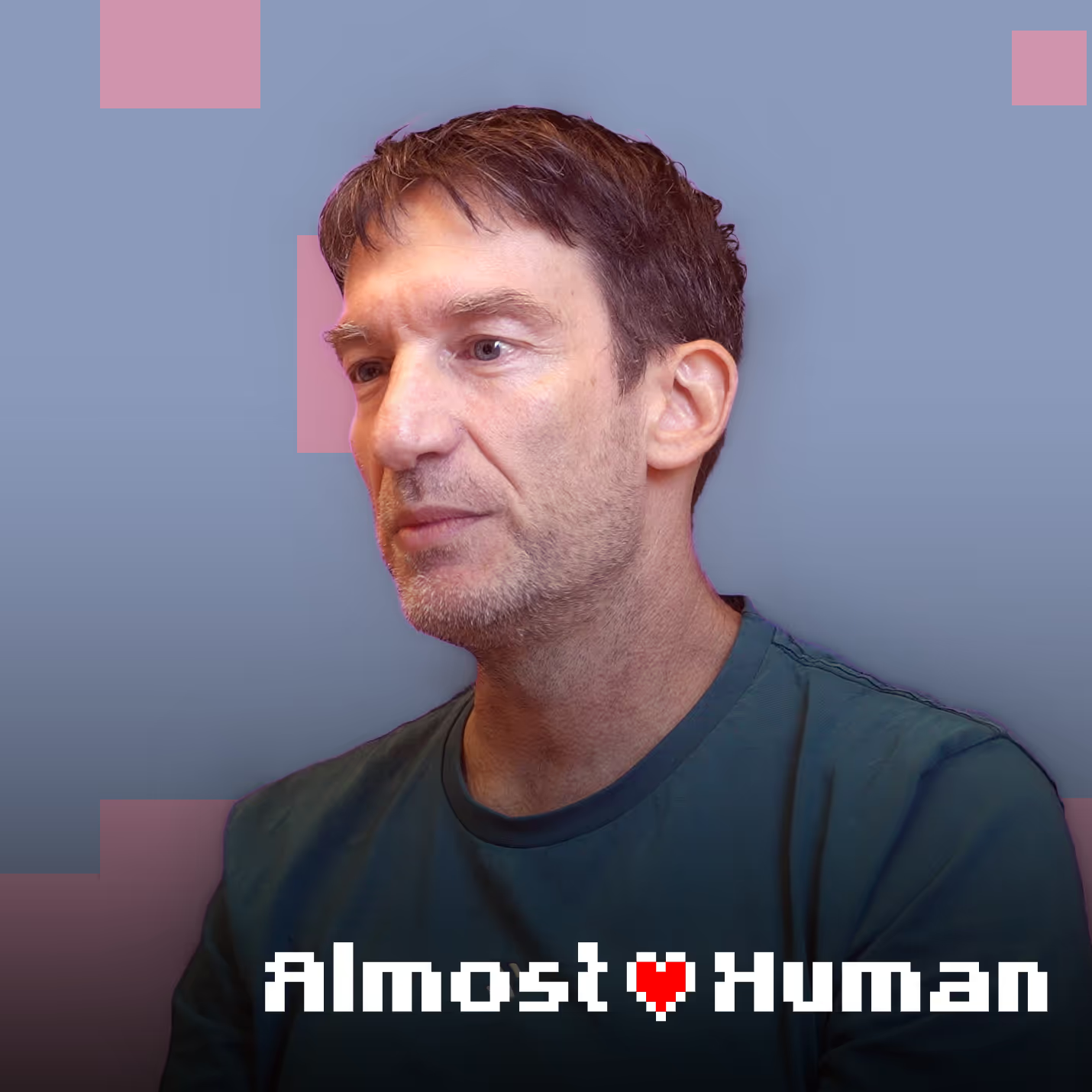
In this episode of Yalla, Let’s Go!, Erica and Abbey sit down with Daniil Chernov — Russian-born oleh, co-founder of The Reboot Startup Nation, Nevo Network board member, and an analytics leader who has worked at some of Israel’s biggest tech companies — for a conversation about arriving with a job but no network, building community from scratch, and what eight years in Israel taught him about impact.
Daniil grew up in a small city near Moscow, studied theoretical physics, decided it was too theoretical, and moved into tech. He made aliyah in 2018 while working at Gett — an arrival so smooth he calls it his “golden aliyah” — and then discovered that having a job is not the same as having a professional network. He and Katerina Greenstein launched The Reboot Startup Nation the day before Russia invaded Ukraine, and pivoted overnight from serving Russian-speaking olim already in Israel to absorbing an entire new wave of them. After October 7th, he turned that same community into Israel Delivery Aid, a volunteer logistics operation that ran roughly 1,000 rides carrying gear, food, water, mattresses, and evacuees across the country.
Also in the episode:
- Making aliyah from Moscow in 2018 with Gett — and why he calls it a “golden aliyah”
- The specific loneliness of arriving with a job but no professional network
- Launching The Reboot Startup Nation the day before the war in Ukraine began
- Israel Delivery Aid: 1,000 volunteer rides organized out of a tech community after October 7th
- Co-founding with a Ukrainian partner while Russia and Ukraine were at war
- Moderating 14,000 community members through the hardest conversations
- Why he has more ability to create impact in Israel than he ever had in Russia
- Hit by a car on an electric scooter — and what the Israeli healthcare system did next
- His wife Ksusha and the reality of building a music career in Israel
- Aliyah advice: learn Hebrew, even if it’s only the alphabet
This is a practical, funny, and quietly moving conversation about networks, generosity, and what one person can actually build in a country this small.
Subscribe for more conversations with people who live, work, build, and stay in Israel.
#DaniilChernov #TheRebootStartupNation #RussianAliyah #Israel #Aliyah #IsraeliTech #NevoNetwork #October7 #TelAviv #RussianOlim #YallaLetsGo #LifeInIsrael #CommunityBuilding #TechCommunity #MakingAliyah
0:00 – Intro
0:56 – Meet Daniil Chernov: Russian Oleh, Israeli Tech Leader, and Community Builder
2:19 – Life Story in One Minute: Theoretical Physics to Israeli Tech
2:59 – Making Aliyah from Moscow in 2018 with Gett: The “Golden Aliyah”
4:02 – Two Very Different Aliyahs: His Experience vs. His Wife’s
5:16 – The LinkedIn Party That Showed Him He Had No Network in Israel
6:00 – Launching The Reboot Startup Nation the Day Before the Ukraine War
6:08 – Building a Russian-Language Tech Community for Olim in Israel
8:11 – After October 7th: How Israel Delivery Aid Was Built
9:30 – 1,000 Volunteer Rides: Gear, Food, Water, and Evacuations
11:39 – Co-Founding With a Ukrainian Partner While Russia and Ukraine Were at War
11:57 – Moderating 14,000 Community Members Through the Hardest Conversations
13:26 – Why He Has More Impact in Israel Than He Ever Had in Russia
14:32 – How Israelis Help Strangers: One Cold LinkedIn Message
15:28 – Hit by a Car on an Electric Scooter in Tel Aviv
15:59 – The Doctors’ Protest, the Ambulance, and the Emergency Room
17:29 – Waiting a Week for Surgery: Inside the Israeli Healthcare System
19:25 – Shoulder Surgery, Private Clinics, and Insurance Through Work
19:48 – Would He Ever Leave Israel? Not Back to Russia
20:52 – His Wife Ksusha and the Israeli Market for Non-Mizrahi Music
22:13 – What He Loves Most About Israel: Freedom and People Who Show Up
23:03 – Aliyah Advice: Learn Hebrew, at Least the Alphabet
23:34 – How Good Is His Hebrew After Eight Years?
23:59 – Rapid Fire: Entrecote in a Tortilla, Tachles & “Who Is a Jew?”
Daniil Chernov — 0:00
If you're going to work on the metro, you just know that all these people, you see them once and you will never see them again. It's not the case in Israel. You always meet someone else on the streets.
Erica Marom — 0:09
You're from Russia and she's from Ukraine. How was it navigating these relationships?
Abbey Onn — 0:15
You were hit by a car.
Daniil Chernov — 0:17
Yes.
Abbey Onn — 0:17
Which, unfortunately.
Erica Marom — 0:17
It's not funny.
Erica Marom — 0:20
What do you love most about living here?
Daniil Chernov — 0:21
For me, personally, obviously, freedom. Comparing to where I'm from. We managed to make like 1,000 rides with — imagine, like, a car fully packed with either equipment or food or water or mattresses or people. Yeah. And drivers going to crazy places across all Israel. You know, it was insane.
Abbey Onn — 0:56
Welcome back to Yalla, Let's Go! The podcast that Erica and I started to talk about aliyah [immigration to Israel], to remind ourselves why we moved here and talk to really interesting people about why they chose to live here. We talk to people that work in tech, venture capital, chefs, athletes. We need some doctors. Anyone that's here.
Erica Marom — 1:16
Teachers.
Abbey Onn — 1:17
Teachers. There's tons of stories. And today we're super excited to talk to Daniil Chernov and hear his story. But before we do that, Erica, pulse check. How are you feeling about living in Israel right now?
Erica Marom — 1:28
Right now, I am really, really happy because it's summer here. The sky is blue every day. The sun is shining every day. It is hot, and I love it. It's like summer vibe. My kids are out of school. It's like beach time, pool time. There's no more homework, no more making lunches. It's just such a summer vibe in Israel, and I love it.
Abbey Onn — 1:50
Yes. This is why we're here.
Erica Marom — 1:51
Yeah. No more New York winters for us.
Abbey Onn — 1:54
No more winters. No more snow. I will take the hot weather. Okay, I'm excited to jump in today and welcome Daniil Chernov. Worked at some of the biggest companies in Israel, made aliyah from Russia, and has also created a really impressive social movement. Daniil, welcome to Yalla.
Daniil Chernov — 2:13
Thanks for having me.
Abbey Onn — 2:14
It's our pleasure. All right, the challenge. Tell us your life story in less than a minute.
Daniil Chernov — 2:19
Okay. Born in Russia, lived in a small city near Moscow. I studied theoretical physics, understood that it's too theoretical. I need something practical. Moved to tech, and then got married. And then we made aliyah eight years ago. From Russia to here. I live in Tel Aviv with my wife, with our cat. And, yeah, just doing what I can in this life.
Abbey Onn — 2:52
I think you're the only person that's ever done it that quickly and gave us really good information.
Daniil Chernov — 2:57
It's really hard.
Erica Marom — 2:59
So you made aliyah while you were already working for Gett from Moscow in 2018. Why did you decide to move here?
Daniil Chernov — 3:08
Okay, so basically, back then Gett had the large operations in Russia. It was a really big market, you know, when Uber only started and stuff like that. When I joined Gett in Russia, I didn't know it's Israeli, by the way. I only learned about it when I saw names of the rooms in Hebrew in the office. It was like Russian, English, Hebrew. I was like, what? Wait a minute. I went to Wikipedia and then I found out. We wanted to experience living abroad from Russia, and Israel was an option. I have an uncle who lives here for a long time and some relatives as well. And working in Israeli company helped a lot. I have a lot of respect for people who move without any job and search for a job here. I'm not sure I would be able to do that. So, yeah, my aliyah was, I call it golden aliyah, really smooth.
Erica Marom — 3:58
But you said that even though you had a job, it was very chaotic when you first got here.
Daniil Chernov — 4:02
Yeah. So first of all, I understood also that for me and for my wife, it was really different, because when I moved, basically on the second day I was in the office, everyone speaks English to me. I know the company, I know the data of the company. I know people. So it was really like an oasis of something familiar in fully unfamiliar environment. And years after I learned that my wife didn't have that, and we actually lived really different experiences in parallel, which was — I should have noticed it faster. I didn't realize until some point is that even though I had a job, I actually didn't know anyone, let's call it my peers from the industry, let's call it this way, because obviously at home I have my people. I studied together with my coworkers, and then, you know, they spread across the country and the market and, you know people everywhere. And here I didn't have such people.
Abbey Onn — 5:01
Okay, so Daniil, you talked about your aliyah as a golden aliyah because you moved with Gett, but on the other hand — and you just said this — that the people that you knew in Israel were only at Gett, and that's a specific kind of loneliness. How did you manage that?
Daniil Chernov — 5:16
Actually, it was a very specific moment when I understood that. Back then it was years of crazy, you know, tech boom in Israel. Every company was hiring like crazy. And we had a lot of open positions and we were not able to quickly close them. So basically the company did what's called LinkedIn party, where basically there is like a meeting for everyone in the company. You just sit in the room, you open a laptop and they have a list of positions, and you need to put people, you know, who are relevant for this position so that they can reach out to them, which is very cool. And then I was looking at positions with our developer, designer, analyst, and I understood every person I want to put there already worked in this company. So I don't know anyone who didn't work at this company.
Erica Marom — 6:00
You launched Reboot Startup Nation the day before Russia invaded Ukraine.
Daniil Chernov — 6:05
Exactly.
Erica Marom — 6:06
What were you trying to build before?
Daniil Chernov — 6:08
Yeah, so we were thinking about this with Katerina from our cohort in Nevo. I'm from Russia, she's from Ukraine. And we understood that the value of Nevo and knowing olim [immigrants] from different countries and being able to discuss things, it's insane. So we understood that we need to somehow share it broader, and we wanted to build a community for Russian-speaking olim who are already here, right? And because the community was very — what's the word — isolated, like people don't really. One of the main kind of values or goals of the previous waves of aliyah from Soviet Union and from Russia was integrate into Hebrew-speaking society as soon as possible and detach from your Russian community. This is basically a thing. So that's why a lot of the community of Russian olim are fully in Hebrew. So somebody who makes aliyah can't get any value from it. So our goal was to create this such community in Russian for tech people who are already in Israel. This was the goal. And when we launched, next day the war started. And basically we thought, okay, it's irrelevant pretty much anymore. For some reason we saw it this way. And then we got a lot of our friends reaching out to us because they want to urgently make aliyah. So we understood, okay, we need to basically pivot from, you know, current people who are already here to accept new people. And we joined forces with Sophia Tupolev, with Ariel Raviv, who were doing a similar thing because we worked in parallel. So we joined forces, which was amazing. You know, we just text each other: let's do it together. Yalla, let's do it together. Yeah, it was insane. And basically our focus was to, you know, bring as much knowledge and connections to them just to help them understand how the market works, how to find a job here. Not only job, actually. It was everything. How to rent an apartment and everything. And, yeah.
Abbey Onn — 8:11
Okay, so in the immediate aftermath of October 7th, there were hard days for everyone, and I think there were a lot of people who felt lost and they didn't know what to do or how to help. I think you and I had that conversation, and instead of staying lost, you kind of within a day or two tried to figure out how to create impact. I think now it feels like a thing you do, and you turn to this community you had built and you created something super valuable — Israel Delivery Aid. Can you talk a little bit about the feeling, and then how you figured out how to create it and what it was?
Daniil Chernov — 8:50
Yeah, so my initial idea was, okay, I have thousands of tech people, developers, whatever, product managers, cyber people. I need to find a place where we can apply us as tech people. So I was talking to all of the cyber initiatives. There were a lot of cyber activities happening, if you remember. You know, crazy messages that you receive and, you know, it was insane. And then Gili from Nevo also, she organized this whole task force — because she was in States, if I remember correctly — of bringing equipment to soldiers, like all of, like, knee pads and shlukerim [CamelBaks] and all of these, like, what's it, lights?
Abbey Onn — 9:28
A word might not have had eight years ago. Shlukerim.
Daniil Chernov — 9:30
Shlukerim, yeah. Yeah, that's how I learned. Yeah. And basically they mobilized a lot of people who were flying to Israel to bring all of this stuff. And the last problem that they had is, okay, now somebody flew from Israel with, you know, three huge bags of this stuff. So how do we deliver it actually to the brother of this guy, or to, whatever, father of this guy, and so on. And basically that's how we understood we can just be drivers. We can just take a car and just drive it. It's not very much a tech type of volunteering. But so I made the post, like, hey, guys, we need someone to, whatever, deliver stuff. If you want to participate, please sign up on this form. First we had also a team of volunteers who were contacting other organizations who needed to deliver food, to evacuate people, and to deliver stuff to soldiers and so on. And then the tech part — basically we had also a tech team who were basically automating all of this. Taking requests, sending them to drivers, putting them a map. You need to go from here to here, all of the statuses. So basically they build an app, so to say, to operate. And we managed to deliver, to make like 1,000 rides with — imagine, like, a car fully packed with either equipment or food or water or mattresses or people. Yeah. And drivers going to crazy places across all Israel. And we had funny situations when somebody was looking for a driver. And then one Israeli guy who needed help, he calls me back, like, who are you sending me? They have this beard and they look like Arabs, you know. They were like, I'm scared. Give me someone else. I'm like, what can I do? He's Russian. He doesn't even speak. So they were really afraid of bearded people back then. But, yeah, again, I'm amazed by these people who really sacrificed a lot of hours of their time and really went to not safe places.
Erica Marom — 11:39
So you built this Reboot organization with your friend Katerina. You're from Russia and she's from Ukraine. How was it navigating these relationships when both of your countries are at war with each other? You have people making aliyah from different places that you're helping, come from different backgrounds?
Daniil Chernov — 11:57
So first of all, she's been great. And I have part of my family is from Ukraine, part from Russia. And it's actually pretty much frequent case, obviously, because of bordering countries and the Soviet past. I would say between us, it was amazing, and we have a total understanding, which I did not expect. I'm not taking it for granted. But the harder part was navigating this inside the community, because people were really stressed. And sometimes in the beginning, we had some heated discussions. Basically what I saw is that these discussions are never to reach any kind of understanding or agreement. It's basically somebody going crazy and being aggressive. And it was — I was really talking to people. If someone was writing crazy stuff, I would sometimes text them in person or maybe call them: listen, hey, what are you doing? And I understood that usually those people who became aggressive, they were not trying to help anyone, trying to help themselves. They were just being aggressive. So it's something that we had to cut in the beginning. But I have to say that maximum, I had to maybe ban five people out of 14,000. I think it's pretty good.
Erica Marom — 13:26
So you've been living here for eight years. You've generated a ton of impact in the time that you've been in Israel, and you've achieved quite a lot, even though you were an immigrant here and you didn't grow up here. You've said before that you feel actually that you have more influence and ability to influence and create impact in Israel than you ever did in Russia. Can you talk about that?
Daniil Chernov — 13:47
Yeah, that's for sure. That's definitely the case. I mean, there are many reasons for this. First of all, even general level of freedom and democracy and stuff like that. Second is it's a very small country. People know each other, people care about other people. You know, let's say typical situation in Moscow: you walk somewhere, you just know for sure you will never see these people ever again in your life. If you're going to work on the metro, you just know that all of these people, you see them once and you will never see them again. It's not the case in Israel. You always meet someone else on the streets who you met before. Work, like job market — I'm not even talking about it. Better be good and behave well and have a good reputation.
Erica Marom — 14:31
Or else. You'll see them on the street.
Daniil Chernov — 14:32
Yeah. And people are very, very open to help each other. When I was starting in the community, even, I didn't know how to do it. And back then it was at Wix, and there was a guy who was doing a large — he's a community builder. I never knew him and I never talked to him. So just texting him, I think even on LinkedIn, not even inside the company, and said, hey, I'm building this community. We just started, or maybe we didn't start yet. Can you give me some advice? He's just send me a phone number: call me. So I'm calling him, he's like, okay, what you need to do, you need to reach 50 people. Once you reach 50 people, this is like real community. And then you. So now I'm remembering. It's crazy. So he didn't knew me, he just said, okay, call me. So this is the thing that's possible here. It happens here, and it allows you to do basically whatever you want. Once you have a need, you have people with you who care about the same need. So basically you can just do it.
Erica Marom — 15:27
Yeah. Wow.
Abbey Onn — 15:28
Wow. Okay. So we've talked about a couple things that have been true Israeli experiences. Talked about war, we've talked about building community, we've talked about influence. You were hit by a car.
Daniil Chernov — 15:40
Yes.
Abbey Onn — 15:40
Which, unfortunately.
Erica Marom — 15:40
It's not funny.
Abbey Onn — 15:40
It's not funny, but it's way more common. And the reason why I will never let any of my children have an electric bike or scooter in this country, because I'm so afraid of this reality. Can you talk us through it a little bit, and then kind of how the healthcare system responded?
Daniil Chernov — 15:59
Yeah. So I was using an electric scooter to go to work and so on, which is super convenient because you don't care about the one-lane roads and a lot of cars. And it just was faster. It was a little bit crazy. Every time I was on the road, I'm like, wow, this is — if I'm honest, it's risky. But basically what happened, it wasn't anything, you know, natural to the — you know how you use a korkinet, an electric scooter. It was just someone being a bad driver and not using the signals and just hitting me basically while turning. And I like flew over the car, I like fell. Somebody called an ambulance and they came really quickly, by the way. And yeah, so I went to Sheba, like to the hospital. And funny — okay, an important piece of information. It was in the time of protests. It was a day of protest in Jerusalem where for the first time doctors went to protest. Okay. So I was going on a korkinet and was like, wow, this is a very interesting philosophical question: can a doctor go in working time to protest? Yeah, they need to be able to exercise their democratic freedoms, but also people lives and health is what they're doing. So it's very interesting dilemma. And I'm getting hit by a car.
Abbey Onn — 15:59
Stop having deep thoughts.
Daniil Chernov — 17:28
Yeah.
Daniil Chernov — 17:29
So they did an X-ray, and the guy basically says, take off your ring, you're getting a surgery right now. I'm like, what's happening? But then he said, okay, we don't have an orthoped to make your surgery, so you need to wait for like one week. And I'm like in pain. Like, what do you mean to wait one week? It's kind of crazy. And by the way, important anecdote: while in ambulance, I was really in pain, and the two paramedics, they were really not seeing me at all, because there were a guy and a girl and they were really interested in the discussion. And the guy was like a medical kind of MASA or like a student from UK, and she's local, and they were having the time of their life. And I'm like, I'm really in pain here.
Abbey Onn — 18:20
I hope this works out soon for you.
Daniil Chernov — 18:24
Yeah.
Daniil Chernov — 18:25
So what happened after?
Daniil Chernov — 18:26
So I was like, okay, one week is kind of crazy. And so my manager from work calls me, he says, hey, how can we help? And I'm being very honest and straightforward: like, honestly, I don't know. What else can I do? How can I get the surgery done? Because they told me to wait one week and it's kind of crazy. It's okay, I'll find you a private, whatever, doctor. So he comes back in a few minutes. Okay. So I asked around. Obviously he had someone to ask around about the doctor. And any random doctor — this guy is really good, call them. So I called a private hospital. And because I had a work insurance from work, that actually doesn't cost a lot in Israel. If it wouldn't be from work, it would be like 100 shekels a month or something. But it was from work also. And they told me, okay, come. I came, they saw me, they said one week. So nobody just could make it in the moment. So I had to wait for one week, which was like crazy week. But then. Yeah.
Erica Marom — 19:24
What did you break?
Daniil Chernov — 19:25
It was something in my shoulder. It's called ACJ — acromioclavicular joint. And yeah, so they had to make a surgery. They did it in — I did it in Rafael, which is like a super posh clinic with hotel-like experience. Crazy stuff. Yeah. So I had two surgeries. First they put a metal thing inside.
Erica Marom — 19:48
So you said that you guys came here because you were interested in living abroad and moving internationally. And I wonder, would you consider leaving Israel? Is there anything keeping you here? Would you go back to Russia? Would you move somewhere else?
Daniil Chernov — 20:04
Go back to Russia? No. Even if, you know, it becomes democratic, which is unlikely. We just understand that it's really not kind of our place culturally and by many reasons. Somewhere else potentially — it's something that we're thinking about as well. Israel is a very special place. You can't really compare it. Make an Excel table with qualities of countries and just compare — you just can't do this. By many reasons: people, and, you know, just the fact that Israel is a special country in many senses. It has problems. So yeah.
Abbey Onn — 20:52
Your wife, Ksusha.
Daniil Chernov — 20:54
Yes.
Abbey Onn — 20:55
The amazingly talented, gorgeous musician. She's facing different challenges here.
Daniil Chernov — 21:01
Yes.
Abbey Onn — 21:02
Does that lead you guys sometimes to think about leaving?
Daniil Chernov — 21:04
So, yeah, she's a musician, she's writing songs, she's on Spotify, whatever. Find her — From:Ksusha. And so when she moved, she was like really, you know, she had a band in Russia. She was doing local concerts and stuff. So this is what she wanted to do here. First challenge was really hard to find people to do music with, because you need not only just, you know — you don't like in tech, you just need a good developer, like a developer in your stack. In music, you need someone who understands your vibe, has the same taste in music. It's so many things. It's a miracle when there is a band, you know. It's really a miracle how people find each other. So it was really hard. She started doing solo, and then eventually she understood she needs to go, like, be independent and online. So this is what she's doing now, basically doing it online. And indeed there is pretty much no market for non-Mizrahi music in Israel. So if you sing Mizrahi, okay, weddings, concerts, whatever, you can do it. If you sing English language, kinda whatever, indie music — no market for it. So yeah, internet is the market.
Erica Marom — 22:13
So what do you love most about living here?
Daniil Chernov — 22:15
For me personally, obviously, freedom. Comparing to where I'm from, I'm not taking it for granted. It's really big deal and it's really different. People — there are different people here. But somehow it's commonly understood and accepted that you need to care about each other, you need to be available to other people. Everyone lives close. If you live in central — we don't live in central Tel Aviv, but if you would live in central Tel Aviv, you would constantly meet people you know, which is, I think, very special. And when my friends go, let's say, back to Russia to meet their family, they say, wow, in Israel I have so much to do and I don't need to pay for it. I just hang out with people. I go to the sea. Yeah.
Abbey Onn — 23:03
Okay. I'm gonna ask you a question without pressure, but I feel like you better have a good answer.
Daniil Chernov — 23:07
Okay.
Abbey Onn — 23:08
Your number one piece of advice for people who are considering or just made aliyah.
Daniil Chernov — 23:12
I would say learn Hebrew. Like, you should have at least some level of — you need to. Of course, at minimum you need to be able to know the alphabet and being able to read at least. Even if you don't understand what you're reading, it helps. But the more you know, the better. It really makes your life much more stressful in the beginning.
Erica Marom — 23:32
How's your Hebrew now?
Daniil Chernov — 23:34
It's ani mistader [I'm managing]. Now it's better. I don't work in Hebrew, I work in English mostly. I am able to listen, to be in the listening mode. But yesterday I had a full call with an insurance agent about whatever. They were asking some questions and I didn't have to switch to English, which is amazing. So yeah, right now I'm very comfortable with my Hebrew, even though I don't work in Hebrew.
Abbey Onn — 23:57
Amazing.
Daniil Chernov — 23:58
Yeah.
Erica Marom — 23:59
Okay, so we're going to do some rapid fire questions. Just give us one word, very fast answers. What is your favorite Israeli food or snack?
Daniil Chernov — 24:09
Anything in tortilla. Something — tortilla with entrecote, you know, this type of stuff.
Abbey Onn — 24:14
Favorite place in Israel?
Daniil Chernov — 24:17
Let's say, the sea, you know the place near Jaffa where you just see the sea.
Erica Marom — 24:21
What's your favorite Hebrew word or slang?
Daniil Chernov — 24:24
A lot. I would say tachles [bottom line]. Yeah, being to the point and business-wise. Yeah.
Abbey Onn — 24:30
Thing that you miss most about Moscow?
Daniil Chernov — 24:34
Family, friends. Nothing particular about the city or the country itself. Yeah.
Erica Marom — 24:40
Tell us an only-in-Israel moment in one sentence.
Daniil Chernov — 24:43
I think the very Israeli moment is when in ulpan [Hebrew language school], when you study Hebrew, they ask you mi ze yehudi [who is a Jew]? And you have this discussion: who is Jewish? And the fact that it's kind of an open question is insane.
Erica Marom — 25:01
Thank you so much for joining us.
Daniil Chernov — 25:02
Thanks for having me.
Daniil Chernov — 25:03
It was fun.
Abbey Onn — 25:04
It's been a pleasure. Thank you so much.
Daniil Chernov — 25:05
Thanks.
Abbey Onn — 25:06
Thank you for joining us on Yalla. We are so glad that you're here, and please share the episode and keep tuning in, and we'll see you next time. Yalla, Let's Go!
Daniil Chernov — 25:18
Yalla, Let's Go!

Follow Daniil on Linkedin
Subscribe to Yalla, Let’s Go
Learn more about Aleph
Sign up for Aleph’s monthly email newsletter
Subscribe to our YouTube channel
Follow us on Instagram
Follow us on TikTok
Follow Aleph on Twitter
Follow Aleph on LinkedIn
Follow Aleph on Instagram
Hosts: Erica Marom, Abbey Onn
Executive Producer: Sarah Bard
Producer: Sofi Levak, Dalit Merenfeld, Myron Shneider
Video and Editing: Nadav Elovic
Music and Creative Direction: Uri Ar
Content and Editorial: Jackie Goldberg
Design: Nimrod Sapir
Follow Daniil on Linkedin
Subscribe to Yalla, Let’s Go
Learn more about Aleph
Sign up for Aleph’s monthly email newsletter
Subscribe to our YouTube channel
Follow us on Instagram
Follow us on TikTok
Follow Aleph on Twitter
Follow Aleph on LinkedIn
Follow Aleph on Instagram
Hosts: Erica Marom, Abbey Onn
Executive Producer: Sarah Bard
Producer: Sofi Levak, Dalit Merenfeld, Myron Shneider
Video and Editing: Nadav Elovic
Music and Creative Direction: Uri Ar
Content and Editorial: Jackie Goldberg
Design: Nimrod Sapir
Follow Daniil on Linkedin
Subscribe to Yalla, Let’s Go
Learn more about Aleph
Sign up for Aleph’s monthly email newsletter
Subscribe to our YouTube channel
Follow us on Instagram
Follow us on TikTok
Follow Aleph on Twitter
Follow Aleph on LinkedIn
Follow Aleph on Instagram
Hosts: Erica Marom, Abbey Onn
Executive Producer: Sarah Bard
Producer: Sofi Levak, Dalit Merenfeld, Myron Shneider
Video and Editing: Nadav Elovic
Music and Creative Direction: Uri Ar
Content and Editorial: Jackie Goldberg
Design: Nimrod Sapir
.jpg)
.jpg)
.jpg)
.jpg)
.jpg)
.jpg)

.jpg)





















.jpg)
.jpg)
.jpg)
.jpg)
.jpg)
.jpg)
.jpg)
.jpg)
.jpg)